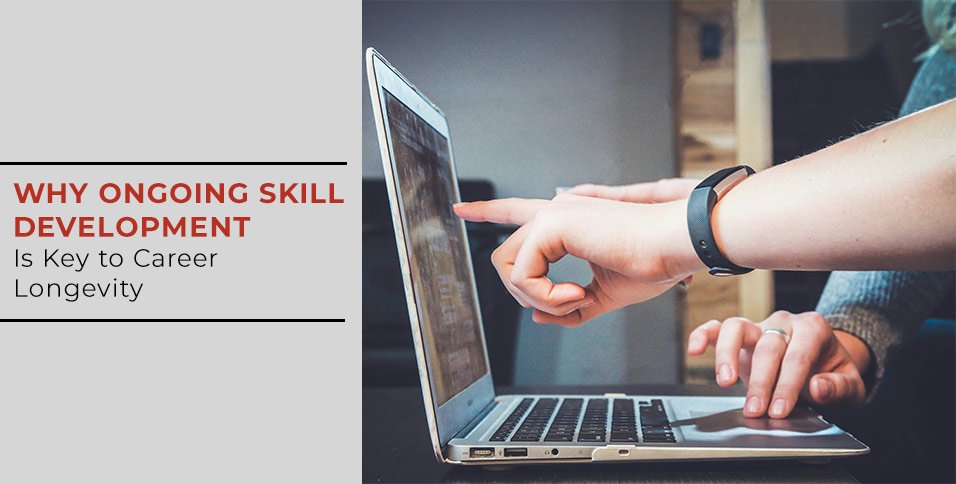
In today’s rapidly changing professional landscape, building new skills is essential for staying relevant and adaptable. Learning shouldn’t stop after getting a job. Statistics show that professionals with a higher level of education or specialized training typically earn higher pay.
Whether through workplace or external opportunities, ongoing skill development is the key to career longevity and growth. Continuous learning has multiple benefits, including boosting confidence, increasing engagement, and preventing career stagnation.
Since the pandemic, it’s also easier than ever for professionals to access formal ongoing education options while working. COVID-19’s social distancing and isolation led to more universities investing in remote learning technology, increasing the number of programs offered online.
This has led to an increased interest in professionals returning to study degrees with flexible learning options, like the online Post-Graduate/APRN Certificate program. Online programs for higher education allow professionals to build on existing experience without stepping away from their careers.
Why is continuous learning important?
Change is accelerating across nearly every industry with the rapid development of technology. It was estimated that around 2025, around 85 million jobs would be altered or replaced due to the rise of artificial intelligence and its impact on how humans and machines divide tasks.
These technological advancements were also expected to create over 97 million roles; however, they would require skills in the right area. Continuous learning, whether through upskilling or reskilling, is a must for employees who want to stay adaptable and relevant, especially as more roles expand to include new technology.
Continuous learning is also the key to sharpening pre-existing skills to increase productivity and keep up with the latest industry trends. As industries shift and talent gaps widen, the only way to stay ahead of change is through ongoing learning—not just for the current job requirements, but for any future responsibilities.
Upskilling and reskilling
If professional development is a career goal of yours, it’s important to understand upskilling, reskilling, and the difference between them. Upskilling is the process of enhancing and expanding your current skills and knowledge.
Beyond helping you remain competitive in your current job market or qualify for a promotion, data from TalentLMS reveals that upskilling can lead to better confidence and increased productivity in employees.
The process of upskilling will depend on the type of work you do and your career goals. Some professions can upskill through internal professional development classes, while others may require formal education, like healthcare.
How is reskilling different?
Where upskilling is a process about enhancing a person’s current skill set tailored towards their role, reskilling is about learning new skills entirely to prepare for different roles or responsibilities.
Reskilling is the pathway chosen if you’re planning to shift career path or need to adapt to emerging role requirements. Being able to identify whether you need to upskill or reskill is the first step to continuous learning.
The impact of artificial intelligence
The U.S. Census Bureau has revealed that many firms in the country have already adopted AI as of year-end 2025. This quick adoption rate is leading to an increase in demand for workers with AI knowledge and associated skills.
The Boston Consulting Group estimates that in the next two to three years, 50% to 55% of jobs in the U.S. will be reshaped by AI. Employees who learn how to utilize new AI tools through upskilling will be less likely to be phased out and stay competitive in their field.
For many fields, considering artificial intelligence training as part of your ongoing skill development will be advantageous.
The rise of remote learning
Professional development has always been a cornerstone of organisational success, providing benefits to both the employee and company. Traditionally, this relied on in-person workshops, seminars, and training sessions.
COVID-19 revolutionized professional development due to the rise of online learning technologies. The pandemic prompted a rapid transition to an entirely virtual education for most students, and also showcased that quality online learning was not only feasible but also preferred by many students and institutions.
Online learning allows for more flexibility, making it possible for people to pursue higher education without having to leave their careers. This is because there’s no need to attend classes on a certain date or time. There’s also a wider selection of programs available, as people can attend institutions from across the country, no longer restricted by travel.
For professionals considering higher education as part of their ongoing learning plan, there are several options available. These include:
- Certificate programs: Certificate programs are a great option for a busy professional looking to gain a specific skill or improve in a specialized area. They’re commonly available through remote learning and offer fast-track training, only lasting 3 – 12 months.
- Associate degrees: This program is between a high school diploma and a bachelor’s degree. They are typically offered at community colleges or technical schools, and can be used to bridge into an undergraduate program.
- Bachelor’s degrees: A bachelor’s degree usually takes four years of study or 120 credit hours. They are offered by most colleges across the United States and are required to pursue postgraduate qualifications.
- Master’s degrees: A master’s degree requires the completion of an undergraduate qualification. If you’re a professional looking to advance your career, many fields, such as healthcare, require a master’s degree for further progression.
- Doctoral degrees: A doctoral degree is the highest level of study, requiring years of research. Whilst most occupations don’t require a doctoral degree, it can lead to better employment and growth opportunities in some fields.