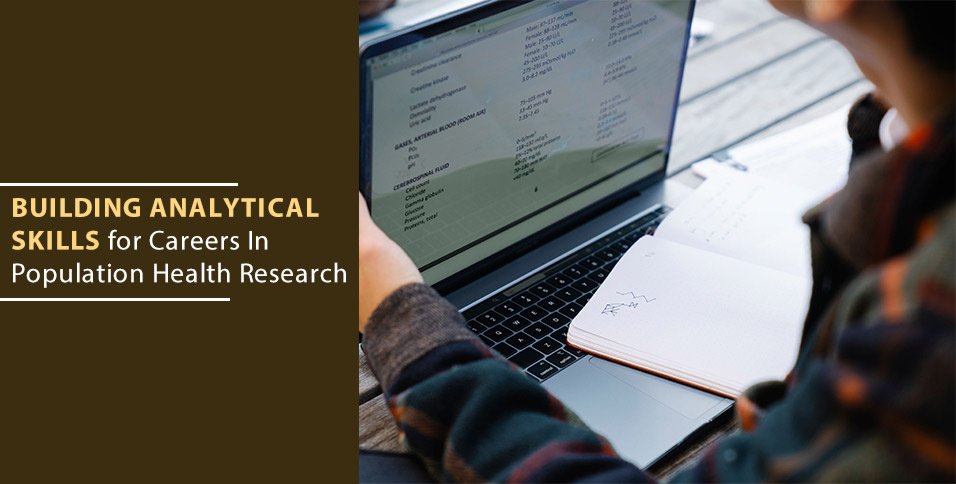
Health systems have grown far more dependent on evidence than they were a generation ago. Decisions about where to place clinics, which patient groups need outreach first, and how to respond when illness spreads through a community all rest on findings produced by people trained to read data carefully.
That work sits quietly behind most of what the public sees, and it rarely gets attention until something goes wrong. For anyone drawn to the analytical side of health, the field offers steady demand and a clear sense of purpose.
Where Formal Study Fits Into This Career Path
Many people arrive in health work through clinical practice or administration and later face questions their original training never touched. Reading disease patterns across a population demands specific preparation, and professionals without it tend to misjudge what a dataset shows or overlook the factors distorting it.
Graduate study centered on population health analysis teaches those methods directly instead of leaving them to instinct. Anyone who needs that grounding while staying in a current role can earn an MS in Epidemiology online and build the analytical foundation the work requires. Studying online lets working professionals keep their hours intact and apply what they learn on the job as they go.
Reading Health Data Without Jumping To Conclusions
Numbers rarely speak plainly. A cluster of cases in one neighborhood might reflect a genuine health threat, or it might reflect nothing more than a hospital that recently expanded its testing capacity. Analysts working in this field spend a great deal of their time separating real signals from artifacts of how information was gathered. That habit of questioning the source before trusting the result is one of the hardest things to teach and one of the most valuable things a researcher brings to a health organization.
Part of the discipline involves knowing what a dataset cannot tell you. Records collected for billing purposes were never designed to answer research questions, and treating them as if they were leads to conclusions that fall apart under scrutiny. Skilled researchers document those limits openly rather than burying them, which builds trust with the clinicians and administrators who act on their findings.
Statistical Thinking Applied To Real Populations
The mathematics involved is not abstract. Every calculation traces back to actual people whose health outcomes are being measured, and the choices a researcher makes about which comparisons to run can shift what a study appears to show. Two analysts given identical records can produce different reports simply by defining their groups differently, which is why methodology gets scrutinized as heavily as results do.
Confounding factors cause most of the trouble. A study might suggest that people in one occupation face higher rates of a particular illness, when the real driver is that the occupation attracts workers from an age group already at elevated risk. Catching that requires both technical skill and a working knowledge of the population in question. Researchers who understand the communities they study tend to spot these problems early, before a flawed conclusion reaches anyone in a position to act on it.
Communicating Findings To People Who Are Not Researchers
A study nobody understands changes nothing. Health officials, hospital boards, and community organizations need findings translated into language they can use, and that translation is a genuine skill rather than an afterthought. Researchers who write clearly about uncertainty, who explain what a result means without overstating it, become the ones whose work actually influences decisions.
This matters most during periods of public concern, when incomplete information circulates quickly, and people look for guidance. Presenting what is known, what remains unclear, and what would change the assessment is more useful than projecting false certainty. Professionals who handle that responsibly earn credibility that carries into every project afterward.
Career Settings Across The Public And Private Sectors
Health departments at the state and county level employ researchers to monitor illness trends and support response planning. Hospital systems bring them in to study patient outcomes and identify where care falls short. Research institutions rely on them to design studies and manage the data those studies generate. Pharmaceutical and device companies need people who can evaluate safety information after a product reaches the market.
Nonprofit organizations working on community health issues represent another route, often for people who want their analytical work tied directly to a specific population or condition. International health organizations recruit for similar skills, though those positions typically favor candidates with field experience alongside their analytical training. The common thread across all of these settings is that employers want people who can move between technical work and practical application without losing either.
Ethical Responsibility In Health Research
Working with health information carries obligations that go beyond following procedure. The records involved describe real illnesses, real diagnoses, and real circumstances that individuals never expected to be examined by strangers. Protecting that information properly is a professional duty rather than a compliance exercise, and researchers who treat it casually damage the trust that makes health research possible at all.
There is also the question of who benefits from the work. Studies conducted on communities that never see any resulting improvement have left lasting damage in some populations, and researchers today inherit that history whether they acknowledge it or not. Building genuine relationships with the groups being studied, and returning findings to them in usable form, has become a standard expectation in serious work.
Staying Current As Methods Continue To Change
The tools available for this work look considerably different than they did ten years ago. Larger datasets, faster processing, and new analytical approaches have expanded what researchers can examine, though they have not reduced the need for careful thinking about what the results mean. Professionals in the field read widely, attend conferences, and often pick up new technical skills throughout their careers.
That ongoing learning is part of what makes the work sustainable over decades. Questions change as populations age, as new health threats emerge, and as the systems collecting information evolve. Researchers who stay curious tend to find that their skills transfer readily across topics, which gives them room to follow whatever problems they find most worth solving.