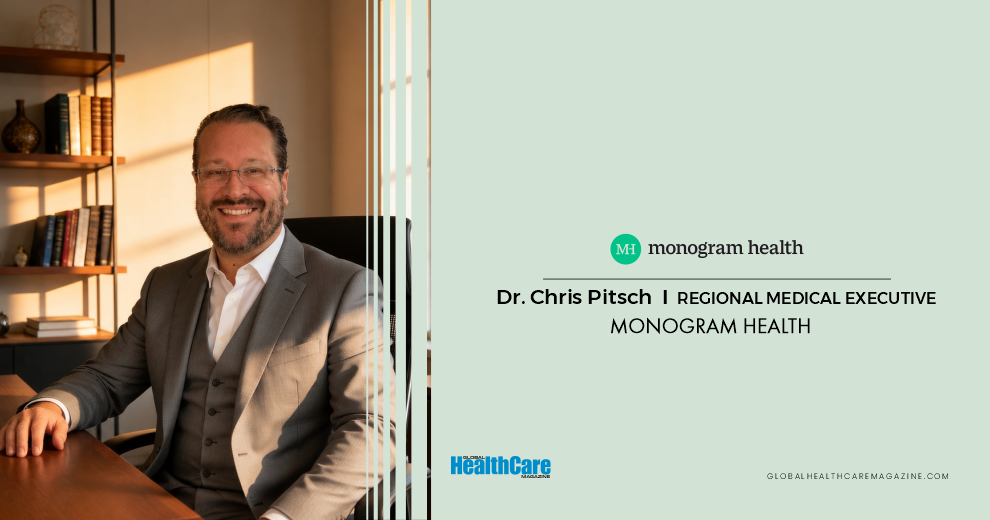
A geriatrics ward is not a place where problems arrive one at a time. A patient comes in with a fractured hip and leaves with a cascade of other things attached to it. Yet, as Dr. Chris Pitsch quickly discovered while caring for older adults across the continuum of care, the most critical hurdles often lay outside the clinic walls: a son who lives four states away, a refrigerator stocked with expired medication, and a home with stairs that no longer make sense for a body that has changed. It was in bridging this gap between acute hospital wards and home-based recovery early in his career that Dr. Chris Pitsch began noticing something that would eventually reroute his entire professional life. Patients with strikingly similar diagnoses were living out strikingly different outcomes, and the difference rarely had anything to do with the disease itself.
“It became clear that many of the greatest barriers to good outcomes were not clinical,” he says. “They were operational.”
That distinction, small as it might sound, changed the question he was asking altogether. Instead of wondering how to help the person in front of him, Dr. Pitsch began wondering something larger and considerably harder to answer: why had the system made this so difficult in the first place, and how might it be redesigned? That question followed him through post-acute care, through physician education, through population health and clinical operations, and eventually into the world of value-based care, where he now serves as Regional Medical Executive at Monogram Health.
Finding a Mission Already in Motion
After spending years navigating the structural boundaries of traditional hospital wards and clinic-based care, moving into a specialized, home-based medical model felt less like a departure and more like a necessary evolution. When Dr. Pitsch describes joining Monogram Health, he does not describe it as a career change. He describes it as a continuation, as though the organization had simply been waiting for him to catch up to it. The problems he had spent years trying to solve – avoidable hospitalizations, fragmented transitions of care, delayed interventions, and poor coordination among providers – were, in his words, “precisely the problems Monogram was built to solve.”
What drew him in was the organization’s insistence that a patient is never only a diagnosis. Behavioral, social, environmental, and functional realities shape a person’s health in ways that a hospital room or a clinic visit simply cannot reveal. Caring for people in their own homes, he found, exposes those realities and opens the door to earlier intervention and more genuine relationships.
Having served first as Market Physician Executive and now as Regional Medical Executive, Dr. Pitsch has responsibilities that span clinical operations, physician leadership, quality improvement, population health strategy, organizational growth, as well as building physician and interdisciplinary teams focused on two goals that are too often seen to be at odds: improving quality outcomes and reducing the total cost of care. For him, executive leadership is simply another way of continuing to care for patients – not one person at a time, but by building the systems, teams, and culture that enable thousands to receive better care.
To him, value-based care is not, at its core, a reimbursement structure. It is a philosophy, one that measures success not by the volume of services rendered but by whether people are healthier, more independent, and better able to live the lives they actually want.
A Shortage of Alignment, Not Intelligence
Ask Dr. Pitsch what worries him about healthcare today, and he does not point to a lack of technology. If anything, he points to an abundance of it. Healthcare analytics has become extraordinarily sophisticated. Artificial intelligence has grown more sophisticated by the year. Predictive modeling and remote monitoring have given healthcare more visibility into patients than it has ever had. And yet, he notes, many organizations remain stuck on the same familiar obstacles: fragmentation, misaligned incentives, communication breakdowns, and clinician burnout.
“Healthcare is not suffering from a shortage of intelligence,” he says. “It is suffering from a shortage of alignment.”
Data, he points out, can flag a patient at risk. It cannot build trust between a physician and a nurse, or between a social worker and a family navigating an unfamiliar diagnosis. Predictive analytics can prioritize where attention should go. They cannot replace the clinical judgment required to decide what the right intervention actually looks like for one particular human being. The defining challenge of the coming decade, in his view, will not be adopting more advanced tools. Most organizations will manage that much. The harder work will be weaving those tools into systems that remain, as he puts it, grounded in compassionate clinical care, where technology augments judgment instead of replacing it.
Data as a Shared Language
If there is a phrase that captures how Dr. Pitsch approaches his work, it might be this one: data should inform judgment, never replace it. He repeats some version of this idea often, and it is not merely a talking point. It is closer to an operating principle.
He believes data alone changes nothing. It only creates the opportunity for change. People still have to interpret it, trust it, discuss it, and act on it together. Throughout his career, he has tried to build cultures where data functions as a shared language among clinicians rather than something that feels like a report card handed down from above. When a clinician understands not just what a number says but why it matters, the improvement that follows tends to last.
“The goal isn’t to chase metrics,” he says. “It’s to enable better decisions that naturally produce better outcomes.”
He is equally candid about the responsibility that comes with his role. Frontline clinicians, he believes, already carry an enormous cognitive load. His job is not to hand them another dashboard or schedule another meeting. It is to help them focus on the information that actually matters and clear away whatever stands between them and good care. “Leadership is not measured by how many decisions I make personally,” he says. “It is measured by how effectively I help others make better decisions.”
The Rooms He Works In
The teams Dr. Pitsch collaborates with read almost like a roll call of medical specialties: nephrology, cardiology, endocrinology, pulmonology, psychiatry, geriatrics, primary care, and palliative care, alongside advanced practice providers, nurses, social workers, pharmacists, care managers, operational leaders, and analysts. Together, these teams are able to build a far more complete picture of each patient’s needs. This level of interdisciplinary collaboration reflects the kind of coordinated care that value-based healthcare strives to achieve.
“The best healthcare teams are not groups of people who think alike,” he says. “They are people who bring different perspectives together in service of a common purpose.”
Alignment, in his experience, is not something hierarchy can manufacture. It has to be built through trust. Accountability matters, certainly, but it holds up best when people understand why the work matters and genuinely believe they are contributing to a mission that recognizes patients as far more than a single diagnosis. That requires psychological safety and mutual respect, qualities Dr. Pitsch says he has learned from the people he has led and likewise. He describes leadership these days less as authority and more as partnership, occasionally punctuated by the responsibility of making or supporting a hard call. In many cases, leadership means not only making difficult decisions, but also supporting the clinicians responsible for making them.
The Winter That Changed How He Led
Every leader, if they have led long enough, can usually point to the moment that tested them most. For Dr. Pitsch, that moment arrived with the COVID-19 pandemic.
As Medical Director for Jefferson Health’s Regional Response Health Collaboration Program, part of Pennsylvania’s statewide pandemic response, he helped coordinate hospitals, skilled nursing facilities, public health agencies, and government partners through what he calls the most uncertain period modern healthcare has experienced. Clinical guidance shifted by the week. Resources ran thin. Decisions had to be made with information that was, by necessity, incomplete, and the stakes attached to those decisions were never abstract.
“Before the pandemic, I believed leadership was largely about solving problems,” he reflects. “During the pandemic, I learned that leadership is often about helping people navigate uncertainty without pretending certainty exists.”
People, he found, did not need him to have perfect answers. They needed honest communication, careful decision-making, adaptability, and someone who could remain steady when nothing around them seemed calm. That lesson still guides him, whether he is helping implement a new care model or working through how artificial intelligence fits into clinical practice. Leadership, as he sees it now, is not about eliminating uncertainty. It is about remaining present within it.
What He Carries With Him
Long before joining Monogram Health, Dr. Pitsch had already built a distinguished record of leadership. Ask him about his proudest achievements, and the list is substantial: leading post-acute care strategy, chairing quality committees, developing the readmission-reduction program known as Partners United in Readmission Reduction Success (PURRS), serving as Medical Director through the pandemic and helping secure what became the largest single grant award in Thomas Jefferson University’s history, contributing to accountable care organizations, and serving nationally on the ACGME Family Medicine Review Committee and the Editorial Board of Osteopathic Family Physician.
But when he speaks about these accomplishments, the word that surfaces most is not pride. It is gratitude. “Every opportunity I have been given was made possible because someone believed in me, invested in me, or invited me into the room,” he says.
One name comes up with particular weight: Dr. Robert Danoff, a mentor who, in Dr. Pitsch’s telling, saw potential in him long before he recognized it in himself, and who modeled a style of servant leadership that still shapes how he tries to lead today.
Teaching has remained a defining thread throughout his career. As Associate Program Director for the Jefferson Health Northeast Family Medicine Residency Program, he has mentored hundreds of medical students, residents, fellows, advanced practice providers, and interdisciplinary professionals, and he is candid that the learning ran in both directions. “I learned as much from those I taught as they ever learned from me,” he says.
What unites these milestones, he insists, is that none of them were solo efforts. They succeeded because talented people chose to work toward something together, and sustainable improvement, in his experience, rarely comes from a single program. It comes from developing people who keep improving the system long after any one leader has moved on.
The Intelligence That Cannot Comfort a Family
Looking toward the future of his field, Dr. Pitsch describes physician executives as entering one of the most consequential periods healthcare has ever seen. Artificial intelligence, predictive analytics, and digital health, he believes, will reshape how disease is diagnosed, how care is coordinated, how resources are allocated, and how clinical decisions get made. He welcomes that shift. But he is careful to draw a line around what these tools cannot do.
“It cannot comfort a frightened family,” he says of artificial intelligence. “It cannot earn a patient’s trust.”
The harder question ahead, in his estimation, is not whether healthcare becomes more intelligent. It undoubtedly will. The question is whether that intelligence translates into wisdom, into stronger relationships, into better judgment, and more human care. That, he believes, gives physician executives a new kind of responsibility: to become architects of learning organizations, places where clinicians, nurses, pharmacists, social workers, data scientists, and operational leaders can think and improve together, continuously.
What Grounds Him
For all the weight his role carries, Dr. Pitsch speaks about balance with the same honesty he brings to everything else. He describes it not as something achieved once and then kept, but as something recalibrated again and again, precisely because meaningful work has a way of quietly expanding to fill every hour available to it.
Family is what keeps him grounded. He says it is a daily reminder that leadership begins long before he arrives at work each morning and that being a better physician executive is inseparable from being a better husband, father, son, and friend. Outside of work, he finds joy in writing, reading, photography, and cooking, along with a continuing curiosity about where healthcare, leadership, psychology, and artificial intelligence intersect. Writing, in particular, he treats as a kind of clarifying exercise. “Many of the ideas I share publicly begin not as conclusions, but as questions,” he says.
A Legacy Measured in People
If there is a single thread running through everything Dr. Pitsch has built, it is the conviction that leadership is not primarily about having the right answers. It is about building the conditions where the right answers are allowed to surface. He no longer thinks of leadership as influence or authority so much as stewardship, a responsibility passed to him and one he intends to pass forward.
His advice to any emerging physician executive: stay curious, stay humble enough to keep learning, and stay courageous enough to change your mind when the evidence changes. Invest in people more than in titles. And measure success not only by what gets accomplished, but by what the people around you become.
Technology, he knows, will keep reshaping medicine. Whether that reshaping strengthens healthcare or quietly erodes it will depend entirely on the people guiding its implementation. His hope, simply put, is for a healthcare system that grows more intelligent without ever growing less human, because no matter how advanced the tools become, the real innovation in medicine will always be the people who help one another care.
Quotes
Also Read: Physician Executive Leadership, Clinical Operations & Data‑Driven Healthcare