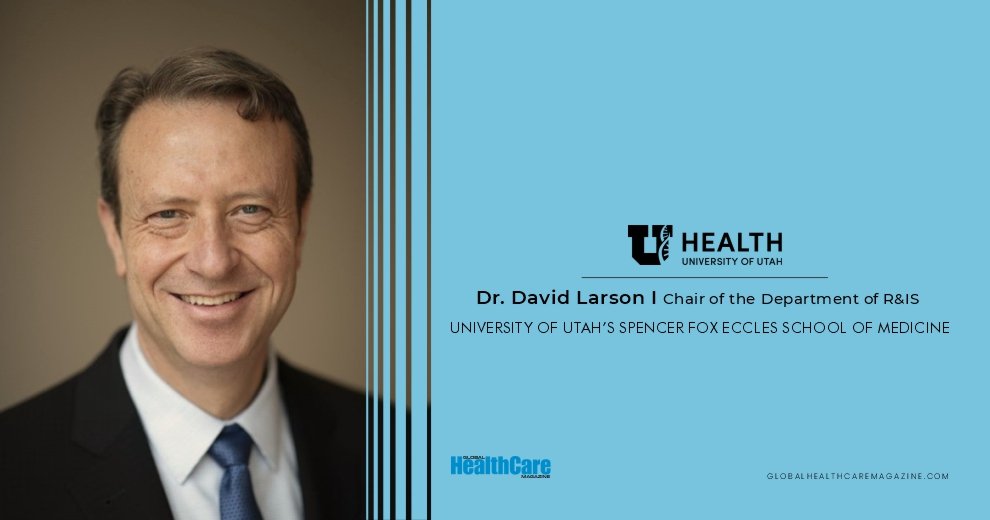
In July 2002, after earning his MD from Yale University, Dr. David B. Larson began his clinical training with a pediatrics internship at Children’s Hospital Colorado in Aurora, in the Denver metropolitan area. Twenty-four years later, in September 2026, he was running a department of radiology in Salt Lake City.
Dr. Larson is now Chair of the Department of Radiology and Imaging Sciences at the University of Utah’s Spencer Fox Eccles School of Medicine. He was plain about the timing: he would be transitioning from Stanford to the University of Utah on September 14, 2026.
His own description of his work is one long sentence with a clear spine. His career, he says, is focused on “systematically improving healthcare delivery at the local, institutional, and national level.”
A Training Built in Order
The path to the chair was laid one year at a time. After the internship, which ran to June 2003, Dr. Larson spent four years as a Radiology Resident at the University of Colorado Anschutz Medical Campus in Aurora, from July 2003 to June 2007.
He stayed in Aurora for a year as a Pediatric Radiology Fellow at Children’s Hospital Colorado, from July 2007 to June 2008.
Then came Utah, a state that is not new to him. A Utah native, he practiced pediatric radiology in the Wasatch Front early in his career before moving to Ohio.
He subsequently joined Cincinnati Children’s Hospital Medical Center in Cincinnati, where he served as the Janet L. Strife Chair for Quality and Safety in Radiology and became part of the James M. Anderson Center for Health Systems Excellence. His work there focused on quality, safety, and improving the systems through which radiology care was delivered. In 2013, he moved to Stanford.
Thirteen Years at Stanford
In 2013, Dr. Larson joined Stanford as Associate Professor of Radiology and Associate Chair for Performance Improvement. His time with the Department of Radiology would run more than 13 years, until his transition to Utah in September 2026.
His first leadership role there was Associate Chair of Performance Improvement, beginning in 2013. In 2017, he became Vice Chair of Education and Clinical Operations. In 2022, he took on the additional title of Senior Vice Chair, Strategy and Clinical Operations, broadening his responsibilities across departmental operations and planning.
He became a full Professor in June 2020, after nearly seven years as an Associate Professor.
The responsibilities then widened quickly. In July 2023, he became Executive Vice Chair, a role he held until October 1, 2024. From February through September 2024, while department chair Dr. Garry Gold was on leave, Dr. Larson took on additional administrative duties, providing leadership across the department’s clinical, research, and educational missions. He also represented the department in strategic planning with leadership colleagues across Stanford Health Care, Stanford Tri-Valley, and Stanford Medicine Children’s Health.
Over the same period, he became the founding co-director of Stanford’s AI Development and Evaluation (AIDE) Lab in 2023. The lab focuses on improving the safety, reliability, and equity of artificial intelligence in healthcare, particularly medical imaging, by developing methods to evaluate AI tools before and after their clinical deployment.
The Theory Beneath the Practice
Dr. Larson’s professional interests are unusually specific. His work is grounded in the study of complex sociotechnical healthcare systems, examining how people, processes, technology, and organizational structures interact to shape the delivery of care.
The idea is that care is never only a technical problem or only a human one. The two are inseparable. His stated goal is to “incorporate both the social and the technical aspects of intelligent problem solving.”
He describes the work as the sustainable improvement of individual skill, care processes, organizational design, leadership and management, and technological systems. The list is a fair summary of his career, spanning performance improvement, clinical operations, education, and artificial intelligence, each at a different altitude.
The Utah Chapter
Dr. Larson began as Chair at University of Utah Health in September 2026, returning to a state where he had practiced earlier in his career. As a Utah native, the appointment brings his professional journey back to familiar territory.
His appointment also places him in a national leadership position. He serves as Vice President of the American College of Radiology and is a member of the Board of Trustees of the American Board of Radiology, bringing his experience in quality, safety, and systems improvement to the wider radiology profession.
At Utah, he takes charge of a department with responsibilities spanning clinical care, research, education, and imaging innovation. His experience across these areas gives him a perspective shaped not by any single operational priority, but by how the different parts of an academic radiology department work together.
The Work of Building Better Systems
What distinguishes Dr. Larson’s approach is his belief that improvement must extend beyond individual technologies or isolated departmental initiatives. A scanner, an algorithm, a staffing model, a reporting process, and the professionals who use them all influence the care a patient receives. His work has consistently focused on making these elements function better together through measurement, shared learning, and deliberate redesign.
As artificial intelligence becomes more deeply integrated into medical imaging, this systems-oriented perspective carries particular importance. Introducing a new tool is only one part of the challenge. Its clinical value must be evaluated, its limitations understood, and its performance monitored in the environment where it will be used.
For Dr. Larson, the future of radiology rests on the ability to combine technological progress with reliable processes, collaborative teams, continuous learning, and a clear commitment to improving care for patients and clinicians.