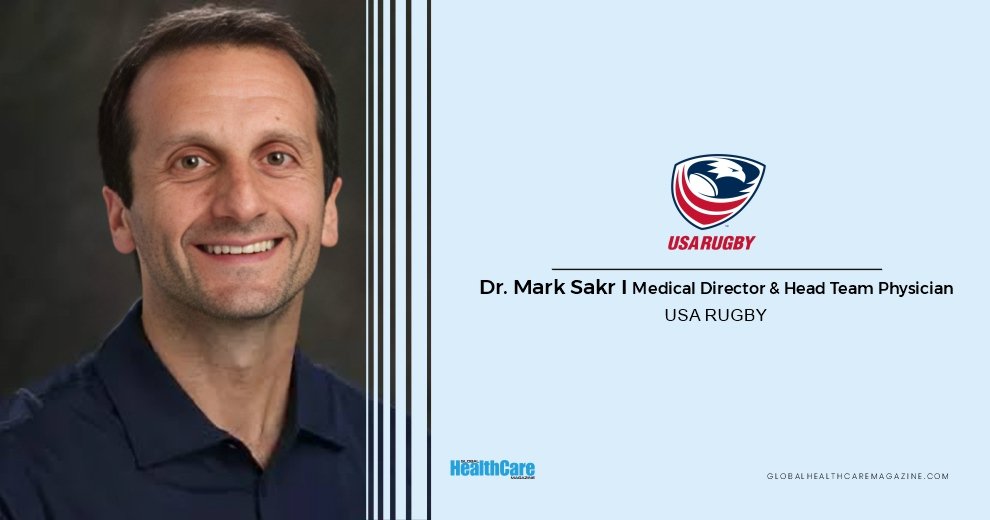
The physical toll of contact sports is a universal language, spoken in the thud of tackles, the strain of prolonged endurance, and the silent, grinding wear of connective tissue. Traversing this demanding landscape requires a medical professional who is as adaptable and resilient as the athletes they treat. From the ice of professional hockey arenas to the international rugby pitch, Dr. Mark Sakr has built a career defined by an unwavering commitment to the elite competitor.
He is a dual board-certified physician in family and sports medicine, and a Fellow of the American Academy of Family Physicians (FAAFP). His journey is a testament to the breadth and demands of sports medicine at its highest echelons.
From the Diamond to the Ice
The academic and clinical foundation of Dr. Sakr’s career was meticulously laid over years of rigorous training. He earned his Doctor of Osteopathic Medicine from Midwestern University’s Arizona College of Osteopathic Medicine in 2008. Between July 2008 and June 2011, he immersed himself in a three-year family medicine residency at Duke University Medical Center. His leadership capabilities were evident early on, resulting in his appointment as Chief Resident of Family Medicine during his final year. Following Duke, he completed a Primary Care Sports Medicine fellowship at the University of North Carolina Hospitals from 2011 to 2012.
The transition from training to elite field care happened rapidly. In October 2011, he served as a team physician for USA Baseball during the IBAF Baseball World Cup in Panama, an international experience that foreshadowed a career that would consistently cross borders. By August 2012, he had joined the Carolina Hurricanes of the NHL as an Associate Team Physician, while also working in primary care sports medicine in Raleigh.
During this intensely busy period in North Carolina, his work expanded across collegiate, professional, community, and endurance-sport settings. He also developed experience in concussion care and mass-participation event medicine, reinforcing a career that moved fluidly between the clinic and the competition environment.
Building Foundations in Pittsburgh and Atlanta
The academic sphere has always been a vital component of his professional identity. At the University of Pittsburgh School of Medicine, Dr. Sakr joined the Division of Sports Medicine as an Assistant Professor, building on his earlier academic work at Duke. During his time in Pittsburgh, he also worked with the UPMC Concussion Center and served as Head Team Physician for Robert Morris University.
His tenure in Atlanta further solidified his reputation as a builder of medical programs. Joining Northside Hospital, he served as Director of Primary Care Sports Medicine and Sports Medicine Fellowship Director, directly shaping the delivery of sports medicine and the training of future specialists. Parallel to his hospital duties, he was the Head Team Physician for Georgia State University.
These roles reflected a consistent pattern in his career: clinical care was never isolated from education, team medicine, or the larger systems required to keep athletes healthy.
The Desert Sun and the Global Stage
The desert offers a stark, unforgiving climate that tests the endurance of any athlete. In April 2022, Dr. Sakr relocated to Tucson to join the University of Arizona. He now serves as Director of Athletic Medicine and Head Team Physician, with responsibility for University of Arizona football, while also practicing sports medicine through Campus Health.
Yet, his local commitments are only half of the story. He has maintained a longstanding relationship with USA Rugby, where he provides care for the USA Men’s 15s National Team and the Olympic 7s Men’s and Women’s Teams. He now serves as Medical Director and Head Team Physician for USA Rugby and contributes to the World Rugby Player Welfare Working Group.
The combination places him at the intersection of elite performance, injury prevention, player welfare, and international competition. Rugby, particularly at the national level, demands medical systems capable of responding to immediate injuries while also addressing the longer-term health of athletes.
His academic and professional work has reinforced that perspective. He has held faculty appointments at Duke University and the University of Pittsburgh and has contributed to sports-medicine research, including published work examining neuromuscular function following knee pathology.
A Career Spanning Competition
Dr. Sakr’s experience extends across a wide range of athletic environments. He has worked with high school, collegiate, professional, Olympic, and mass-participation athletes, giving him a perspective that reaches well beyond a single sport or level of competition.
His previous roles include Associate Team Physician for the Carolina Hurricanes, Head Team Physician for Georgia State University and Robert Morris University, and leadership of primary care sports medicine and fellowship education at Northside Hospital. The range is important because the needs of an Olympic athlete, a collegiate football player, and a participant in a mass endurance event may differ dramatically, yet all require thoughtful medical decision-making and coordinated support.
That breadth also informs his approach to primary care sports medicine. The specialty is not confined to treating an isolated injury. It encompasses prevention, rehabilitation, performance, return to activity, and the management of health concerns that can influence an athlete’s ability to train and compete.
Building Systems, Not Just Treating Injuries
The most recent chapter of Dr. Sakr’s career adds another dimension to that systems-oriented approach. In 2026, CrossFit appointed him Medical Director of the CrossFit Games, placing him in charge of a multidisciplinary medical operation serving athletes competing in one of the world’s largest functional-fitness competitions. CrossFit says his responsibilities include leading the medical team and overseeing athlete care and medical operations during the Games.
The appointment is notable not simply because of the scale of the competition, but because of what it represents about modern sports medicine. CrossFit athletes arrive from varied backgrounds, compete across demanding events, and require medical planning that extends from preparation and screening to emergency response and on-site care.
For the 2026 Games, CrossFit also introduced mandatory preparticipation medical evaluations for Individual and Team athletes, making medical readiness an explicit part of the competition process. His appointment came as part of that broader expansion of athlete-safety infrastructure.
Medicine Without Borders
His professional portfolio also includes entrepreneurial and educational work. Through Hawk SportsMed Consulting and his work with American Tens, Dr. Sakr has extended his involvement beyond institutional medicine into sports consulting and rugby-related leadership. His professional work has also included collaboration with industry and medical-education organizations.
At the same time, he continues to contribute to the education of physicians and other healthcare professionals. His career has repeatedly moved between teaching, clinical care, research, team medicine, and program leadership, suggesting that his influence is measured not only by the athletes he treats but also by the systems and clinicians he helps shape.
That emphasis is particularly visible in fellowship education. At Northside Hospital, he helped lead a primary care sports medicine fellowship, while his academic appointments at Duke and Pittsburgh gave him continued opportunities to teach and mentor.
The Primary Care Advantage
At the center of all these roles is a specialty designed to keep care close to the athlete. Primary care sports medicine allows physicians to approach injuries in the context of the whole person rather than as isolated orthopedic problems.
For Dr. Sakr, that philosophy has been tested across nearly every level of competition. Whether working in a university athletic department, an international rugby program, or a major fitness competition, the physician’s job extends beyond diagnosis. It involves understanding the athlete’s environment, coordinating with other professionals, weighing the demands of competition against health considerations, and creating a pathway back to activity.
His career reflects the evolution of sports medicine itself. The physician is no longer confined to a training room or a sideline. The work now reaches into education, concussion care, player welfare, performance systems, prevention, event medicine, and global sport.
The Next Field of Play
Dr. Sakr’s current roles bring those strands together. At the University of Arizona, he remains closely tied to collegiate athletics and primary care sports medicine. With USA Rugby, his work extends into international competition and player welfare. With CrossFit, he now helps shape medical operations for a global competitive community.
The result is a career built not around one sport, one institution, or one definition of the athlete, but around a broader principle: medicine must be able to move wherever competition moves.
From baseball fields and hockey arenas to rugby grounds and the CrossFit Games, Dr. Sakr has followed that movement with a model of sports medicine grounded in primary care, education, collaboration, and preparation.
The pitch may change. The athlete may change. The stakes may change. But the responsibility remains the same: to help athletes compete safely, recover intelligently, and return to the activities that define their lives.