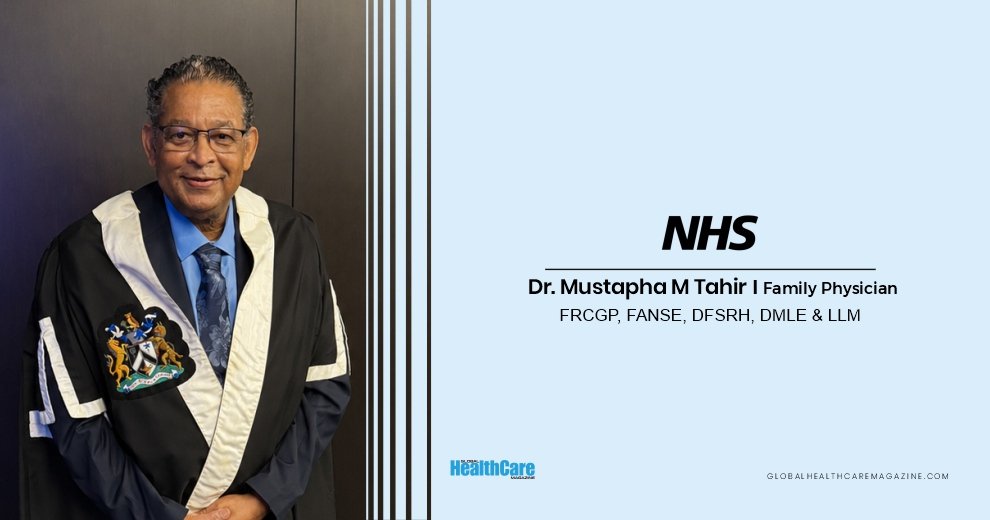
A stethoscope has a way of outlasting almost everything else in a medical career. Diplomas fade into frames on office walls, hospital wings get renamed, entire specialties reorganize themselves every decade or so. But the simple act of a doctor sitting across from a patient, leaning in, and listening, that has remained, for Dr Mustapha M Tahir, the constant thread of an unusually varied professional life. Today, Dr Tahir is a Family Physician holding the credentials FRCGP, FANSE, DFSRH, DMLE, and LLM, and he has spent 36 years in service to the NHS, a run long enough to have watched entire theories of medicine rise, fall, and rise again.
What makes Dr Tahir’s story worth telling is not simply its length. It is its refusal to sit still. He has been an obstetrician who delivered babies by forceps and caesarean section, a researcher whose findings reshaped how doctors investigate postmenopausal bleeding, a psychiatry registrar, a full-time accident and emergency doctor, a trustee of the Royal Society of Medicine, a prospective Conservative parliamentary candidate, and a scholar of medical law with a thesis on the ethics of terminal sedation. Ask him to describe himself, though, and he will not reach for any of those titles. He will simply say he is a family physician. “I am not a specialist in any of those areas,” he says. “A baby is important to me as a mentally ill patient or a geriatric patient.”
From Nigeria to the NHS
Dr Tahir’s path into medicine began in Nigeria, where he trained in Obstetrics and Gynaecology at the West African College of Surgeons, reaching the rank of Registrar in 1989. In 1990, he crossed into the British healthcare system, joining the NHS as a Senior House Officer and rotating through Cornwall and Hammersmith Hospital. It was at Hammersmith that he conducted an audit of twice-daily fraction radiotherapy in the treatment of vulval carcinoma, an early sign of the meticulous, research-minded doctor he would become.
From there, Bristol called. Recruited to Bristol Medical School and St. Michael’s Hospital as a lecturer and research fellow, he specialised in transvaginal sonography, office hysteroscopy, and Pipelle uterine biopsy. It was here that he pioneered a one-stop menstrual disorder clinic, a piece of clinical innovation that would eventually be cited well beyond Bristol’s walls. Over the course of his obstetric career, he delivered over 500 babies, some by forceps, others by caesarean, groundwork he now describes with a kind of quiet, hard-won pride.
But something in him wanted more than a single speciality. “I felt I had achieved almost everything in obstetrics and gynaecology,” he recalls. “I decided I wanted to be like a proper doctor rather than a specialist doctor, because my ambition from childhood was to see patients with illnesses of all types, not just in one section of medicine.”
Becoming a Complete Physician
That ambition sent him into the Bath and Wiltshire Vocational Training Scheme, where he trained for three years and qualified as a General Practitioner in 2000. Even that was not enough. Sensing gaps in his understanding of psychiatric illness and substance misuse, he pursued additional training in psychiatry at the registrar level, an unusual detour for a GP but one entirely consistent with his stated philosophy that a family physician should be able to meet any patient who walks through the door.
He went on to hold a full-time partnership in a practice serving 14,000 patients, a role he held for eleven years. In 2010, he attained Membership of the Royal College of General Practitioners. For three years, he also worked full time in Accident and Emergency, splitting his week between three days in emergency medicine and two as a family physician, an arrangement that speaks to a stamina many younger doctors might envy.
His obstetric training, he insists, was never wasted. It surfaces still in the exam room, in the instincts of a physician who has, in his own words, “seen it all.” As he puts it, plainly and without apology for the specialists who might disagree, “once you go out of their territory, they really are not doctors anymore.” For Dr Tahir, broad clinical knowledge has always been central to his philosophy of family medicine.
A Career Written Into the Medical Record
Ask Dr Tahir about his proudest professional contribution, and the conversation returns, inevitably, to a single paper. His doctoral research on transvaginal ultrasound, hysteroscopy, and endometrial biopsy in the diagnosis of endometrial cancer was published in the British Journal of Obstetrics and Gynaecology in December 1999. The work was first incorporated into the Scottish Intercollegiate Guidelines before later informing guidance from the National Institute for Clinical Excellence (NICE). Today, it stands as standard practice around the world for the investigation of postmenopausal bleeding, a rare and lasting kind of legacy for any single piece of research to carry, and one that continues to be cited in the medical literature.
Around the same period, he served as a Trustee and Council Member of the Royal Society of Medicine in London, working under four successive presidents and contributing to oversight of the Journal of the Royal Society of Medicine. It was in this capacity that, in 2006, he received an invitation few doctors ever see: a dinner at the palace, hosted by the late Queen Elizabeth II, recognising contributions to medicine alongside Britain’s living Nobel Laureates in science, medicine and physiology, including Professor Stephen Hawking. “It was a big honour,” he says, of an evening that placed a family doctor from Kent in the same room as some of the most celebrated scientific minds in the country.
The Constituency He Chose
Not every ambition in Dr Tahir’s life led him deeper into medicine. As his reputation grew within the British Medical Association, where he served as a regional chairman, and within the Kent Local Medical Committee, where he represented fellow GPs for three years, he found himself pulled toward Westminster. He was called to Milton Keynes for a rigorous interview to become a Conservative Party parliamentary candidate and was subsequently placed on the party’s A-list, part of an initiative under David Cameron’s leadership to bring more ethnic minority candidates into Parliament, before Rishi Sunak had entered the party’s ranks.
He was offered constituency after constituency. He turned them down.
“I reflected on the number of patients that I see, and also certain patients with terminal illnesses and the elderly patients I tend to meet, and my conscience couldn’t allow me to leave them,” he explains. It is, in some ways, the defining decision of his career, a doctor choosing his exam room over the House of Commons. His political instincts did not disappear, though. Through a long-standing patient relationship with his local Member of Parliament, spanning some 15 years, he helped raise health concerns directly with the Health Secretary, an effort that contributed to the establishment of new urgent care services in his community, along with sexually transmitted disease clinics, family planning units, and podiatry services initiated during his time with the Kent LMC.
Medicine, Ethics, and the Law
Perhaps the most distinctive turn in Dr Tahir’s career came when he pursued formal study in medical law, particularly clinical negligence, a subject he approached under the supervision of Professor Price, then editor of the British Medical Law Review and head of the Medical Law department at Leicester. He completed a Diploma in Medical Law and Ethics in 2012, followed by an LLM in 2016.
His thesis, “Legal and Ethical Dimensions in the Practice of Terminal Sedation,” examined suicide, euthanasia, and what the UK prefers to call palliative sedation, a legally intricate space where a patient may be sedated near the end of life without crossing into euthanasia, which remains illegal in Britain even as it is permitted elsewhere in Europe and in parts of the United States. “There are a lot of legal landmines in that practice,” he says, a subject his professor believed deserved serious academic attention.
That legal grounding, he says, has shaped how he practices today, not as a shield for defensive medicine, which he firmly rejects, but as a form of literacy. “Having a good knowledge of medical law does help you to know how to respond to complaints,” he notes, whether those complaints are directed at him or at colleagues who come to him for guidance.
An Annus Mirabilis
If a single year could be said to crown a 36-year career, it was the one Dr Tahir refers to, borrowing the phrase from Isaac Newton, as his annus mirabilis. In May 2025, Kent and Medway NHS presented him with a Long Service Award, recognising his dedication and outstanding service to the NHS, delivered, he notes, with “discipline, distinction, and excellence.” That July, he was called to the Fellowship of the Academy of Natural Sciences and Engineering. In October, he was named a Fellow of the Royal College of General Practitioners, a distinction he calls the pinnacle of achievement in family medicine in the United Kingdom.
His BJOG research, meanwhile, has gone on to be cited 193 times in the medical literature, a body of citations that stretches across nearly a quarter century, a testament to the staying power of work he completed as a young lecturer in Bristol.
The Discipline of Ten Minutes
If there is a philosophy that runs beneath all of Dr Tahir’s professional choices, it is a belief in listening, actual, uninterrupted listening, as a diagnostic tool. He practices what is known in general practice as the Pendleton method of consultation, and he is candid about the pressures working against it. The NHS allocates roughly ten minutes per patient, a window he considers too narrow for the kind of holistic medicine he believes in. “Even the vets don’t give more than 10 minutes with a dog,” he observes dryly.
He is equally candid about the challenges of practising medicine in what he calls the internet age, where patients often arrive already convinced of a diagnosis pulled from an unreliable corner of the web. “Professor Google has not seen you,” he says, “has not asked you a question, has not examined you.” His approach is neither paternalistic nor passive. “When a doctor listens to the patient for 10 minutes, doesn’t speak, lets the patient speak for 10 minutes, the patient will lead you to a diagnosis.”
That same instinct extends to his teaching. He has trained medical students at the University of Bristol and Canterbury Christ Church University, served as a GP Trainer under the Kent, Surrey and Sussex Deanery, now KSS HEE, and holds an appointment as Community Educational Supervisor for FY2 doctors. He teaches final-year medical students emergency call triage on weekends in Ashford, and each year, alongside his local MP, he conducts mock interviews for teenagers applying to medical school. More recently, he appeared on Nigerian television advocating for Significant Event Audit principles as a way to strengthen healthcare governance and reduce corruption, extending his commitment to stronger healthcare governance and accountability well beyond the walls of any single clinic.
The Ledger of a Life
Dr Tahir is unsentimental about the mathematics of medical error, and he uses it to make a point about humility. “If you diagnose 99 per cent of breast cancer cases in a year, but you miss one, that one you miss is perhaps the mother of two children, the wife of a person, or the grandmother,” he says. “To those families, your 99 per cent success rate offers little comfort.” It is a hard, clarifying way of framing the stakes of his profession, and it is why, he says, he still asks junior doctors to imagine every patient as a member of their own family.
His secondary school in Nigeria, he notes with evident pride, produced two Nigerian presidents, numerous ambassadors, generals, and professors. He remains, to this day, the only student from that institution to achieve a distinction in the West African School Leaving Certificate, an achievement so enduring that the school has since instituted annual prizes for the best students in science and information technology in recognition of academic excellence.
Family, Not Sport
Asked how he manages work-life balance after nearly four decades in medicine, Dr Tahir does not talk about hobbies or exercise regimens. He talks about a piece of hospice research that stayed with him, in which dying patients were asked what they would do differently, and more than 90 per cent said they would spend more time with family. It is a statistic he has clearly internalised. He now works four to five clinical sessions a week, has turned down repeated offers to practice in Dubai and Canada, and prioritises short trips to the Mediterranean over long-haul travel, preferring, as he puts it, not to “come back feeling fatigued.”
His counsel to the next generation of doctors is not complicated, but it is firm. “If you go into medicine in order to be rich, you will likely end up unhappy all your life,” he says, recalling the words of his own professor. “If you do medicine in order to cure the sick, you will be happy all your life, and you will lead a middle-class life.” For a man who once stood a candidacy away from Parliament, and who has spent his career resisting the pull toward specialisation, prestige, and higher pay, it is perhaps the most honest summary he could offer of a life spent, deliberately, at the bedside.
Quotes

Also Read: Leaders Advancing Holistic Family Medicine & Medical Law Innovation 2026