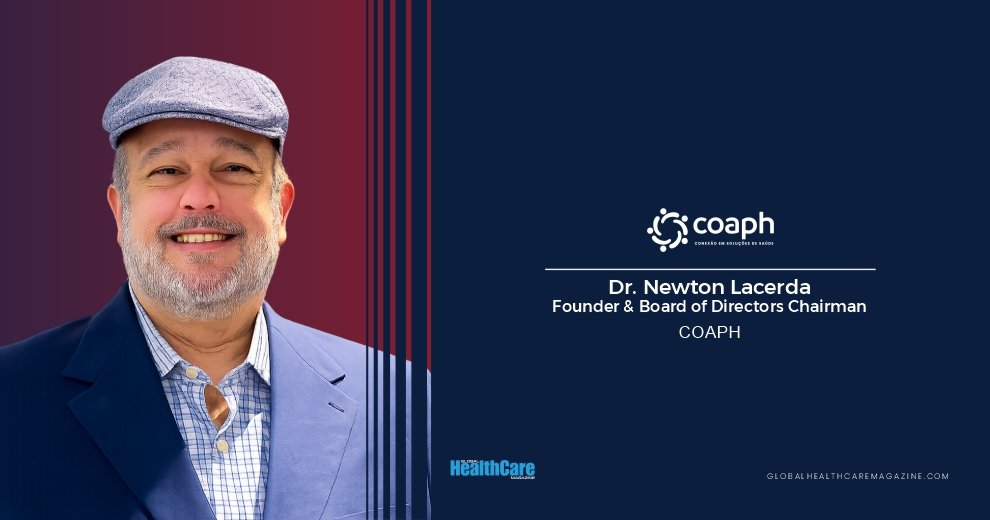
For thirty years, he has carried two identities inside a single body: physician and neuroscientist on one hand, builder of institutions on the other. It is a rare kind of double vision, the sort that lets a person diagnose a patient in the morning and diagnose an entire broken system by afternoon. “I always felt the need to make a greater contribution to healthcare,” he says, and it is this sentence, more than any resume line, that explains everything that follows.
Today, Dr. Newton Lacerda serves as Founder and Chairman of the Board of Directors of Coaph, the pre-hospital and hospital care cooperative he helped bring into existence in Northeast Brazil, and as Founder and President of the HDOC Saúde Group, the wider ecosystem that has since grown up around it. He holds a medical degree from the Federal University of Ceará, postgraduate qualifications in Strategic Business Management and Health Management from Fundação Getúlio Vargas, and is currently completing a Master’s degree in Health Management, Quality, and Innovation at Harold Gilles University. He is a certified cooperative board member through OCB and FGV, chairman of the board at Celint, co-author of the book Conselheiros com Visão de Futuro, and a man who, by his own admission, has never quite managed to step away from the bedside.
The Spark in Ceará
The story begins in 2008, in the state of Ceará, where Brazil was rolling out its Mobile Emergency Care Service, known by its acronym, SAMU 192. It was a moment that most people would have registered as a policy update. Dr. Lacerda registered it as an opening.
He noticed something the system itself had not yet caught up to: there were not nearly enough professionals trained in pre-hospital care to meet the need. So he gathered twenty other physicians around him and, together, they founded the first cooperative in Northeast Brazil dedicated entirely to that gap. They called it Coaph.
From its first days, Coaph carried two missions that Dr. Lacerda still recites like a personal creed. The first was to guarantee quality care in “a healthcare sector that was still largely unexplored.” The second was to give the cooperative’s own professionals something just as essential: continuous technical and scientific education, and a work environment that was safe, organized, and, in his words, one that “values people.”
Learning a New Language
The founders’ biggest obstacle was not funding, or bureaucracy, or even the daunting scale of emergency medicine. It was that none of them understood the cooperative business model they had just committed themselves to. So they did what physicians do best: they studied it. They researched its history, its guiding principles, its long-term potential, until something shifted in how they saw it.
They stopped thinking of it as a corporate structure and started seeing it as a philosophy, one built on collaboration, collective growth, and a genuine regard for the people inside it. That reframing, Dr. Lacerda suggests, is the quiet engine that has powered every expansion since.
Growth Without Losing the Center
What started as a single SAMU 192 contract in one state did not stay small for long. Coaph’s footprint spread across virtually all of Ceará, then crossed into other Brazilian states, until the cooperative’ s portfolio reached approximately two hundred contracts.
The services multiplied in step. Ambulance and home care came first. Then hospitals. Then polyclinics, neurodevelopment specialty clinics, clinical laboratories, diagnostic imaging centers, and telemedicine. Eventually, Coaph built an innovation division whose sole purpose is developing health-focused startups, a signal that Dr. Lacerda has never been content to simply maintain what already exists.
More recently, two additions have arrived that he describes as embodying his vision for where healthcare is heading: a Behavioral and Social Neuroscience Laboratory, and, perhaps closest to his heart, a palliative care hospital. That facility spans more than nine thousand square meters and was designed entirely according to Environmental, Social, and Governance principles, complete with extensive green spaces, solar power generation, a wastewater treatment plant, and a permanent education center for training healthcare professionals.
An Ecosystem, Not Just an Organization
All of it now sits under one roof: the HDOC Saúde Group, the umbrella Dr. Lacerda founded to hold Coaph together with every other venture built along the way. His role inside it, he admits, has become “primarily strategic.” But strategy has never been the whole story for him.
“As a physician, I have never been able to step away completely from patient care, as I believe our roots lie precisely in caring for people,” he says, and it is a sentiment that reads less like a mission statement and more like a confession, the kind a person makes when the thing they built accidentally became bigger than the reason they built it.
Outside HDOC, his professional history reaches further still. He spent years in leadership at the Hapvida Group, serving as Director of Auditing and Director of Provider Credentialing. He founded SOS Caucaia, SAMU Caucaia, and SAMU Ceará. He has also built companies entirely outside medicine: a confectionery chain called Dandelli, a security services group under the Carneiro name, a children’s entertainment venture called Clube das Estrelinhas, and the now inactive Fantasia franchise chain. It is a portfolio that reveals a restless, almost compulsive builder’s instinct, one that happens to have found its deepest expression in healthcare.
The Test of a Lifetime
Ask him about leadership under pressure, and there is no hesitation in his answer. It is the COVID-19 pandemic, without question, that he calls “the most defining period” of his professional life.
“We had to learn on the fly while caring for our patients and, simultaneously, protecting our staff,” he recalls. Behind the scenes, teams not directly on the front lines worked without rest to secure diagnostic tests and personal protective equipment inside a market defined by extreme scarcity. He does not soften the memory. It was, he says plainly, one of the hardest stretches he has faced as president.
What carried the organization through, in his telling, was not a strategy document or a contingency plan. It was people, placed deliberately at the center of every decision. Transparent communication. Genuine care for teams, from administrative staff to those working inside intensive care units. A collective decision to face a global crisis as one unit rather than many fragmented parts.
The Priceless Ledger
Every institution he has built, Dr. Lacerda insists, is ultimately just an instrument. The true asset, always, is people. Thousands of healthcare professionals now make up what he calls the group’s real value, with hospitals and clinics serving merely as the vessels through which the larger purpose gets fulfilled: making the world healthier.
But there is a second ledger he keeps, one measured not in contracts or square meters but in nights missed and weekends surrendered. His wife, Najla, and his five daughters, Carol, Giovanna, Mariana, Beatriz, and Fernanda, absorbed the cost of his ambitions quietly, for years. He is candid about what that cost them, and unequivocal about what he has learned from it.
“I often tell young people not to let work or money take the place of what truly matters,” he says. “There is no greater asset than family.”
His life outside the boardroom bears this out in other ways too. He is a practicing Catholic, involved in social projects through the São Joaquim and Santa Ana Parish, work that runs quietly alongside the corporate one and seems, to him, to be part of the same continuous effort at service.
A Message to the Healers
For those who have chosen healthcare as their life’s work, Dr. Lacerda offers something closer to gratitude than advice. Few professions, he argues, allow a person to witness the things his teams witness: the birth of a child, the easing of a patient’s pain, the delivery of hope to someone at their most vulnerable. “Caring for people is both a privilege and an immense responsibility,” he says, and the line carries the weight of three decades behind it.
Looking Toward the Hundredth Year
Dr. Lacerda is, by his own account, preparing to step down as HDOC’s executive president. It is not spoken of as a retreat, but as a handoff, one he approaches with what sounds like genuine peace. He trusts that the generation coming up behind him will build on what Coaph and HDOC have become, carrying forward the same values and the same mission that carried the cooperative from a single SAMU contract in Ceará to a two-hundred-contract, multi-service healthcare ecosystem.
He imagines a future president, decades from now, sitting for an interview much like this one, recounting the next chapter of a story that began with twenty-one physicians who did not yet understand the cooperative model they had just committed themselves to, and ends, he hopes, at Coaph’s hundredth anniversary, celebrated together.
Quote