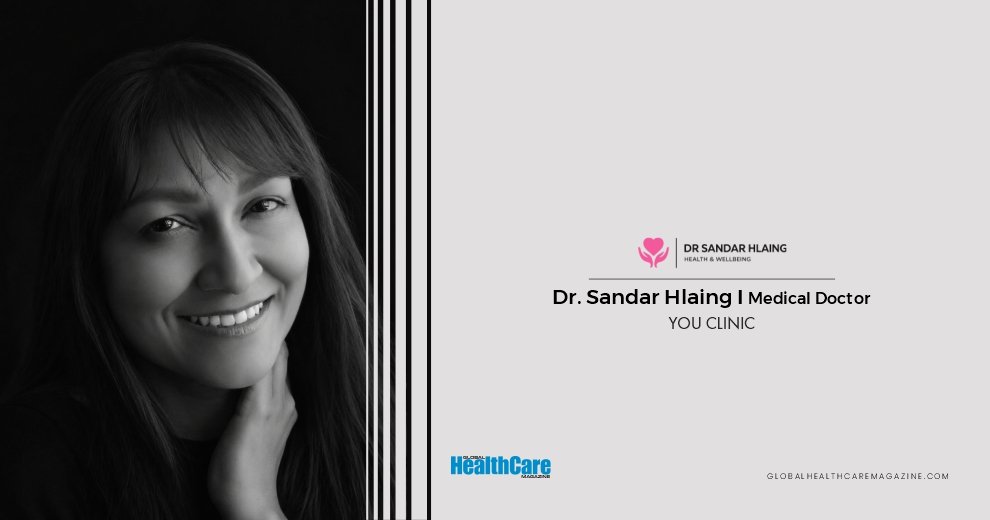
For eight years, a body kept sending signals that no one around her could quite translate. The fatigue. The joint pain. The fog that crept into ordinary thoughts and refused to lift. It would be tempting to call this a medical mystery, except that the person living inside it was, herself, a doctor. That contradiction, a physician unable to diagnose her own suffering, sits at the centre of the story of Dr Sandar Hlaing, the Medical Doctor at YOU Clinic, whose work now shapes the conversation around menopause, weight, and the body’s quiet unravelling.
A Body That Spoke in a Language No One Answered
Dr Hlaing grew up in a developing country, in a household she describes as modest, where “women’s health was rarely prioritised or openly discussed.” It is a detail that seems small until you understand what came next. The symptoms she now recognises as primary ovarian insufficiency began in adolescence, though no one, including her, had a name for them yet.
By the time she was 37, she had reached premature menopause. It took more than eight years for a formal diagnosis to arrive. In the meantime, she was still practising medicine, still showing up for patients, still carrying the weight of a practice she had built and led for 13 years. Eventually, the cumulative physical and emotional burden became too much. She retired from that practice, undone by brain fog, joint pain, insomnia, and a fatigue so profound it altered the architecture of her days. Anxiety over the undiagnosed symptoms compounded the physical toll. Then came the fracture: a severe osteoporotic break of her right hand and wrist, the kind of injury that turns an abstract diagnosis into something you can hold, or, in her case, something you suddenly cannot.
“These debilitating symptoms eroded my confidence, my sense of identity, and my joy in life,” she says.
Turning Sleepless Nights Into Expertise
What happened next is the part of the story that explains everything that came after. Rather than let the insomnia simply take her nights, Dr Hlaing began to study during them. She immersed herself in the mental and physical health conditions shaping women’s wellbeing, and slowly, methodically, became a menopause specialist. Not because a curriculum demanded it, but because her own body had.
She describes the relationship with her patients as reciprocal in a way that feels almost old-fashioned in its sincerity: “My patients show me what matters to them, and I study to meet those needs.” Recognising the longstanding gaps in women’s health funding, research, and education, she began creating accessible avenues for women to learn and seek help. She now speaks at women’s forums and professional education events regularly, always without charge, driven by a conviction that no woman should feel unseen or unheard.
The Clinic Born From Being Truly Listened To
YOU Clinic did not emerge from a business plan so much as from an absence she had felt herself. The name itself serves as a deliberate mission statement. “The clinic is named YOU because it is all about YOU, the patient,” she explains. It reflects her belief that every consultation should be centred on the individual rather than on a doctor’s assumptions or traditional beliefs. “You own this consultation. I am there to facilitate it, not to dictate.”
The structure of the clinic reflects that belief in practical terms. Dr Hlaing built her hours around late evenings and weekends, carved out of her own personal time, so that women with complicated, overfull lives could still find a way in. Every consultation runs a full hour, a deliberate refusal to let concerns be minimised, rushed, or dismissed. She points to specific examples of what tends to get brushed aside elsewhere: menopause related hair loss, sudden changes in body shape, the emotional weight of hormonal decline. At YOU Clinic, every concern is treated with seriousness and compassion, and solutions are built holistically rather than piecemeal.
Rewriting What Menopause Is Supposed to Mean
Ask Dr Hlaing about the misconceptions she encounters most often, and she does not hesitate. The prevailing one, she says, is the idea that menopause is simply a natural stage women should endure quietly, and that struggling through it is a sign of insufficient resilience. She rejects this framing entirely, and she has the evidence to back her up.
Hormone replacement within the first decade of menopause, she explains, offers significant protection for the heart, bones, and brain, while also improving sleep, mental wellbeing, skin quality, weight regulation, and hair health. Hormonal imbalance is a major driver of hair thinning, skin laxity, and central weight gain, three concerns that are often treated as cosmetic footnotes rather than what they actually are: physiological signals. “Addressing these issues holistically, rather than in isolation, is essential for achieving meaningful improvements in a woman’s overall wellbeing,” she says.
A Practice Built on Belief, Not Procedure
What distinguishes Dr Hlaing’s approach, by her own account, is a kind of radical trust. “I believe my patients. I respect their experiences,” she says, and from there she explains what is happening, why it is happening, and how evidence-based medicine can address it. She encourages questions. She wants every woman to understand the reasoning behind her own treatment plan, not simply follow it.
Just as telling is what she is willing to say no to. Dr Hlaing is transparent when a requested treatment lacks clinical evidence or does not align with established guidelines. “My consultations are not driven by the pursuit of procedures,” she says. “They are driven by the pursuit of healing, whether physical, psychological, or both.” It is a distinction that separates a clinician from a salesperson, and she draws it without apology.
A Life Divided Between Two Systems
Dr Hlaing’s days are split between the NHS and private practice, and she describes both as enriching her clinical perspective rather than pulling her in opposing directions. Beyond direct patient care, she serves on the local medical committee, where she represents GPs, and she trains future general practitioners while also teaching medical educators. It is a full schedule by any measure, though she is clear that the patient-facing parts of the work remain what she cares about most.
None of it, she is quick to note, happens in isolation. She credits SA1 Medical Centre, Sancta Maria Hospital Swansea, 1192 Clinic, and the Independent General Practice in Cardiff and Carmarthen as the organisations whose infrastructure and investigative support make her holistic, patient-centred model of care possible. “Without them, the level of care I provide would not be possible,” she says.
The Crises That Tested Her Leadership and Resilience
If there is a chapter in Dr Hlaing’s career that reveals what she is made of, it is how she navigated two distinct crises that tested both her professional leadership and her personal resilience. Throughout the entirety of 2020, as she led her NHS practice of 13 years, the COVID-19 pandemic arrived. She worked daily in patient-facing roles, overseeing inpatient care in nursing homes, even as the practice itself faced severe financial strain. Her leadership during this period was steady and unwavering, even while her physical reserves were being quietly depleted by menopausal symptoms.
The ultimate test of her resilience, however, arrived in November 2022, an event she describes as the biggest blow of her life. Having made the difficult decision to leave her NHS practice due to debilitating menopause symptoms, she planned to pivot her career, believing that her knowledge and clinical expertise would carry her forward. Just four days before she was set to open her new aesthetic clinic, she suffered a devastating fall. Because of underlying osteoporosis caused by years of untreated premature menopause, the impact smashed multiple bones in her right hand and wrist.
Suddenly, a physician who thought she would be relying on her mind discovered just how much her life and profession depended on her right hand. The clinic she had spent months preparing to launch was suddenly delayed by nearly eight months.
Most people faced with such a severe physical compromise would accept a permanent limitation. Dr Hlaing did not. She began intensive physiotherapy just two weeks post-operation, starting months ahead of the standard six-week mark. Because her wrist would no longer articulate normally, she spent months retraining her body with the help of a dedicated physiotherapist, who patiently watched procedure videos on YouTube with her to understand the precise mechanics required.
To perform every delicate task required of a medical and aesthetic doctor, she learned to compensate by initiating movements from her shoulder and torso rather than her wrist. To guarantee that her diagnostic and procedural dexterity remained absolute, she mastered the use of ultrasound scanning for facial and joint assessments. While she permanently lost her pretty handwriting, and nightmares of the fall still occasionally return, she emerged from the grueling ordeal immensely proud of her physical recovery and her emotional evolution over the years. Today, she looks back on that period not with lingering bitterness, but with a deep, quiet satisfaction with her life.
“Despite ongoing personal and professional challenges,” she says, “I remain committed to advancing women’s health.”
Bringing Rigour to Aesthetics
Aesthetic medicine is not, technically, a field that requires advanced academic credentials in the UK. Dr Hlaing pursued them anyway, completing a Master’s degree in Aesthetic Surgery at University College London. Her reasoning is straightforward: she wanted her practice grounded in rigorous scientific evidence, whether or not the profession demanded it of her.
That same rigour shapes how she evaluates newer treatments. She continues to review peer-reviewed literature on innovations such as PRP, exosomes, and polynucleotides, ensuring that as these tools enter her practice, they do so responsibly and ethically and in line with scientific evidence.
Beyond the Clinic Walls
Dr Hlaing’s influence has extended into spaces well beyond her own consultation room. She designed a comprehensive website, found at drshlaingwomenhealth.co.uk, where women can educate themselves on every aspect of their wellbeing. She has collaborated with local women’s forums to deliver education directly to the people who need it, and she has worked with Members of Parliament to help shape women’s health policy, particularly around obesity management. She has also contributed to local medical projects, helping shape women’s health protocols, work that moves beyond individual patients toward something closer to systemic change.
What She Sees Coming
Asked about the future of her field, Dr Hlaing’s outlook is measured but hopeful. She believes women’s health will continue rising in priority, and that this shift will be driven largely by women themselves. Menopause, she notes, has become a major topic of discussion in women’s forums, a sign of how far the conversation has moved. She expects aesthetic medicine to be increasingly recognised as a legitimate part of women’s wellbeing, tied not to vanity but to confidence, identity, and a fuller sense of self. For YOU Clinic, she sees the mission continuing much as it began: as “a source of education, empowerment, and joy.”
The Garden and the Quiet
Away from the clinic, Dr Hlaing’s rhythms slow considerably. Her garden, she says, is her sanctuary, a place of peace and renewal. She practises cognitive behavioural therapy techniques, mindfulness, and biofeedback meditation, tools she uses to stay grounded amid a schedule that would exhaust most people twice over.
A Philosophy, Plainly Stated
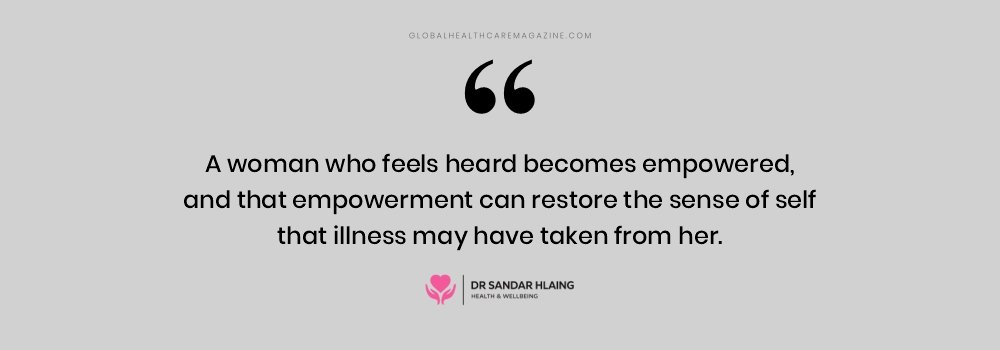
If there is a single sentence that captures how Dr Hlaing sees her own work, it may be this one: “My guiding philosophy is that every woman deserves to be heard, believed, and cared for with dignity.” She does not view leadership as a position of authority. She views it as an act of service, one she intends to keep performing with, in her words, compassion, scientific integrity, and unwavering respect.
It is a philosophy that traces directly back to those eight undiagnosed years, to a fractured wrist, to sleepless nights spent studying rather than simply enduring. Dr Sandar Hlaing did not allow her own diagnosis to define her. Instead, she transformed it into a lifelong mission of listening to, educating, and advocating for women.
Quotes