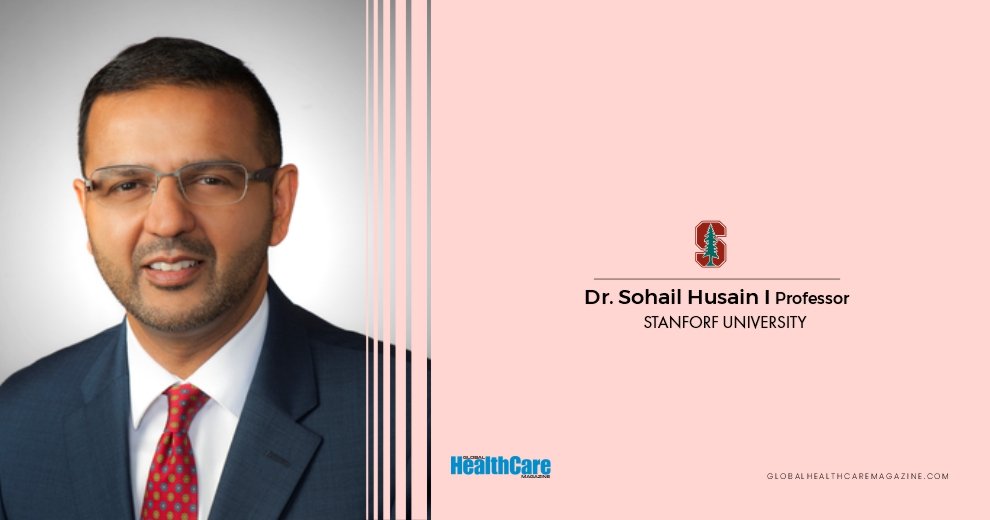
Some physicians describe their work in terms of diagnoses and treatments. Dr. Sohail Husain describes his in terms of marriage, specifically, the marriage of science and medicine. It is an unusual metaphor for a pediatric gastroenterologist, but it captures a career devoted to narrowing the gap between laboratory discovery and the child lying in a hospital bed.
Dr. Husain currently serves as the Chambers-Okamura Endowed Professor and Chief of the Division of Pediatric Gastroenterology, Hepatology, and Nutrition at Stanford University, a position he has held since 2019. His vision is for Stanford to become “the pre-eminent provider of pediatric GI care in the region” and “a global leader in pediatric GI research and education.” More than an institutional aspiration, it reflects the mission he promotes for the division: “heal children with digestive disease through innovation.”
The Long Education of a Pancreas Specialist
Dr. Husain’s academic foundation is both broad and deeply specialized. He earned a BS in Biological Sciences from Binghamton University in 1994 before receiving his MD from Tufts University School of Medicine in 1998. He completed his pediatric residency at New York University Medical Center from 1998 to 2001 before moving to Yale University School of Medicine, where he completed a clinical fellowship in Pediatric Gastroenterology, Hepatology, and Nutrition in 2002, followed by a postdoctoral research fellowship in 2004.
He remained at Yale from 2001 through 2011, first as a postdoctoral fellow and later as an Assistant Professor. During those years, his scientific interests became increasingly focused on disorders of the exocrine pancreas, laying the groundwork for a research career centered on pancreatitis and pancreatic regeneration.
Pittsburgh, and a Widening Research Agenda
In 2011, Dr. Husain joined the University of Pittsburgh School of Medicine, where he served as Professor and Director of the Pediatric Exocrine Pancreatic Disorders Program until 2019. It was during this period that his research program matured around three major questions: the molecular and immune signaling pathways that initiate pancreatitis, the mechanisms that drive pancreatic regeneration after injury, and the causes of drug-induced pancreatitis.
His research group has remained guided by a clear purpose: to “make breakthroughs in the pancreas and beyond that benefit patients and society, through innovation, partnerships, inclusion, and integrity.”
Arriving at Stanford
When Dr. Husain joined Stanford in 2019 as Division Chief, he assumed responsibility not only for leading one of the nation’s premier pediatric gastroenterology programs but also for expanding its clinical, research, and educational impact.
In addition to serving as Division Chief, he is a Member of Bio-X, the Stanford Medicine Children’s Health Center for IBD and Celiac Disease, and the Stanford Diabetes Research Center. His board certification in Pediatric Gastroenterology is through the American Board of Pediatrics.
Beyond the Laboratory
What distinguishes Dr. Husain’s career is that it extends well beyond research laboratories and academic medicine.
Born in India, raised in Brooklyn, and now living in California’s Bay Area, he brings a perspective shaped by multiple cultures and communities. Outside medicine, he enjoys hiking, swimming, and jogging.
Equally significant is his longstanding humanitarian work with Humanity First USA. Through the organization, he participated in disaster relief efforts following the 2005 tsunami in Banda Aceh, Indonesia, Hurricane Katrina in New Orleans in 2006, and the devastating 2010 earthquake in Port-au-Prince, Haiti. These missions reflected the same commitment to service that defines his clinical and research careers.
The Throughline
It would be easy to separate Dr. Husain’s career into distinct roles: researcher, physician, educator, administrator, humanitarian, and mentor. Yet his own philosophy resists those boundaries. He speaks of marrying science and medicine, not merely combining them, believing that scientific discovery achieves its greatest value when it directly improves the lives of patients.
Today, as the leader of one of America’s foremost pediatric gastroenterology divisions, Dr. Husain continues to pursue that vision by advancing innovative research, expanding collaborative partnerships, and building programs grounded in inclusion, integrity, and compassionate care. His ambition is not simply to grow a division, but to create a lasting legacy that transforms how digestive diseases are understood and treated for generations of children.
Also Read: The 10 Most Visionary Leaders in Gut Health & Gastroenterology 2026