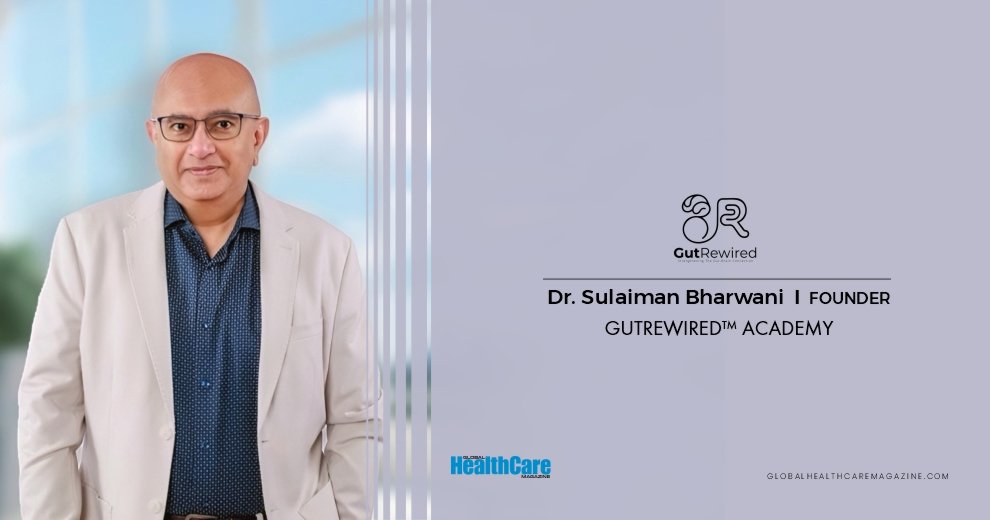
There is a particular kind of doctor who spends thirty years accumulating credentials the way other people accumulate stamps in a passport, and then, somewhere along the way, decides that none of it matters unless it reaches the person sitting across the table, worried, bloated, and out of answers. Dr. Sulaiman Bharwani is the kind of doctor. He is currently the Founder of GutRewired™ Academy, a board certified gastroenterologist and a board certified nutritionist who has spent close to three decades moving between laboratories, lecture halls, and exam rooms on four continents, and who now spends a good deal of his time trying to explain, in language a tired parent or an anxious professional can actually use, why the gut has been quietly running the show all along.
A Journey Through the Body’s Front Door
Dr. Bharwani did not set out to become a specialist in the relationship between the stomach and the mind. He set out, as a young trainee, to understand the human body as something more than a set of separate rooms. Gastroenterology appealed to him for a reason that sounds almost architectural: the digestive tract is literally our primary interface with the outside world. It is, in other words, the front door.
The turning point came later, in the exam room itself, where he began to notice a pattern that the textbooks of his early training had not fully prepared him for. Patients with chronic gastrointestinal complaints kept arriving with something else riding alongside their symptoms, a heaviness of stress, a fog around the edges of their thinking, and an anxiety that seemed to travel with the bloating rather than sit apart from it. Treating the gut in isolation felt incomplete. As the science of the microbiome and the gut-brain axis began, in his words, to “explode,” revealing the gut as a kind of second brain home to extensive neural activity and a major site of neurotransmitter production, highlighting its close relationship with the brain. He wanted to be, as he describes it, a bridge between hard gastroenterological science and the lived, neurological, and emotional realities of the people he was treating.
That instinct for bridge building has defined nearly everything since. It carried him through his medical education, where he trained as an alum of Brown University School of Medicine and the University of Chicago, and it followed him into a research career that has produced close to 100 scientific publications in peer-reviewed journals, work that has been cited close to 3,000 times by fellow scientists over the past decade. Along the way, he received the Southern Society Research Award for his discovery of the connection between estrogen and liver transplant survival, and the United Kingdom Liver Foundation Award, honors that sit quietly behind a much louder public life.
The Wall of Fifteen Minutes
If there was a single frustration that pushed Dr. Bharwani out of the exam room and onto a screen, it was time, or rather, the lack of it. A standard clinical consultation, he points out, runs somewhere between fifteen and twenty minutes. That is not enough time to teach a patient how to overhaul a microbiome, master the gut-brain connection, and rebuild a lifestyle from the ground up. It is barely enough time to say hello.
Into that gap poured a flood of noise: wellness influencers, aggressive supplement marketing, and fad diets promising overnight transformation. Dr. Bharwani watched his patients drown in it, starving for actual, medically sound guidance even as they were bombarded with the opposite. So he built GutRewired™ Academy, a structured, accessible roadmap meant to translate complex gastroenterological science into practical, daily protocols. The goal, as he puts it, was to democratize clinical knowledge that had, until then, mostly lived behind a closed exam room door.
Rainforests, Not Pills
Ask Dr. Bharwani what people get wrong about the microbiome, and he will not hesitate. The most common misconception, he says, is what he calls the “magic pill” fallacy, the belief that a damaged gut can be repaired by popping a generic probiotic capsule or buying an expensive green powder. A close second is the assumption that gut health begins and ends with diet.
He prefers a different picture entirely. The microbiome, in his telling, is a living, breathing ecosystem, much like a rainforest. You cannot cure a degraded rainforest by dropping in a single plant species. You have to cultivate the soil, manage the climate, and nurture the whole habitat. And when he explains the gut-brain connection itself, he reaches for the vagus nerve, the physical highway that links the two systems. If your mind is in a constant state of fight-or-flight, your brain is sending signals down that highway that physically slow your digestion and trigger micro-inflammation. To heal the gut, we must also soothe the mind, he tells his patients, and the sentence has the quality of something he has said many times, refined by repetition into something close to a mantra.
Diversify, Don’t Starve
The GutRewired™ philosophy, as Dr. Bharwani lays it out, positions itself deliberately against the reactive posture of conventional gastroenterology, which he respects for its treatment options but critiques for leaning so heavily on symptom suppression, pharmaceuticals, and diagnostics after the fact. His own approach is proactive, holistic, and, he stresses, deeply personalized.
Two principles anchor it. The first is dietary: rather than relying permanently on highly restrictive elimination diets, which can deplete microbiome diversity over time, Dr. Bharwani’s method focuses on crowding out the bad by introducing a vibrant array of polyphenols, prebiotic fibers, and targeted barrier-repair nutrients. The second is systemic: treating the whole axis, meaning nutritional science integrated with somatic nervous system regulation, because true healing, in his view, requires addressing both the food on the plate and the neurological environment in which that food is digested.
The Chair with Four Legs
Dr. Bharwani has a favored image for explaining how gut, brain, food, and lifestyle interact, and it is disarmingly simple: think of these four elements as the legs of a chair. If one is compromised, the entire structure wobbles.
Eat nutrient-dense, polyphenol-rich food, he explains, and you feed the beneficial microbes in the gut. Those microbes break the food down into short-chain fatty acids, among them butyrate, which strengthens the gut barrier and helps send anti-inflammatory signals through gut-brain communication pathways. Run the equation in reverse, and the picture darkens. Chronic stress and poor sleep activate the sympathetic “fight-or-flight” nervous system, which can slow gut motility, thin the protective mucosal lining, and allow toxins and other substances to pass more readily across the gut barrier, a process associated with systemic micro-inflammation. Addressed together, he argues, these four elements create a positive feedback loop that improves immunity, mental clarity, energy, and long-term health.
A Curriculum, a Community, a Country’s Worth of Church Basements
The daily rhythm of running GutRewired™ Academy is, by Dr. Bharwani’s own account, highly dynamic. He oversees curriculum development for the Academy’s twelve-week educational program, ensuring it stays current with microbiome and neurological research, hosts live Q&A sessions, collaborates with wellness partners, and personally engages with a global community of members. What energizes him most, he says, is the “aha” moment, watching someone who has suffered for a decade from debilitating bloating, brain fog, or anxiety suddenly connect the dots and reclaim a greater sense of their life.
The Academy itself is hosted on Skool, a choice made deliberately to avoid the isolation of a typical self-paced online course. It is built instead as a community-first ecosystem, where members learn side by side, share their journeys, and support one another through weekly, bite-sized modules covering everything from repairing the gut’s mucosal barrier and vagal nerve stimulation to improving sleep and dietary diversity. The intent, he says, is to arm families with the exact questions to bring to their physicians, protecting them from what he calls the predatory marketing of the wellness industry and turning them into active, informed advocates for their own health.
That same instinct for reaching beyond restriction shows up well beyond the platform. Dr. Bharwani has held professorships at prominent universities across the United States and Canada, sat on advisory boards, and helped establish clinical programs stretching from Afghanistan to Qatar, the Emirates, and East Africa, where he currently serves as an International Project Consultant helping to establish a Gastrointestinal Motility Center in Nairobi. Years earlier, in Northeast Arkansas, he built a pediatric GI subspecialty program from the ground up, one that folded hypnotherapy, breath testing, and transnasal endoscopy alongside dietary medicine as standard tools of care, an unusually integrative model for its region. He has been invited to speak at Harvard, Tufts, Michigan, Dubai, Abu Dhabi, London, and Qatar, and has delivered keynote addresses at the American Gastroenterology Association, the North American Society of Gastroenterology, Hepatology and Nutrition, as well as the gastroenterology and nutrition societies of Spain and Ireland. Within NASPGHAN, he chairs the Internet Committee and sits on the Public Education Committee.
Skepticism, and the Discipline That Answered It
Not everyone applauded when Dr. Bharwani began building a digital following. Medicine, he acknowledges, can carry a healthy measure of skepticism toward online education and public health advocacy conducted outside the traditional clinic walls, and when he first voiced his vision for GutRewired™ Academy, some peers wondered aloud why a board-certified gastroenterologist would pour so much energy into building an online community.
His answer was not an argument but a commitment to maintaining high standards. He resolved to lead with integrity, ensuring that every protocol, video, and post the Academy produced was backed by rigorous, peer-reviewed medical literature. By holding that line without compromise, he says, he was able to bridge the gap between clinical medicine and scalable public wellness, and to demonstrate that digital platforms could be vehicles for genuine, responsible patient empowerment rather than a retreat from it.
The Milestones, and the Man Who Got His Life Back
Recognition has followed the work. Dr. Bharwani has been named a Castle Connolly “Top Doctor,” an honor extended to only seven percent of top physicians across the United States, and he co-authored an international bestselling book, Crack the Rich Code, endorsed by Tony Robbins. He is also the author of two published titles, Of Myriad Paths and Wind in the Flute, alongside book chapters and television interviews, with two further books, Microbiome and Me and his forthcoming Rewiring from the Gut, currently in development.
But when he is asked what best reflects the impact of his work, he does not reach first for the awards. He reaches for a patient, a high-performing professional who arrived at the Academy with severe, treatment-resistant IBS and chronic anxiety threatening to derail his career, a man who had cycled through countless medications without relief. Within months of joining, the patient worked through a systematic repair of his gut barrier, an optimization of his microbial diversity, and daily vagal nerve stimulation. According to Dr. Bharwani, the patient experienced a complete resolution of his symptoms and regained his focus, vitality, and quality of life. He didn’t just get his digestion back; he got his life, focus, and vitality back, Dr. Bharwani says, and it is clear from the way he tells it that this is the story he considers his proudest achievement, more than any plaque on a wall.
Where the Highway Leads Next
Dr. Bharwani’s sense of where healthcare is heading is not vague. He believes the future of medicine is personalized, preventative, and decentralized, and he wants gut-brain medicine and microbiome education woven into standard preventive care on a global scale. In the immediate term, that means expanding GutRewired™ Academy, translating its programs into multiple languages, and partnering with corporate wellness initiatives to confront what he describes as the modern epidemic of chronic inflammation and burnout at its root. The larger ambition, as he states it, is to build the world’s most trusted, evidence-based repository for gut-brain harmony and longevity, a place where clinical science meets daily lifestyle integration at scale.
Pottery, Poetry, and Church Basements on His Own Dime
For a man who preaches nervous system regulation for a living, Dr. Bharwani treats his own calendar as something closer to an energy-management system than a to-do list, with firm boundaries drawn around deep work, clinical duties, and personal rejuvenation. Away from the screen, he cooks nutrient-dense, globally inspired meals for his family, practices mindfulness, and spends time in nature, pursuits he credits with keeping him grounded. He also makes pottery and writes, producing both poetry and children’s books, and stays physically active, with travel offering him what he calls a recurring reminder of the beauty of diverse ecosystems, both in nature and within ourselves.
Service, he says, is essential to his belief system, and it shows in the less publicized parts of his schedule. On his own dime, he has traveled to Tennessee, Georgia, Alabama, Ohio, Illinois, and Michigan to deliver free sessions on gut health and longevity at community and church invitations, a habit that has less to do with building the Academy’s brand than with a simple, older idea of a doctor showing up where he is needed.
A Body That Is Not Broken
If Dr. Bharwani has a closing argument, one that seems to sit underneath everything else he says, it is this: your body is not broken, and you are not destined to live in chronic discomfort. The human body, he insists, carries an astonishing, innate capacity to heal and regenerate when given the right environment, and the gut, the brain, and the microbiome are constantly listening to the signals sent through food, thought, and lifestyle. His hope for anyone struggling with chronic symptoms is a shift in orientation, away from simply fighting disease and toward actively cultivating health. Healing is a journey, he says, and it starts with a single, mindful step toward harmony.
You can reach him at:
Skool Community: https://www.skool.com/gutrewired/about
Website: http://www.gutrewired.com
Instagram: Gutrewired
YouTube: @gutrewired
Email: Gutrewired@gmail.com
Quotes
“By maintaining an uncompromising standard of scientific excellence, I was able to bridge the gap between clinical medicine and scalable public wellness.”
Also Read: The 10 Most Visionary Leaders in Gut Health & Gastroenterology 2026