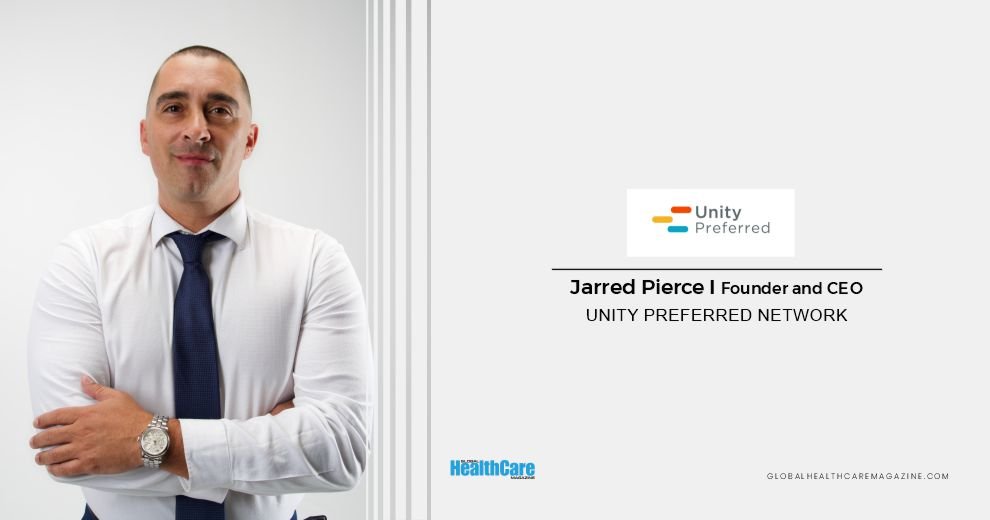
There is something worth noting about people who find their calling early: they tend not to let go of it. Jarred Pierce was seventeen years old when he first walked into the healthcare industry, and the industry, as it turned out, never quite let go of him either.
Twenty-four years later, he is the Founder and CEO of Unity Preferred Network, a company built on the conviction that healthcare networking had grown far too comfortable with its own dysfunction. He had watched legacy systems calcify, transparency vanish, and both providers and members quietly absorb costs that nobody seemed willing to challenge. So he decided to challenge them himself.
The career that led him here was not narrow. Jarred worked across the provider field, network development, billing, and healthcare education, gathering the kind of layered, ground-level understanding that cannot easily be acquired from a single vantage point. He moved through the industry the way a careful reader moves through a complicated text: slowly, attentively, with the intention of understanding what lies beneath the surface.
“I’ve had the advantage of working across all sectors of the industry,” he says. “This experience allowed me to identify systemic issues from every angle and develop a model designed to benefit all parties involved.”
It was that accumulated perspective, not any single revelation, that eventually made Unity inevitable.
The Problem No One Was Solving
By the time Jarred was ready to build something of his own, the healthcare networking space had settled into a kind of institutional inertia. Legacy networks had stopped innovating. Oversaturation had set in. The cost-containment tools that were supposed to protect people from financial strain had themselves become sources of it, burdening both providers and members while administrative fees for employer groups continued to climb.
And then there was the transparency problem. Medical claim repricing had become a process that obscured more than it revealed, delivering overpriced services with little accountability to anyone.
“I observed legacy networks failing to evolve, becoming oversaturated and increasingly dependent on solutions that created financial strain for both providers and members,” he explains. “I witnessed a lack of transparency in medical claim repricing, which only offered overpriced services.”
Unity was created specifically to answer these failures. The goal was not to create just another version of what already existed. It was to build something the industry had not yet managed to build: a network that genuinely worked for all parties, one that would improve the member experience, ensure provider satisfaction, reduce administrative fees, and bring what he calls true “Unity” to every stakeholder involved.
Not Another Discount Network
One of the first obstacles Jarred encountered when introducing Unity to the market was a familiar kind of skepticism. Providers had been burned before. The assumption was that a new network would simply be a new discount network, what the industry calls a “PPO network,” a structure that aggregates discounts but fails to deliver meaningful patient volume or steer members toward participating providers.
He understood where that skepticism came from. The industry had, in many ways, earned it.
“A common misconception among providers is that we are simply a ‘discount network’ that fails to bring new volume or steer members to their centers,” he says. “I understood that the industry did not need another ‘PPO network.’”
Unity’s answer to this was structural. Rather than taking the conventional path, the company focused on selling directly to innovative health plans and TPAs that were already looking for a better way forward. This allowed Unity to customize its network to the specific needs of members, while building in real incentives for utilization.
Crucially, Unity is clearly identified on the member ID card. Members know where to go to benefit from meaningful patient volume. The contrast with older models, and with the access problems common to Reference Based Pricing, is not subtle. It is the kind of difference that shows up immediately, in practice, in ways both providers and members notice.
The Architecture of Trust
At the center of everything Unity does is a principle that sounds simple and proves, in execution, to be genuinely difficult: transparency.
The company’s operating philosophy is to create what Jarred describes as a simple and friendly ecosystem, one that clearly defines objectives and responsibilities for every party involved. Competitors, he notes, often avoid this level of openness, and the reason is not mysterious. Transparency exposes conflicting incentives, and many business models continue to rely on those conflicts remaining hidden.
“While many competitors avoid this level of transparency due to potential strain from conflicting incentives, we believe it is the only viable approach,” he says. “We recognize that this standard is difficult to achieve, but it remains our primary commitment and something we will not change.”
There is a quiet firmness in that last sentence. Not a boast, but a line drawn in the ground, a statement about character as much as strategy. Unity’s goal is to be the preferred choice for value and fair pricing for all parties involved, and he speaks about that goal the way people speak about things they have decided are non-negotiable.
The People Behind the Vision
Jarred is candid about something important: he did not build this alone. The team he assembled around Unity reflects the same cross-sector depth of understanding that defined his own career.
Charlie Hildebrand, Unity’s President, has developed healthcare solutions that became industry standards. He has also built two companies that each resulted in successful nine-figure exits, a track record that speaks to both his vision and his ability to execute it.
Morgan Smith, the COO, helped develop the largest bundled surgery network in the country, a platform responsible for funding hundreds of millions of dollars across the healthcare sector.
Lisa Rock brings more than thirty years of experience negotiating managed care agreements and advocating against silent PPO networks and Reference Based Pricing companies. She built one of the largest revenue cycle management and billing companies in the country, working with thousands of surgery centers and hospitals over the course of her career.
EVPs Baek Kim and Matthew Jacobs contribute a combined forty-five years of experience in building national healthcare networks and cost-containment solutions.
“I am fortunate to be surrounded by some of the industry’s most accomplished leaders,” he says.
It is not false modesty. The composition of his leadership team is itself an argument for what Unity is trying to do, assembling people who have operated at the highest levels of every relevant discipline, from billing and revenue cycle management to network construction and cost containment.
The Daily Work of Building Something Real
Ask Jarred what his days look like, and the answer reveals a leader who has not allowed success to create distance between himself and the work.
He still speaks directly with providers being considered for the network. He still takes calls from brokers, health plans, and TPAs. He is, by his own account, engaged in the business from the moment he wakes up until he goes to bed, not out of obligation, but out of something closer to vocation.
“I truly love what I do and am fully invested in understanding every role within the company,” he says.
This hands-on approach is not a relic of the startup phase. It is a deliberate leadership philosophy, grounded in twenty-four years of industry experience, that holds that proximity to the work is what keeps an organization honest. He also invites the same spirit of challenge from the people around him.
“I encourage my partners and staff to challenge me as well,” he says. “I believe this approach allows us to listen to our clients, diversify our model, and clearly identify the ‘Unity Difference’ compared to our competitors.”
It is a mode of leadership that resists the drift toward insularity, which is, perhaps, exactly what an organization built on transparency must demand of itself.
A Network in Motion
Unity tracks its progress with structure and intention, setting goals at monthly, quarterly, and yearly intervals across every department. And by the measure that matters most, the network is growing at a pace that exceeds even Jarred’s previous accomplishments.
“Our Provider Network is growing at an unprecedented pace, surpassing even the growth I achieved at my previous ventures,” he says.
That is a meaningful benchmark, coming from someone with two decades of network-building behind him. The growth reflects not only effective execution but also clear market validation: health plans, TPAs, and providers are finding in Unity something they could not find elsewhere.
The path forward involves continuing to expand partnerships with health plans and TPAs nationwide, deepening Unity’s presence as the primary partner in the cost-containment space, and delivering on what he describes as a seamless, noise-free experience for the provider community.
Beyond that, there are initiatives currently in development that he is not yet ready to name publicly. New dimensions to Unity’s role in the industry are being planned, with releases expected in the coming years.
“You’ll have to stay tuned to see the progress,” he says, with the ease of someone who is not anxious about what he is building toward.
Passion, Family, and the Long Game
Outside the office, Jarred travels when time allows. He cooks, stays active through the gym, volleyball, and golf, and is deliberate about time with his family. These interests remain important to him. But he is honest about where the center of gravity sits right now.
“I am fully committed to growing this company for the benefit of my family, partners, employees, and the healthcare industry,” he says.
The story of Unity is also, in its way, a story about withstanding doubt. Before the company launched, there were voices that questioned the premise. Why pursue this? Did he truly believe he could start a new network? Did he understand how hard it would be?
He understood. He built it anyway.
“I chose to ignore the doubt and instead focused on my own capabilities and goals,” he says. “For some, this journey may have been viewed as a gamble filled with struggles and nonstop stress, but I saw it as just the challenge I needed.”
There is something worth sitting with in that reframing. What looks, from the outside, like a gamble felt, from the inside, like a necessary challenge. The difference between those two perspectives is not recklessness or naivety. It is the kind of clarity that comes from knowing, precisely and specifically, what problem you are there to solve, and believing, without flinching, that you are the one to solve it.
That belief, more than any strategy or structure, may be the most defining thing about Jarred Pierce. And in the end, it is the foundation upon which Unity was built.
Quotes
Also Read: The Most Visionary Healthcare CEOs of 2026