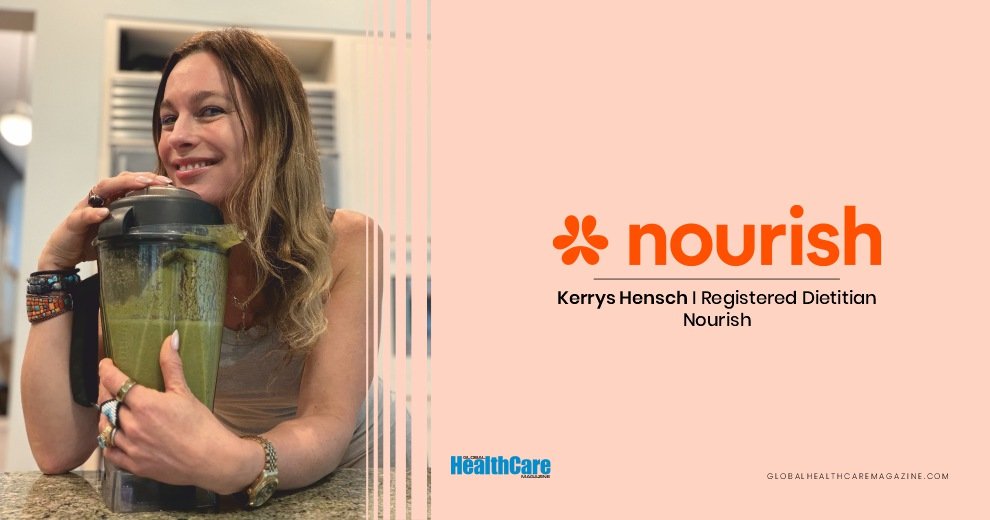
There is an exercise that Kerrys Hensch loves to guide her clients through, and it involves a single raisin. The client holds it. They look at it. They notice its weight, its texture, the way it catches the light. They bring it slowly to their lips, and only then do they eat it. It takes far longer than any raisin has a right to. That, Kerrys will tell you, is precisely the point.
“It highlights how often we rush through meals without fully experiencing them,” she says, with the kind of quiet conviction that makes you feel you have been doing everything wrong your whole life and, simultaneously, that it is perfectly fine because you can begin again right now.
This is the particular gift of Kerrys Hensch, a Registered Dietitian at Nourish, the founder of the Satiated Life App, a certified Well-Nourished Life Coach, and a Flow Breathwork Facilitator with a Master of Science in Clinical Nutrition from New York University. She has spent her career turning the most fundamental human act, the act of eating, into something intentional, something felt, something that reaches well beyond the plate.
A Story That Began Across the Ocean
To understand what drives her, you have to go back to Wales.
Kerrys was born there, raised between two cultures, and eventually brought to California as a child, where she absorbed American life with the openness of someone encountering it for the first time. But back home, something was quietly unraveling. Her father was struggling. Stress, smoking, drinking, and steadily declining health were taking their toll, and the weight of it pressed down on the entire family. He had multiple heart attacks.
“Those experiences inspired my lifelong passion for health, wellness, and helping others live healthier lives,” she reflects. The family eventually moved back to Wales, seeking the support of the community and the access that free healthcare could offer. Her father improved some of his habits over time, though the health challenges never fully retreated.
What stayed with her, far longer than any geography, was the lesson she absorbed as a young girl watching someone she loved suffer the consequences of how he lived. Lifestyle choices, she understood early, not only touch the person, but also make them. They ripple outward to everyone in the room.
That knowledge became the architecture of everything she would later build.
Becoming Who She Was Always Going to Be
In 2009, Kerrys became a Registered Dietitian. She was, at the time, in the middle of raising four children, a detail she mentions without drama but which tells you something essential about her relationship with difficulty. She does not wait for the right moment. She finds nutrition in the moment she is already in.
She went on to complete her dietetic internship at New York Presbyterian Hospital, then earned her Master of Science in Clinical Nutrition at NYU. She became certified in MB-Eat, a mindfulness-based eating program. She trained as a Flow Breathwork Facilitator. She became a Well-Nourished Life Coach.
Each credential was not simply an addition to a resume. Each one was a door she opened because she believed something important was waiting on the other side.
The throughline in all of it is mindfulness. The idea that the body, the breath, and the moment of eating are not separate territories to be managed independently, but a single, connected experience that deserves attention.
What She Finds in the Room
Kerrys sees approximately six clients a day at Nourish, where she offers flexible telehealth nutrition coaching. The virtual format is intentional. It removes barriers, makes the work accessible, and meets people where they are, in their kitchens, their offices, the corners of their lives where wellness either takes root or does not.
What she consistently finds, regardless of background or circumstance, is a cluster of the same misconceptions.
“Many people believe being healthy means following a restrictive low-carb or low-fat diet,” she says. The fitness and wellness industry, with its relentless appetite for the next framework, the next elimination protocol, the next transformation challenge, has done enormous damage to the way ordinary people think about food. She spends a meaningful portion of her work carefully dismantling those beliefs.
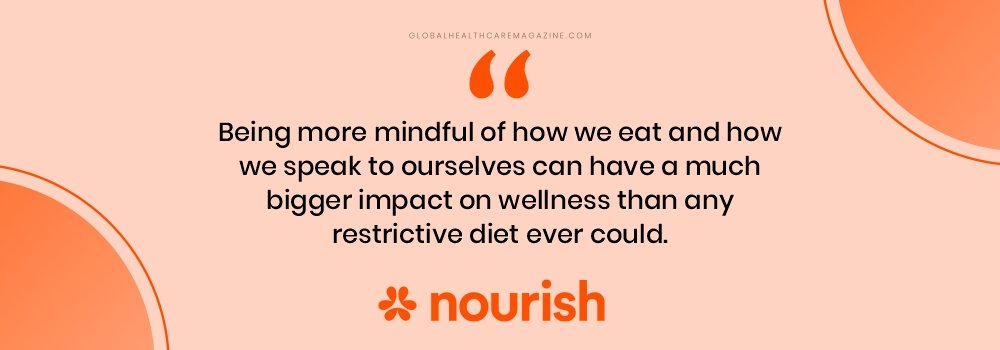
In her view, greater self-awareness and intentional eating habits can have a much bigger impact on wellness than any dietary category.
The problem with multitasking while eating, she explains, is that it severs the connection between consumption and satisfaction. When we are not present with our food, we miss the enjoyment. And when enjoyment is missing, we tend to go looking for it elsewhere, in ways that do not always serve us. This is not a vague philosophical preference. It is, for her, a clinical observation drawn from years of sitting across from people who are eating plenty but feeling empty.
The Method Behind the Mindfulness
Her approach is grounded in both evidence and empathy, and the balance between those two things is where her methodology becomes distinctive.
When a new client arrives, Kerrys begins not with a meal plan but with a conversation. She takes time to understand their history, their goals, and what genuinely motivates them. From there, she starts with blood work. She believes blood work provides valuable insight that complements a client’s self-reported habits and experiences.
Then come the habits. Small ones, built slowly. Weekly SMART goals and regular check-ins create the structure through which change becomes possible without becoming overwhelming. Every three months, labs are retested. “This helps clients see how consistent small changes can lead to meaningful improvements in their health and overall wellness,” she explains.
The goal is never rapid transformation. The goal is a life the client can actually live. She helps people move away from the all-or-nothing mindset, toward a more realistic and adaptable approach to wellness that fits everyday life.
For clients who carry more than nutritional weight into the room, which is to say, clients carrying emotional, spiritual, or relational weight alongside their wellness concerns, she takes a whole-body approach. She considers emotional, spiritual, social, and artistic fulfillment as part of the picture because imbalances in those areas can directly influence how and why people eat. At Nourish, she can refer clients to other healthcare specialists, and she recognizes the value that cognitive behavioral therapy can bring as a complement to nutrition care.
“Sometimes, instead of turning to food for comfort, there may be a more nourishing solution: a creative outlet, social interactions, or guidance from another healthcare provider,” she notes.
The Morning Before the Sessions Begin
There is a version of Kerrys that exists before the first client of the day, and it is worth describing, because it is inseparable from the professional she becomes by mid-morning.
She begins early. Meditation comes first. Then movement. Then nourishing food, dog walks, time with her children, yoga, and breathwork. By the time she opens her first session, she has already created a grounded and intentional start to her day.
“My mornings are built around non-negotiable routines that keep me grounded and energized so I can best support others,” she says.
This is not incidental. It is, in fact, the model she offers her clients: that wellness is not something you add to your day when you have time, but something woven into its beginning, its rhythm, its texture. She practices what she teaches, not because it makes for a tidy story, but because she has found it to be true.
The Pandemic, the App, and the Screenplays
During the pandemic, Kerrys was a mother of four navigating remote learning and the particular uncertainty of a world that had stopped making sense. She did what she has always done in difficult terrain: she built something.
The Satiated Life App was born from that period. Designed to create balance and structure during a time when both felt impossible, the app guides users through simple daily habits: meditation, journaling, hydration, self-care, and nourishing the body with anti-inflammatory foods. The premise is modest and serious at once. Small, consistent steps, taken daily, create balance, mindfulness, and healthier routines over time.
The pandemic also deepened her education in mindful eating and wellness practices, and it unlocked something she had not expected. “Creativity.”
She began studying modern screenwriting at New York University’s Tisch School of the Arts online. She now writes screenplays in her spare time. It is a detail that surprises people, and then, after a moment, makes complete sense. A woman who teaches presence, who believes in the nourishing power of artistic fulfillment, who built a wellness app during one of the most disorienting periods in modern history, of course, she writes.
The Measure of the Work
Ask Kerrys about her achievements, and she lists them with the same matter-of-fact quality she brings to everything.
The internship at New York Presbyterian. The master’s at NYU. The MB-Eat certification. Becoming a Well-Nourished Life Coach. Designing the Satiated Life App. Becoming a Flow Breathwork Facilitator. Raising four happy, healthy teenagers. Completing her first six months at Nourish.
It is a list that moves between the professional and the personal without embarrassment, because for her, they are not separate categories. The four teenagers are as much a part of her professional identity as the clinical credentials. They reflect the values she tries to live by every day. That a person can be deeply engaged in the work of caring for others while also doing the harder, less glamorous work of caring for themselves and the people closest to them.
She has learned, over the years, not to become attached to outcomes. “Lasting wellness is about the journey, and everyone moves at their own pace,” she says.
Clients begin with weekly or biweekly check-ins. Over time, as habits solidify and confidence builds, they transition to monthly and then yearly support. The relationship stretches and adjusts because wellness is not a destination you arrive at and then leave behind. It is an ongoing practice, quietly maintained.
The Future She Hopes For
Kerrys speaks about the future with a kind of measured optimism, the optimism of someone who has seen what is possible when people are given the right support.
She is glad, she says, to see growing awareness around the impact of nutrition on health. She is troubled by how much of today’s food supply lacks true nourishment. She hopes that nutrition education and counseling become more accessible and that they eventually become part of the core school curriculum.
“I dream of a future where many preventable illnesses related to poor nutrition and inactivity are greatly reduced, allowing future generations to grow up healthier and happier,” she says.
She intends to keep leading by example, staying current with the latest research, and reminding people that health looks different for everyone. That the road is wide and forgiving and available to anyone who chooses to walk it.
What She Wants You to Know
At the end of a conversation with Kerrys Hensch, you are left with something. Not a meal plan or a supplement recommendation or a list of foods to avoid. You are left with a feeling, quiet and unhurried, that you might be worth a little more attention than you have been giving yourself.
Her philosophy, distilled to its essence, belongs to no dietary school or wellness movement. It is simply this:
“It’s never too late to start your journey. You deserve to enjoy this life. When you feel good, everything feels better. No one will take care of you the way you can. Self-care is essential. Every small change you make, no matter how minor, leads to progress.”
She says it the way people say things they have earned the right to say, not from a book, but from a childhood spent watching someone she loved suffer the cost of ignoring it, from a career spent sitting with people who are trying to reconnect with healthier, more intentional lives, and from a life built, morning by careful morning, around the conviction that how we treat ourselves is not a trivial matter. It never was.
Quotes
Also Read: The Visionary Leaders in Nutrition, Fitness & Wellness of 2026