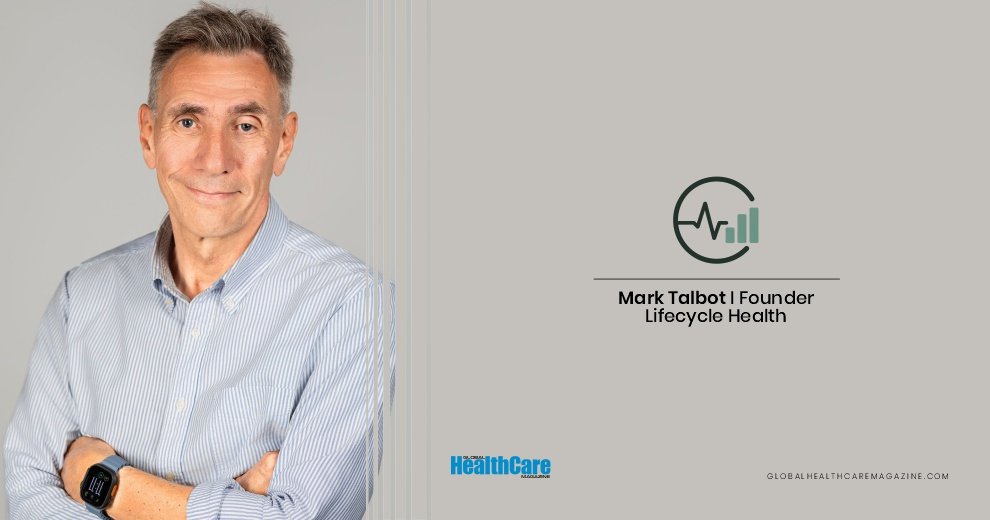
A bathroom scale is a small, unassuming object. It sits in a corner, mostly ignored, until the morning it delivers a number you were not expecting. For Mark Talbot, that number was 204 pounds, the heaviest he had ever weighed, and it arrived on an otherwise ordinary morning nine months before this interview took place. He was not a healthcare executive. He had spent two decades building businesses in technology, commercial strategy, and SaaS, an industry fluent in dashboards, pipelines, and metrics, but entirely unfamiliar with the particular arithmetic of a human body. That morning, standing on the scale, the two worlds collided.
Mark is now the Founder of Lifecycle Health, a platform built to bring together the scattered signals of a person’s physical life, sleep, nutrition, movement, cardiovascular data, recovery, and training into something a person, or the professional guiding them, can actually read and act on. It is a company that did not begin in a boardroom or a pitch deck. It began, by his own account, with dumbbells in a spare room and a watch on his wrist.
A Scale, a Staircase, and a Stubborn Number
Mark’s account of the beginning is almost disarmingly plain. He started training at home, using dumbbells, an Apple Watch, and workout videos, the ordinary toolkit of someone trying to reverse a bad morning. Two weeks in, he broke his foot on the stairs. The setback cost him nearly a month of progress, and he had to start over.
“Eventually the weight came off, my fitness improved, and I felt great,” he says. “Then at around 189 lbs, everything stopped.”
For three weeks, the number would not move. He became so convinced that his scale had failed him that he bought a second one, hoping for a different verdict. It gave him the same answer. The scales were not broken. His understanding of the problem was.
That frustration, mundane and deeply relatable, is the exact seed from which Lifecycle Health grew. It is worth pausing on this, because it is rare for a health technology founder to describe his origin not as a grand epiphany but as an argument with a bathroom scale that he ultimately lost.
The Dashboard That Asked a Better Question
What Mark had, at that plateaued moment, was not a shortage of data. It was an abundance of it, scattered across incompatible silos. His Apple Watch tracked one slice of his life. Lose It! tracked another. His Withings scales offered a third angle, and Apple Health held whatever the others had not already claimed. Each app was competent at its own narrow task. None of them, together or apart, could answer the only question he actually cared about.
“Why has my weight stopped moving?”
So he built a dashboard. Not a company, not yet, just a way of seeing his own information in one place. The answer, once it was visible, turned out to be almost embarrassingly simple: his training was consistent, his nutrition was broadly on track, but he was not moving enough during the rest of his day. He pushed his walking up to roughly 10,000 steps and, over the following three weeks, lost another four pounds.
It is a small, specific detail, the kind he returns to often, and it marks the moment the idea shifted shape in his mind. A personal fix had revealed something structural: the health data ecosystem was full of fragments, and nobody had built the connective tissue between them.
What the Platform Actually Does
The platform, as Mark describes it, is organised around four categories of signal: body composition, exercise, recovery and nutrition. The premise is that no single metric tells the whole story, and that the interesting information often lives in the space between numbers rather than inside any one of them.
Weight, Mark points out, might hold steady while body composition quietly improves underneath it. Nutrition might look adequate on paper while protein intake consistently falls short. Training volume might climb even as sleep and recovery slide in the opposite direction. The company’s task is to connect those threads and track them over time, rather than presenting them as isolated readings on a given day.
That longitudinal view, he says, has pulled the product beyond the problem he originally built it to solve. What started as a personal fix now has, in his words, real potential for the professionals who need to understand what happens to a person between the moments they actually see them.
Where Artificial Intelligence Fits, and Where It Stops
Ask Mark about the role of artificial intelligence in his platform, and he draws a firm, almost architectural line. “AI is an interpretation layer, not a replacement for human judgement.”
The technology’s job, as he frames it, is to examine multiple signals simultaneously and surface patterns that are difficult to see when the same information sits scattered across separate systems. For an individual, that might mean understanding what changed, what is going well, and what deserves attention. For a professional, it means turning a long-running stream of information into a focused view of what matters now, rather than another wall of raw numbers.
The company has built out its next chapter, which he calls Specialist Care. The company’s stated focus is private, permissioned AI that works only with authorised data and maintains a clear line back to where that information originated. Mark is explicit and unambiguous about the platform’s limits: Lifecycle Health does not diagnose, treat, or prescribe. Everything it surfaces is illustrative and non-diagnostic, not a substitute for a clinician. The goal, he says, is better information and better-informed conversations, nothing more, and nothing less.
Privacy as Architecture, Not Afterthought
Health information is, by nature, intimate. Mark treats that fact as a design constraint rather than a compliance checkbox. “Privacy has been an architectural principle from the beginning,” he says. The platform is built to minimise what needs to leave a user’s environment, and health information is deliberately kept separate from the systems that manage authentication and subscription billing.
As the company extends into Specialist Care, those architectural choices become more consequential. Permissioning, tenant separation, auditability, and control all matter more once practitioners are involved, because a practitioner should only ever see the information they are authorised to see. His summary of the philosophy is characteristically direct: trust cannot simply be a paragraph in a privacy policy. It has to be built into the product itself.
Filling the Gap Between Appointments
The clearest articulation of what Lifecycle Health is actually for comes when Mark describes the working life of a specialist. A practitioner, he notes, typically sees only a tiny fraction of somebody’s life. A specialist might see a patient periodically. A nutritionist might check in every few weeks. Between those moments, the person’s body keeps generating information regardless of whether anyone is watching.
He offers a handful of concrete examples: a cardiovascular specialist gaining longitudinal context on activity, heart rate trends, and recovery between consultations. A menopause specialist observing changes across sleep, activity, and body composition over time. A nutrition professional able to verify whether an agreed behavioural change is actually showing up in the data, rather than relying on a patient’s memory of the past few weeks.
“The platform helps fill that gap,” he says, “seeing activity, training, nutrition, body composition, sleep and recovery before a conversation, rather than just asking, ‘How did your week go?’” The intent, he stresses, is to give the professional a clearer picture of the period between visits, not to replace the professional’s expertise.
The Verticals Ahead
Traditional healthcare, in Mark’s framing, is necessarily episodic: an appointment, a conversation, then a gap of three to six months before the cycle repeats. In that interval, the body is generating data every minute of every day, captured piecemeal by wearables, smart scales, nutrition platforms, and other connected devices, and mostly left fragmented rather than assembled into something meaningful.
He identifies the areas where Specialist Care is headed: cardiovascular health, nutrition and weight management, rehabilitation and recovery, menopause and women’s health, and cystic fibrosis – not abstract priorities, but ones the leadership team has lived through personally. The company’s stated aim is to organise appropriate, permissioned information around the individual, making meaningful change easier to understand, rather than handing practitioners yet another dashboard cluttered with thousands of measurements.
Guarding Against Data Overload
It would be easy for a platform built on four categories of longitudinal health signal to collapse under its own complexity. Mark seems keenly aware of that risk. “More data doesn’t automatically mean more insight,” he says.
His argument is that people do not need another app explaining what an obscure readiness score technically means. What they want are answers to plain questions: How am I doing? What changed? Is what I am doing working? Is there something I should pay attention to? The complexity, in his view, should live underneath the surface, invisible to the user, while the experience itself stays simple.
The same principle, he adds, applies to professionals. The technology should absorb the complexity rather than pass it on, leaving practitioners free to focus on the person rather than deciphering the underlying measurements.
Two Audiences, One Underlying Dataset
Mark has learned, in building a platform meant to serve both individuals and professionals at once, that the underlying data can be nearly identical while the needs attached to it diverge sharply. Specialist practitioners require relevant longitudinal context, correct permissions, and confidence about where a given piece of information originated. Individuals want clarity above all else.
“One dashboard can’t serve all of that,” he says. It is a modest admission from someone building a single company to serve two audiences, but it is also, in its way, the most candid line in the entire conversation. The second lesson follows closely behind it: technology, in his view, should never become the centre of the relationship. Whether someone is working with a menopause specialist, a cardiologist, or a nutritionist, AI and data are meant to support that human relationship, not stand in for it.
From Personal Dashboard to Growing Company
What began as a private tool to explain a stalled weight loss has, by Mark’s account, moved with striking speed. Within weeks of its first version existing, people were signing up, professionals were testing it, and a team was forming around the idea. Lifecycle Health is in the process of bringing together a team of advisors whose expertise spans cardiovascular health, cystic fibrosis, menopause, nutrition, human performance, and wearable technology, a roster that is helping the company understand how far the platform can extend beyond the problem that originally inspired it.
His own numbers, the ones that started this entire story, have kept moving too. He is now nearly 30 pounds lighter, and by his own description, stronger and fitter than he has been since his twenties. “My weight stopped moving, and I wanted to understand why,” he says. “That problem became a dashboard. The dashboard became an application. The application became a product, and the product became a company.” The company, he adds, is still at the beginning of its journey, but the underlying principle has not shifted: without the data, a person is simply guessing.
What Comes Next
Wearable technology continues to sharpen its precision, heart rate variability, continuous glucose monitoring, and increasingly granular sleep staging, and Mark considers that progress genuinely useful. But he is careful to note that more sensors, on their own, only produce more raw data. Something still has to turn that data into an answer.
The larger shift he is watching is a change in what artificial intelligence is asked to do: moving from simply summarising what already happened toward helping shape what deserves attention next, delivered in a form that a specialist, or an individual, can actually act on. Within Specialist Care specifically, that means AI that is permissioned, traceable, and useful between appointments, something a cardiologist or a menopause specialist can trust to hold up between appointments.
Today, Lifecycle Health serves individuals, and the company has built out its Specialist Care platform, covering cardiovascular health, menopause, nutrition, rehabilitation, and conditions such as cystic fibrosis that carry personal weight for its leadership. The same non-medical boundaries, Mark is careful to note, hold throughout that expansion.
His longer-term ambition is disarmingly modest for a founder describing a health data company. He wants a weekly health review, for an individual or a specialist practitioner alike, to feel as ordinary as checking a bank balance: quick, clear, something a person acts on rather than something they stare at, puzzled. Get that right, he suggests, and people will spend less time decoding their own health data, and more time actually doing something about it.
Quotes
Also Read: Digital Health, AI-Powered Wellness & Health Data Innovation Leaders to Watch in 2026