At HCA Healthcare UK, London Spinal Surgery brings together four surgeons from a single, exacting tradition, united by the conviction that the best spinal care begins long before the first incision.
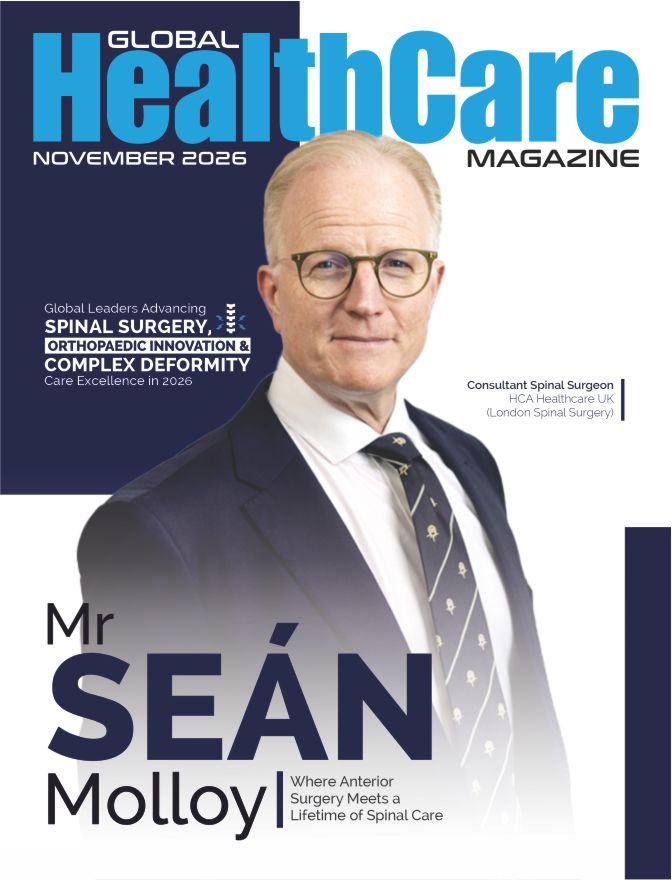
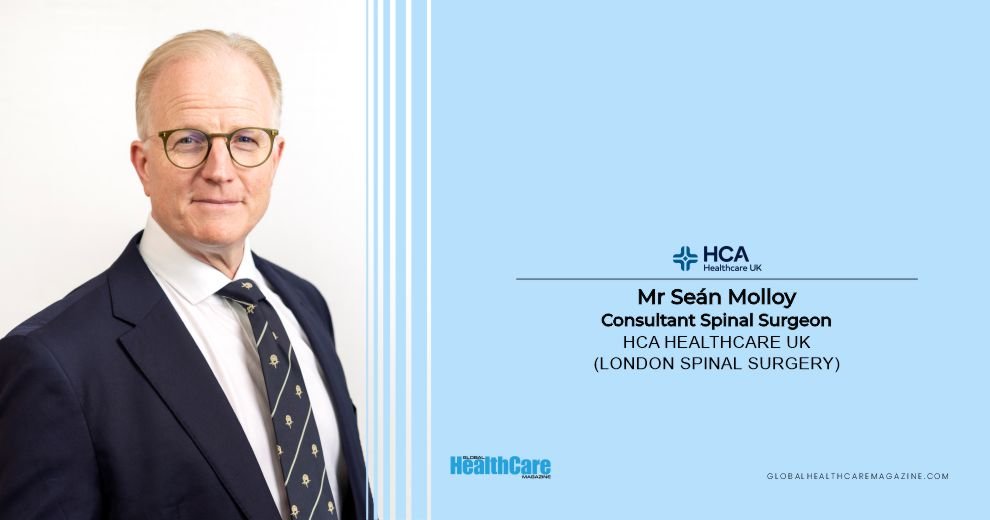
Complex spinal surgery demands technical precision, but precision alone is not enough. The best outcomes rest on an understanding of how spinal conditions emerge, evolve and change over a lifetime: through childhood, into adulthood and on into later life. That long view is the defining principle of London Spinal Surgery, a multidisciplinary practice that’s part of HCA Healthcare UK, led by Mr Seán Molloy, Consultant Spinal Surgeon, alongside fellow consultants Mr Jan Herzog, Mr John Afolayan and Mr Roozbeh Shafafy.
Under Mr Molloy’s leadership, the practice has built a reputation, nationally and internationally, for its work in spinal deformity and anterior spinal surgery. Yet what sets London Spinal Surgery apart is not the standing of any single surgeon. It is the strength of the team he has assembled, and the shared discipline with which its members think through every case long before an instrument is lifted.
A Team Forged at the Royal National Orthopaedic Hospital
Every surgeon in the practice trained at the Royal National Orthopaedic Hospital, an institution with a long and distinguished record of training surgeons in complex spinal reconstruction for patients of every age, from young children to the elderly.
That common grounding has given the group a shared philosophy: in how patients are assessed and investigated, in how surgical decisions are reached, and in knowing when not to operate at all. Having trained and worked closely together over many years under Mr Molloy’s guidance, the surgeons have developed closely aligned treatment algorithms and a consistent way of reasoning through difficult problems.
That alignment matters, because the team’s expertise is broad by design. It spans anterior and posterior approaches; cervical, thoracic and lumbar surgery; paediatric and adult deformity; complex reconstruction; revision surgery; and endoscopic spinal surgery. The team is a strong advocate of emerging technology, from computer-assisted and navigated surgery to minimally invasive techniques, and remains actively involved in research, adopting new approaches as the evidence supports them. Central to that commitment is a focus on advanced diagnostics and newer imaging modalities, including radiation-free imaging, all in the service of better outcomes.
A Practice Built Around the Whole Lifespan
London Spinal Surgery’s model is built around caring for patients from birth, through adulthood and into later life, underpinned by a deep understanding of how spinal conditions behave as patients age. That breadth allows every decision to be made with a patient’s whole lifetime in view, rather than treating each condition in isolation.
Diagnosis is approached with the same rigour as surgery. The team draws on advanced imaging and specialist radiological opinion to build a detailed picture of each patient’s anatomy and pathology before any treatment plan is agreed.
The conditions the group treats read almost as a map of the specialty: congenital spinal anomalies, degenerative disease, scoliosis and kyphosis, paediatric and adult deformity, complex revision cases, and both primary and secondary spinal tumours. Yet the length of the list matters less than the infrastructure built around it. Patients have access to specialist non-operative support from orthotists, radiologists and physiotherapists, all working within a genuinely multidisciplinary structure. Complex cases are approached through shared decision-making and, where appropriate, dual-consultant operating, with two senior surgeons working together to improve outcomes and reduce complications.
Precision as a Working Philosophy
The team’s collective experience in complex spinal surgery, scoliosis, navigation and robotics shapes its approach to precision technology.
Navigation improves the accuracy of spinal instrumentation, a critical consideration when working millimetres from the nerves and spinal cord. It guides precise screw placement and spinal fixation, and helps the surgeon identify and negotiate complex anatomy during the operation.
Minimally invasive techniques serve a related but distinct purpose. By reducing trauma to the surrounding tissues, they lessen post-operative pain, allow patients to mobilise sooner and support a faster recovery. Together, these approaches deliver greater accuracy, a lower risk of implant failure and fewer mechanical complications: a combination of particular value for older patients with reduced bone density who require complex reconstruction.
The Team Behind the Surgeon
London Spinal Surgery draws on the combined experience of a closely aligned team. Rather than dividing the specialty between them, all four surgeons share a common core of expertise, allowing the most complex cases to be planned and, where needed, operated on together.
That shared expertise centres on paediatric and adult spinal deformity surgery, degenerative spinal conditions and revision surgery. Degenerative and revision cases in particular often call for anterior, minimally invasive approaches, an area of real strength for the group and one that reflects the anterior surgical tradition Mr Molloy has long championed and passed on to his colleagues.
The team also undertakes cervical spine surgery, alongside decompression, microdiscectomy and other procedures for nerve compression and disc-related pain. Patients with these more common spinal conditions benefit from the same depth of experience, and the same careful decision-making, as those with the most complex deformities.
How the Multidisciplinary Model Works
The multidisciplinary model provides a structured forum in which difficult and complex cases are examined in detail. Expert radiologists contribute to the assessment, and the team can call on advanced diagnostic opinion to identify the less obvious factors that may shape a patient’s outcome.
This rigorous, analytical review ensures that each patient is guided towards the most appropriate treatment pathway, whether surgical or non-surgical.
Beyond the Operating Table
For a surgical practice, London Spinal Surgery places unusual emphasis on care that takes place away from the operating table. Its approach is holistic, centred on overall health rather than on surgery as the first resort. It extends to wellbeing, exercise, nutrition and the working environment, in recognition that spinal health is shaped by far more than what happens in theatre.
Patients are encouraged to take up exercise, yoga and Pilates as part of a broader management strategy, one that complements clinical treatment and supports wellbeing over the long term.
Staying at the Leading Edge of the Field
Every member of the practice remains actively engaged in continuing professional development, research and academic teaching. The surgeons regularly attend and speak at national and international courses and conferences, keeping them at the forefront of developments in spinal surgery, evidence-based practice and clinical research.
Having been shaped by one of the country’s great surgical training traditions, the team is equally committed to passing that knowledge on. Through postgraduate teaching, examination courses and the mentoring of surgeons in training, they are helping to shape the next generation of spinal surgeons.
The ambition is clear: to offer advanced, evidence-based treatment while remaining early adopters of new techniques and innovations that genuinely improve care.
What Comes Next
Asked about the future of London Spinal Surgery, Mr Molloy is ambitious yet precise. The practice intends to keep growing, with one clear purpose: to widen patient access to leading treatments and technology.
Several priorities stand out. Radiation-free imaging is one, including its integration into navigation workflows, a development of particular significance in the care of children. Anterior spinal reconstruction and adult deformity surgery remain central to the practice’s work, alongside anterior scoliosis surgery for younger patients.
The team also plans to collect patient-reported outcomes before and after surgery, building a clearer picture of how patients experience life after treatment. Further research is planned into fusion surgery for carefully selected patients with back pain, and into physiotherapy-led correction for certain forms of kyphosis.
The Philosophy That Holds It Together
If a single principle captures how London Spinal Surgery approaches its work, it is an unwavering commitment to treating the right patient, for the right indication, with the right operation.
Success, in the team’s view, rests on a chain of sound judgement: understanding the pathology, making careful decisions, selecting patients appropriately, choosing the correct procedure, and then delivering it with high-quality surgical execution and excellent postoperative care.
That, ultimately, is the purpose of London Spinal Surgery: to achieve the best possible outcomes through high-quality surgery, meticulous attention at every stage of the patient’s journey, and an exceptional experience of care.
Quote