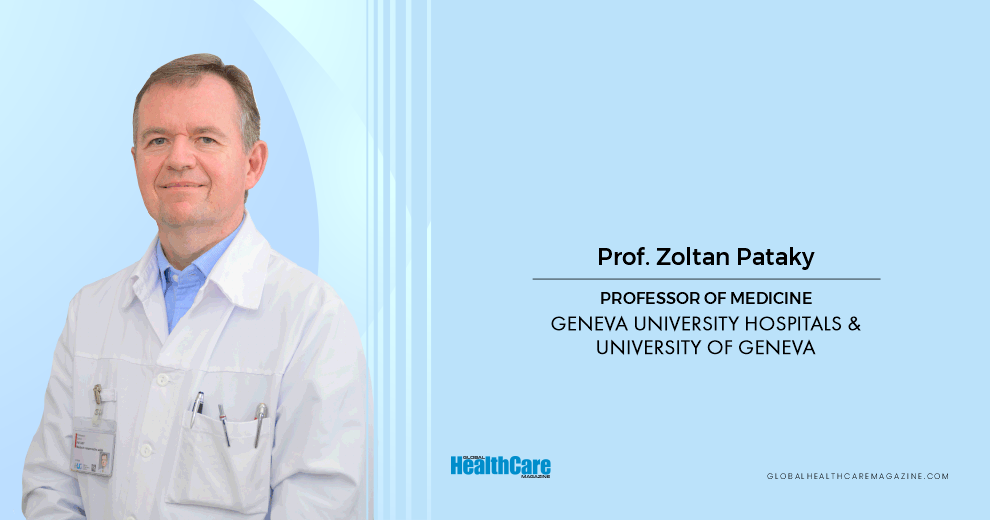
Set among the greenery of Geneva, an annex of the Geneva University Hospitals is home to a unit that has spent five decades challenging the way chronic disease is treated. The Unit of Therapeutic Patient Education was founded on a simple but transformative idea: patients should not merely receive care; they should be active partners in shaping it. For the past thirty years, Prof. Zoltan Pataky has carried that philosophy forward, building his career around a principle that remains at the heart of his work: before medicine can teach, it must first learn to listen.
Throughout his career, Prof. Pataky has built his work on a premise that still unsettles parts of modern medicine: that a person living with obesity or diabetes is not a set of symptoms to be corrected, but an expert partner whose own knowledge of their life is essential to treating them. Today he is a Professor of Medicine at Geneva University Hospitals (HUG) and the University of Geneva, Head of the Unit of Therapeutic Patient Education for Diabetes and Obesity and of the Adult Obesity Consultation at HUG, Director of the World Health Organization (WHO) Collaborating Centre for Reference and Research in the Field of Education and Long-Term Follow-up Strategies for Chronic Diseases, Director of the European Association for the Study of Obesity (EASO) Collaborating Centre for Obesity Management, and Director of the university’s Certificate and Diploma program in Therapeutic Patient Education.
It is a long list of titles for a man whose real interest, by his own account, has never been titles at all. It has been the quiet, unglamorous work of teaching medicine to listen and consider the patient as a partner.
An Inheritance of Ideas
Prof. Pataky did not invent the philosophy he now leads. He inherited it, and he has spent three decades sharpening it. His path, he says, turned decisively when he began working alongside Prof. Jean-Philippe Assal, who fifty years ago looked at medicine and diseases differently, centred on the person, not the disease.
Prof. Assal founded the Unit of Therapeutic Patient Education in 1975, bringing a humanistic, bio-psycho-social model into a field of diabetology that had been built almost entirely around acute care. In 1983, the Unit became a WHO Collaborating Centre for Reference and Research in the Field of Education and Long-Term Follow-up Strategies for Chronic Diseases, and in 1998, Prof. Assal led the World Health Organization’s first expert report on therapeutic patient education. The Unit later became an EASO Collaborating Centre for Obesity Management as well.
Prof. Pataky took over the Unit in 2021. The vision, he insists, has not moved an inch since Prof. Assal first sketched it out. Patients are expert partners, and every program the Unit runs for people living with diabetes and obesity is built on that partnership.
Redefining a Broken Model
Medicine keeps advancing, Prof. Pataky points out, yet the prevalence of chronic diseases continues to rise, even though many cases are preventable, because care remains built around an acute-care model that reaches only about 10 percent of patients. Chronic disease accounts for 80 to 90 percent of all outpatient consultations, and he believes it needs a wholly different approach, one that respects a patient’s own rhythm of life.
The misconception he encounters most often, he says, is that obesity is a matter of willpower, of ‘eat less, move more.’ It is not. Obesity, in his description, is a chronic, multifactorial disease shaped by biology, psychology and environment, and framing it as a personal failing is not just inaccurate. It is stigmatizing. The same holds true, he adds, for diabetes.
A subtler misconception, one that persists even among clinicians, is mistaking information for patient education. Explaining a treatment to a patient is not therapeutic patient education, he says. It isn’t; that’s simply information. Real education builds knowledge, skills, and confidence, and it requires health professionals to be structurally trained and involves changing their own attitude, replacing judgment with curiosity.
In his broader public commentary on the subject, he has pointed to a third pillar that is easy to miss in a clinic focused on food and movement: the emotional dimension of eating. People, he has explained, do not eat without reason. Certain foods can become a refuge on a stressful day, and treating that pattern as a moral failing only adds shame to an already difficult problem.
Five Steps to Partnership
Ask Prof. Pataky to describe his method, and he will not reach for jargon. He will describe a five-step process, developed together with the WHO: understand the patient’s full situation, help them set their own SMART goals, co-build a personalized plan around knowledge, skills, and confidence, support implementation, and reassess regularly as life changes.
The patient, in this framework, is never a recipient of instructions. Solutions, he believes, must come from the patient to be sustainable. What makes the approach effective over the long term, he says, is that it’s a continuous partnership woven into ongoing care, not an add-on to it.
Where Clinic, Research, and Classroom Meet
As Head of the Unit and of the adult obesity consultation, and through his directorships of both the WHO Collaborating Centre and the EASO Collaborating Centre, Prof. Pataky keeps clinical practice, research, and teaching feeding one another. Insights from consultations shape the Unit’s research questions, and findings feed directly into the postgraduate Certificate and Diploma programs he leads at the University of Geneva.
That loop, from clinic to research to education and back into clinical practice, is how what began as a local model in Geneva has become something other countries can adopt.
A Team, Not a Treatment
Day to day, Prof. Pataky coordinates an interdisciplinary team and oversees the Unit’s obesity and diabetes consultations and its training programs for patients. The team itself is sizable: more than 30 professionals, among them physicians, nurses, dietitians, psychologists, a physiotherapist, pedagogues specialized in adult pedagogy, an art therapist, and researchers, delivering around 7,000 outpatient consultations a year.
That diversity is deliberate, he explains. Durable change requires nutritional, psychological, physical, and pedagogical expertise working as one team around the patient. What he remains most passionate about, after thirty years, is still the direct contact itself: the moment someone moves from feeling judged or defeated to feeling understood and capable of change.
Milestones That Travelled Beyond Geneva
The Unit’s reputation has long since outgrown Switzerland. Since 1983, it has served as a WHO Collaborating Centre, and it holds parallel standing as an EASO reference centre for obesity management. The postgraduate Certificate and Diploma launched in 1998 remains, to Prof. Pataky’s knowledge, unique worldwide, training professionals from Switzerland and dozens of other countries.
With WHO EURO, the team updated the Introductory Guide to Therapeutic Patient Education in 2023, and with WHO EMRO co-developed a training curriculum in therapeutic patient education for people living with diabetes, training local trainers primarily in low- and middle-income countries. In an earlier interview, he described that the curriculum could reach trainers across some 22 countries in North Africa and the Gulf states, a region where diabetes is rising quickly.
The Unit, as he tells it, remains one of very few in Europe offering such a comprehensive, person-centred model rather than a purely pathology-centred one, combining individual and group support under one roof.
Beyond the Scale: Diabetic Feet and Prevention
Obesity and diabetes are not the whole of Prof. Pataky’s field. Diabetic foot and the prevention of amputation sit alongside them in his areas of expertise, a reminder that the multidisciplinary model he champions extends well past nutrition and psychology into the practical, often overlooked work of protecting a patient’s mobility and independence over time.
He has also served as Vice-President of the Swiss Association for the Study of Metabolic Diseases and Obesity, a role that placed him at the centre of Switzerland’s own professional conversation about how these diseases should be treated, well before that conversation became fashionable elsewhere.
The Fight to Stay Person-Centred
Leadership, for Prof. Pataky, has not been without its hurdles. A few years ago, he recalls, the Unit’s approach was challenged for not being, in his words, evidence-based, and his team faced pressure to shift toward a more traditional, assembly-line model of medicine.
He couldn’t accept that. It took nearly two years to convince his hospital’s managers that the Unit’s human-centred approach was correct, evidence-based, unique, and aligned with WHO recommendations. Proving that time spent listening to patients isn’t time wasted, inside a system built around short-term productivity targets, was, in his description, the real test, and it shaped how he leads ever since.
The New Medications, and Their Limits
Few subjects animate Prof. Pataky more than the arrival of a new generation of anti-obesity medications. He considers them a transformative advance, but insists they are most effective only when embedded within comprehensive, multidisciplinary care rather than prescribed on their own.
Drawing on his clinical experience and public educational work, he explained that drugs such as semaglutide and tirzepatide can help patients lose on the order of 15 to 20 percent of their initial body weight over a year to a year and a half, largely by acting on the brain’s reward system and normalizing satiety signals. He was equally direct about their limits: without addressing the underlying causes of the disease, patients often regain much of the lost weight once treatment stops.
For him, therapeutic patient education is not a soft complement to pharmacology. It is, in his view, as fundamental as pharmacological treatment in achieving outcomes that last. He is equally insistent that addressing weight stigma is not only a matter of equity and compassion; it is also essential to improving clinical outcomes themselves. The future of obesity and diabetes medicine, as he sees it, lies in personalized, evidence-based, multidisciplinary care tailored to each individual’s needs.
A Life Outside the Clinic
Balance, Prof. Pataky says, has always come naturally to him. His family, his parents, his loved ones come first, a rule he has kept since his first job, regardless of his position or his superiors. Outside the office, his time belongs to his children, his spouse, and to nature: hiking and photography, including developing black-and-white photographs the classical way, by hand.
Once your private life is solid, he says, work becomes a welcome complement, not the centre of everything.
Passing the Torch Forward
Looking ahead, Prof. Pataky’s priority is closing the gap between what the evidence shows and what patients actually receive. Obesity and diabetes, he warns, are becoming the defining chronic disease challenges of our time, and, like climate change, delay now means a higher cost later. He wants therapeutic patient education recognized as core to chronic disease care and taught earlier to doctors and other health professionals, who today receive very little training for chronicity.
In 2024, the Unit celebrated the 50th anniversary of therapeutic patient education in Geneva, and he had the privilege of welcoming Prof. Jean-Philippe Assal back to the very institution where his ideas first took root. Introducing him that day, Prof. Pataky says he realized something simple: leadership isn’t about being the most visible person in the room; it’s about carrying forward an idea that always puts patients first.
To learn more about Prof. Pataky’s work, including his clinical practice, research, educational programs, international collaborations, and recent media appearances on obesity and diabetes, visit www.zpataky.com.
Quote
Also Read: Global Leaders Advancing Obesity, Diabetes & Therapeutic Patient Education Excellence in 2026