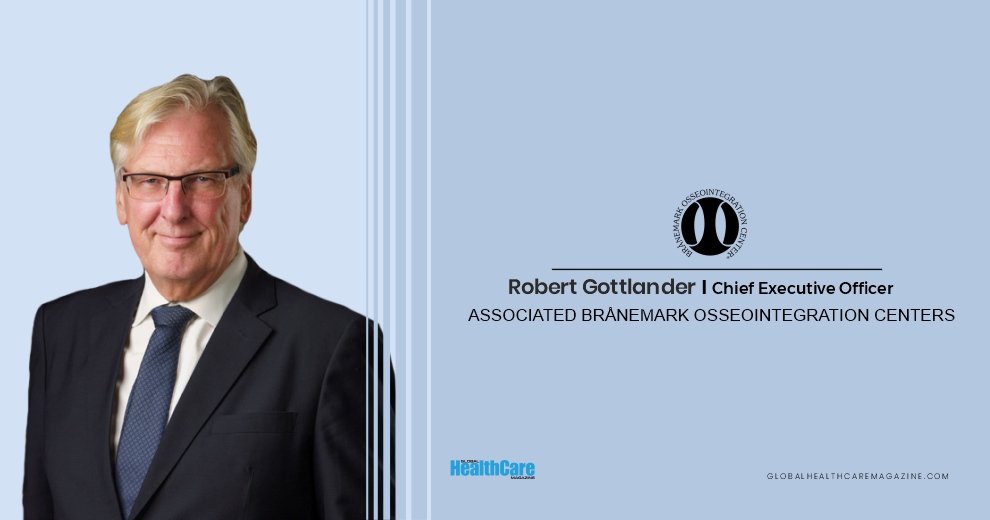
There are fields of medicine that transform patients in ways that are quiet but total. Not the dramatic interventions that make the evening news, but the ones that give someone back something so ordinary they had forgotten it was possible to miss it. The ability to eat without pain. To smile without thinking twice. To feel comfortable simply being themselves again. Osseointegration is one of those fields. And Robert Gottlander has spent his entire professional life making sure the world understands that.
The Student Who Met a Legend
In 1975, Robert Gottlander was a dental student at the University of Gothenburg’s School of Dentistry in Sweden. He was not yet someone with a career to speak of, not yet someone who had any reason to believe his path would diverge from the one most dentists walk. And then he met Professor Per-Ingvar Brånemark.
That encounter did not immediately change everything. It planted something. It was the kind of meeting that a person only understands in hindsight, when enough years have passed to see the shape of what followed.
By 1980, he had completed his dental degree at the University of Gothenburg. Shortly afterward, in his graduate training, he began conducting research on implants and orthodontics, and found himself drawn back into Brånemark’s world. What he observed in those early years was not simply a scientific procedure. It was the restoration of something deeply human.
“This sparked my interest in osseointegration, especially when I saw the impact these procedures had on patients,” he has said. “It truly transformed their lives.”
That observation, plain and unadorned as it is, became the quiet engine of everything that came after. From that point on, he left the clinical side of dentistry and committed himself entirely to spreading the word about osseointegration.
Employee Number Seven
In 1984, Robert joined Nobelpharma, the company through which Brånemark’s revolutionary science would reach the wider world. He was employee number seven. That detail is worth sitting with. Not because the number itself is remarkable, but because of what it means to arrive somewhere that early. It means the outcome is not yet written. It means you are building something that does not yet fully exist. It means that the belief required to show up is, in itself, a kind of courage.
His initial work at Nobelpharma centered on training professionals in implantology using osseointegration. This required more than clinical knowledge. It required the ability to make something deeply unfamiliar feel credible to people who were not yet sure it deserved their confidence, and there were many such people. The skepticism within the dental profession at that time was real and considerable. Colleagues doubted whether osseointegration worked at all.
“Over time, we succeeded, but it took many years,” he reflects.
It is a sentence that sounds almost offhand, but it contains within it years of patient advocacy, rigorous research, and the slow, grinding work of changing how a profession thinks.
Teaching a Profession to Believe
One of the most consequential things Robert did in the early years of his career is also one of the least visible. In the 1980s, he introduced osseointegration to 40 dental schools across the United States. That is not a footnote in the history of the field. That is the field, at the level where it actually takes root: in classrooms, in curricula, in the minds of practitioners who had not yet formed their assumptions.
He went further. He created a global university program designed to advance education and research in osseointegration and established guidelines for global education and conferences. Through these collective efforts, tens of thousands of professionals have received training.
This is work that does not generate awards in the conventional sense. It generates something more durable: a global community of practitioners who know what they are doing, and who understand why it matters.
He is direct about why this investment in knowledge is not optional. “The field is constantly evolving, making ongoing education essential. Treatment workflows today are very different from when I started in the early 1980s, and continuous learning is necessary to stay ahead.”
He has never stopped believing that.
A Philosophy Carried Forward
There is a sentence attributed to Professor Brånemark that Robert uses as both a compass and a standard. It is not a clinical guideline. It is a moral one: “No one should die with their teeth sitting in a glass of water.”
The image is stark and deliberately so. It is not about implants or biological bonding or surgical success rates. It is about dignity. About what it costs a person to live without something as fundamental as their own teeth, and about what it means to give that back. This is the philosophical backbone of the Associated Brånemark Osseointegration Centers (ABOC).
ABOC was established in 1989 in Gothenburg, Sweden, with a mission to offer exceptional treatment to patients facing severe oral and maxillofacial challenges. Robert, as the CEO, describes the organization’s vision with the same plainness that characterizes everything he says about his work: to deliver life-changing treatments, to handle all types of patient situations, and to diagnose and treat tooth loss with aesthetic, long-lasting, and predictable outcomes.
“The patient is always our primary focus,” he says.
It would be easy to read that as a slogan. It is not. It is a structural principle, embedded in how the organization operates and how he leads it.
The Architecture of Trust
ABOC is not built like a conventional corporate network. The clinics within it are individually owned and operated. Each one carries its own identity, its own leadership, its own daily rhythms. What unites them is not ownership but standards, and a shared understanding of what excellent patient care actually looks like at every stage of the journey.
Robert’s role within this structure is to set priorities, provide direction and support to both the group and the individual clinics, and to create and lead the projects that sustain patient treatment across them. The clinics engage in research, education, and publications alongside their daily clinical work.
He is measured and deliberate about what leadership means in a field that moves as quickly as this one does. “In day-to-day leadership within an evolving field, it is important to set direction and targets while allowing skilled colleagues the space to work toward them. Micromanagement in a rapidly changing environment can create more problems than it solves.”
This is not a passive philosophy. It is considered one, earned through years of watching what happens when talented people are either trusted or not trusted to exercise their expertise. The combined knowledge across ABOC’s clinics, he believes, is among the best in the world. That knowledge spans the entire patient journey, from the very first contact through active treatment and into the long-term aftercare that determines real clinical success.
“This comprehensive approach is essential for long-term success,” he says. “We actively share knowledge across clinics to ensure the highest standard of care.”
What He Is Most Proud Of
Robert does not speak about his accomplishments the way someone might who has spent decades accumulating them for their own sake. He speaks about them as evidence of what was possible when a group of people committed themselves to something larger than any individual career.
He is proud, he says, of having been one of the key contributors in the early development of osseointegration. Professor Brånemark conducted research for approximately 30 years before the field was commercialized. To have joined that effort at its commercial inception, as employee number seven at Nobelpharma, is something he holds with genuine weight.
But when he speaks about his milestones, the word he returns to is “education.” The 40 American dental schools. The global university program. The guidelines and conferences through which tens of thousands of professionals have been shaped. These are the things he values most.
“While I have been involved in many product developments, what I value most is not the products themselves, but what they enable for patients,” he says. “The patient is always at the center.”
The Future He Sees Coming
Robert does not speak about the future of osseointegration with the kind of uncritical enthusiasm that sometimes accompanies people who have staked their identity on a single idea. He speaks about it carefully, as someone who understands both the excitement of new technology and the irreducible primacy of biology.
“Biology remains fundamental. It is the foundation of osseointegration,” he says.
That grounding matters because the technological changes arriving in his field are significant. Advances in AI, robotics, software, and other digital tools are increasingly being applied to support clinical workflows. The procedures of the future, he believes, will be simpler and less traumatic for patients. Processes will become more predictable and more accessible.
And the demand, he is certain, will continue to grow. Global demographic and economic trends are pointing consistently in one direction: more people, living longer, needing these treatments, and increasingly positioned to access them.
The field that began with one scientist’s three decades of foundational research is now reaching into territory its founder could not have fully imagined. He stands in that space both as a guardian of the original vision and as a thoughtful guide toward what comes next.
A Life That Knows Its Own Edges
There is something worth understanding about people who have spent careers inside demanding, high-stakes disciplines: the best of them almost always know how to step away. They know the difference between presence and overextension, and they protect the former.
Robert and his family enjoy outdoor activities together, including boating, sailing, and skiing, as well as traveling. When time allows, he reads. These details are not incidental. They are the texture of a life that has remained, across more than four decades of professional intensity, genuinely inhabited.
“Work-life balance is very important, and it is essential to enjoy what you do,” he reflects. “It is not only about the amount of time spent, but also about being present in what you are doing.”
That word, present, is doing a great deal of work in that sentence. It describes what he asks of himself inside the clinic and what he asks of himself beyond it. And it is, perhaps, what has made both sustainable.
What He Wants the Field to Remember
If Robert were to leave one instruction for everyone working in osseointegration today, it would not be about technique. It would not be about which technology to adopt or which workflow to follow. It would be about orientation. About where to look when the decisions get hard.
“My most important message is that anyone working in osseointegration should always put the patient first. If you focus on products and workflows that genuinely help patients and meet their needs, they will seek treatment. This benefits the profession and, ultimately, also the companies involved.”
He has spent more than four decades building that belief into institutions. From a dental student who first met a visionary professor in 1975, to employee number seven at the company that commercialized a scientific revolution, to the CEO of ABOC, Robert Gottlander has helped transform osseointegration from a once-questioned concept into a globally respected standard of care.
Across every stage of that journey, his focus has remained remarkably consistent: improving lives by ensuring patients receive treatment grounded in knowledge, collaboration, and long-term care.
Quote
Also Read: The 10 Most Impactful Osseointegration Leaders to Watch in 2026