There is a part of every hospital that most people walk past without thinking twice. It sits behind the clinical floors, removed from the hush of recovery rooms and the careful rhythm of care. It is a world of coding, billing, claims submissions, denial queues, reimbursement timelines, and revenue ledgers. It is not, by most accounts, where you would expect to find a man with a philosophy.
But this is precisely where Sheldon A Pink began.
Early in his career, while working in a hospital business office, Sheldon witnessed something that would stay with him far longer than the position itself. He watched as fragmented financial workflows and administrative inefficiencies did something no clinician intended: they stood between patients and the care they needed. Not through negligence. Not through indifference. But through the quiet, grinding friction of systems that had never been built with the patient in mind.
That observation did not simply redirect his career. It gave it a purpose.
“Financial stewardship in healthcare,” he would later reflect, “is not about protecting margins. It is about protecting access.”
For more than 25 years, everything Sheldon has built has been in the service of that single conviction.
A Career Built on More Than Credentials
Sheldon holds an MBA, is a Fellow of the Healthcare Financial Management Association (FHFMA), and holds a Lean Six Sigma Black Belt (LSSBB). These are not decorative titles. They represent a particular kind of professional formation: one that insists on rigor as a precondition for compassion, and on precision as the foundation of good service.
Over more than two decades, he has advanced through leadership roles across some of the most demanding environments in American healthcare. Multi-billion-dollar academic medical centers. Integrated delivery networks. Faith-based health systems where the tension between financial performance and organizational mission is not an occasional point of friction, but a daily reality that leadership must navigate with both honesty and care.
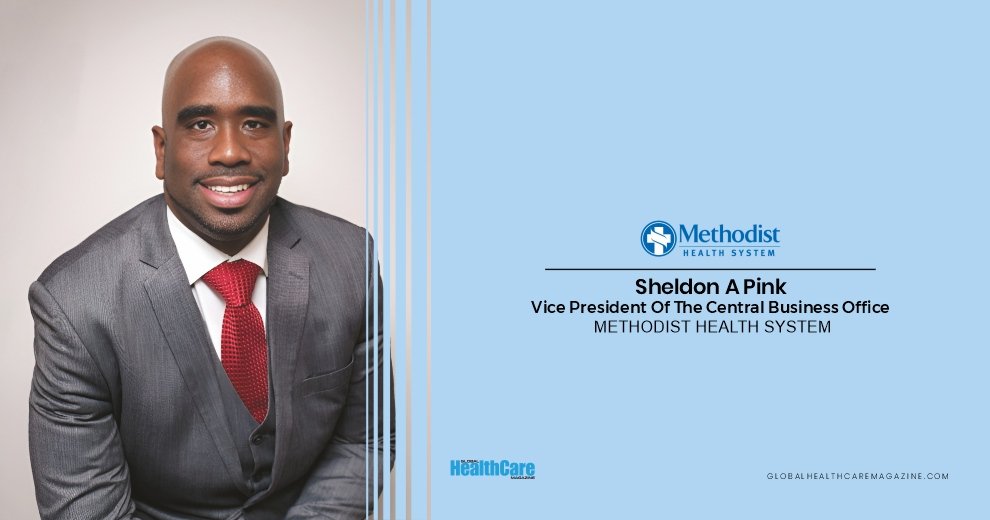
Today, Sheldon serves as Vice President of the Central Business Office at Methodist Health System, where he provides executive oversight for centralized revenue cycle strategy across a multi-hospital integrated delivery network.
His scope is broad and deliberate. He oversees performance governance, aligns financial and clinical leadership, and drives digital transformation initiatives designed to strengthen both financial sustainability and patient access. His responsibilities include accounts receivable governance, payer performance analytics, denial optimization, Project Management, and revenue technology strategy, including Epic optimization.
Over the course of his career, these efforts have generated more than $400 million in cumulative financial performance improvements.
That number is significant. But Sheldon would be quick to tell you it is not the point.
The Blind Spot No One Likes to Discuss
If you ask Sheldon what he considers the most persistent and underacknowledged problem in healthcare revenue cycle leadership today, he does not hesitate.
“The assumption that financial outcomes can be optimized within departmental boundaries’ he says. “That is one of the most common blind spots executives carry.”
It sounds simple. But its implications are far-reaching.
In the traditional organizational understanding, the revenue cycle is a downstream function. Claims go out. Payments come in. Denials are worked. It is treated in many institutions as a back-office operation: necessary but contained, managed at a remove from the strategic conversations happening at the executive table.
Sheldon sees it entirely differently.
In his view, the revenue cycle is a strategic infrastructure, as central to an organization’s ability to function as its clinical workforce or its technology platforms. When it is siloed, the entire enterprise suffers. Access suffers. Throughput suffers. And the trust between an organization and the communities it serves begins to erode quietly.
“Today’s healthcare environment requires revenue cycle leaders to function as enterprise integrators,” he explains, “partnering across clinical, operational, IT, and compliance domains:”
This is not a theoretical position. It is one he has lived, tested, and refined across every organization he has led.
What Alignment Actually Requires
The word “alignment” is often used in executive conversations. It is one of those terms that sounds self-evident until the moment you actually try to achieve it, at which point it reveals itself to be one of the most demanding and elusive things a leader can pursue.
Sheldon has thought carefully about why it fails, and why, in the right conditions, it holds.
“True alignment is achieved when leaders intentionally understand how financial decisions affect clinical workflows, workforce engagement, and patient experience,” he says.
The operative word, he will tell you, is intentionally.
It is not enough to convene clinical and financial leaders in the same room. Meaningful alignment requires translation: the ability to take a revenue strategy and articulate it in terms that resonate with a nurse manager, a compliance officer, or a frontline billing associate. Each stakeholder group speaks a different language. The leader’s job is to be fluent in all of them.
“When teams feel heard and see how their work contributes to mission-driven outcomes,” he notes, “alignment becomes durable rather than transactional.”
Durable alignment, in Sheldon’s framework, is what separates organizations that sustain improvement from those that achieve it briefly and then watch it dissolve. It is built through governance structures that function not as bureaucratic checkpoints, but as living forums where performance data is openly reviewed, shared goals are established, and innovative solutions are welcomed from every level of the organization.
Governance, he believes, “reinforces mission, clarifies decision rights, and enables leaders to respond proactively to financial and regulatory challenges.”
This is governance not as compliance, but as culture.
When the Work Gets Hard
There is a particular quality to the way Sheldon speaks about the hardest moments of his leadership. He does not dramatize them. He does not minimize them either. He simply describes what was required and what it taught him.
The most significant tests, he says, came during periods of large-scale organizational transformation, specifically when he was implementing automation and governance changes that challenged operational norms in place for years.
Anyone who has led change inside a large health system understands the particular weight of that kind of resistance. These are not merely procedural objections. They are expressions of identity, of habit, and in many cases, genuine fear of what the new way might mean for the people who mastered the old one.
“Successfully navigating resistance required transparency, education, and persistence,” Sheldon reflects.
No shortcuts. No mandates issued from above and left to land however they may. Instead, a sustained commitment to explaining the ‘why,’ building trust incrementally, and maintaining strategic focus even when the path forward offered no easy terrain.
These experiences did not merely test him. They refined something fundamental in his convictions: the belief that sustainable change depends on building trust, not simply building systems.
The Meaning of Stewardship
The word Sheldon returns to again and again across years of executive leadership and professional reflection is stewardship.
It is a word with weight. In its oldest sense, a steward is someone entrusted to care for what belongs to others. Sheldon applies it with full and deliberate awareness of that meaning.
“Results matter,” he has said, “but how they are achieved matters more.”
In mission-driven and faith-based healthcare environments, financial stewardship is, in his framing, inseparable from organizational purpose. The revenue cycle and the reason the hospital exists are not in tension. They are, when properly understood, expressions of the same obligation.
This philosophy shapes every dimension of how he builds and leads teams. He recruits not only for technical expertise but for cultural alignment and a growth mindset. He establishes clear expectations while providing structured development opportunities. He creates what he describes as environments “where accountability and support coexist.”
The downstream effects of this approach, he believes, show up not only in financial performance metrics but in organizational culture, in the confidence of caregivers, and ultimately in the communities that health systems are built to serve.
Developing the Leaders Who Come Next
Among all of Sheldon’s achievements, the one he speaks about with the most evident warmth is not a financial milestone. It is people.
Over the course of his career, he has mentored emerging healthcare leaders through significant professional transitions, guiding them into executive roles in revenue cycle, finance, and health information management. For him, this work represents something that balance sheets simply cannot capture: the deliberate strengthening of an industry’s leadership pipeline.
“Organizational success,” he says simply, “is ultimately sustained through people development.”
He is not naive about the difficulty of making this a priority. Leadership development in healthcare is complicated by the relentless pace of operational demands, and there is always a real risk that succession planning gets perpetually deferred in favor of the urgent over the important.
Sheldon has pushed against that tendency, intentionally and consistently, choosing to invest in the next generation even when the pressures of day-to-day performance would make it easy to delay.
It is, he will tell you, a long game. But it is the only game worth playing.
The Road Ahead
When Sheldon talks about the future of healthcare revenue cycle leadership, there is a particular clarity to his description. Not optimism for its own sake. Not an alarm, either. Simply a precise understanding of where the industry is headed, and what it will demand of the leaders who must take it there.
He envisions a future where Chief Revenue Cycle Officers and Senior Vice Presidents are not positioned at the periphery of executive decision-making, but at its center, influencing workforce design, technology investment, regulatory readiness, and system growth strategy in ways that extend well beyond traditional operational management.
The forces shaping this future are already fully in motion.
Regulatory expectations around price transparency are intensifying. Reimbursement models are shifting in ways that require organizations to be both agile and deeply prepared. Digital disruption is accelerating. Workforce dynamics continue to evolve in ways that no organization fully anticipated just a few years ago.
Sheldon’s response to these pressures is structural. He is focused on advancing standardized, technology-enabled financial frameworks, including automation and predictive analytics, to reduce administrative complexity and improve transparency for both patients and caregivers.
The goal, as he describes it, is to help health systems move from reactive revenue cycle management to proactive financial stewardship: from organizations that respond to financial pressure after it arrives, to organizations that anticipate it, prepare for it, and use that preparation to expand access rather than constrain it.
He is equally committed to academic and professional engagement, including teaching, research, and industry thought leadership, aimed at equipping the next generation of healthcare leaders with a fluent understanding of the strategic connection between financial stewardship and patient care.
“Revenue cycle and health information leadership,” he says, “are essential components of healthcare delivery. Financial stewardship enables organizations to invest in caregivers, expand services, and improve patient access.”
The vision is ambitious. But it is grounded, as everything Sheldon builds tends to be, in something he has believed since the very beginning: that the financial infrastructure of healthcare is not separate from its soul. It is what allows the soul to keep doing its work.
The Whole Person
For someone whose professional life centers on performance governance, enterprise transformation, and complex financial strategy, Sheldon maintains a remarkably grounded perspective on sustaining oneself over a long and demanding career.
He does not describe work-life balance as a clean separation between what happens inside the office and what happens beyond it.
“I view balance not as separation from work,” he says, “but as alignment with purpose.”
Outside of his executive responsibilities, he remains actively engaged through industry research, mentorship, and professional collaboration. He values time with family, community involvement, and what he calls continuous personal development. These are not stress-relief strategies. They are, in his understanding, extensions of the same intellectual curiosity and relational commitment that define how he leads.
Intellectual curiosity, he believes, is not a luxury for healthcare executives. It is a professional obligation, particularly in an industry where the connection between financial stewardship and clinical outcomes grows more complex and more consequential, with every passing year.
The Legacy He Is Building
There is a phrase Sheldon uses that captures, perhaps more than any credential or title, what he is ultimately working toward.
He speaks of healthcare organizations “where financial clarity strengthens compassion, where operational discipline enables access, and where future leaders are empowered to carry the responsibility of sustaining care for generations to come.”
It is a legacy statement. And it is a serious one.
In an industry navigating extraordinary and compounding pressure, Sheldon A Pink represents a particular kind of leader: one who refuses to separate the technical from the human, the financial from the compassionate, the discipline of today’s performance from the possibility of tomorrow’s reach.
He started in a hospital business office, noticing something that most people walked past without a second thought. He has spent 25 years doing something about it, one governance structure, one team, one emerging leader, one transformed system at a time.
“When revenue cycle leaders build transparent, resilient systems,” he reflects, “they are not just improving performance; they are preserving the ability of communities to receive care when it matters most.”
That is, in the end, what stewardship looks like when it is done right.
Quotes
Also Read: The 10 Most Impactful Healthcare Revenue Leaders to Watch in 2026