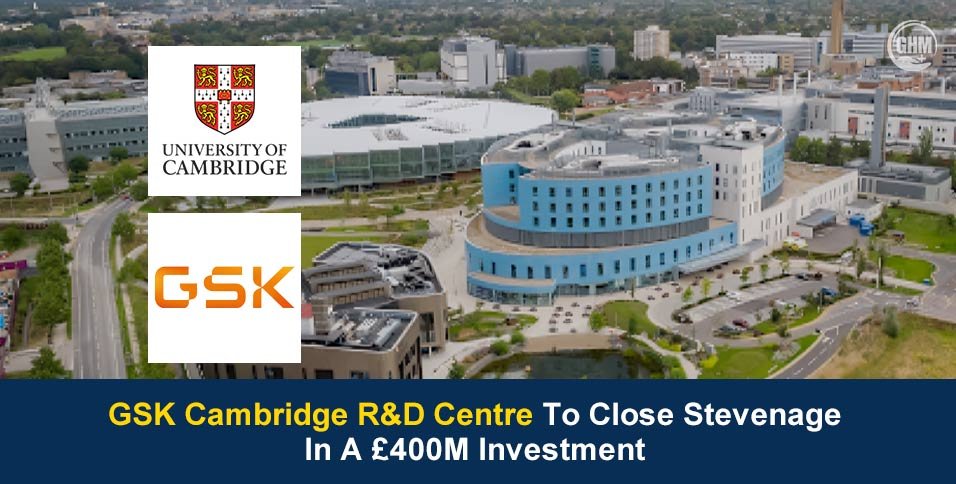
The pharmaceutical giant GSK has announced a £400 million investment to establish a flagship research and development facility on the Cambridge Biomedical Campus. The GSK Cambridge R&D Centre will relocate more than 1,000 scientists from the company’s Stevenage site by 2029 while strengthening its research presence in one of the world’s leading life sciences ecosystems.
This GSK Cambridge investment aims to accelerate medicine development through closer collaboration with universities, hospitals, biotechnology companies, and artificial intelligence (AI) research partners. Alongside the new facility, GSK will modernize its laboratories in Ware, Hertfordshire, while keeping its global headquarters in London unchanged.
GSK Cambridge Investment to Expand Research Pipeline
The new GSK Research Centre in Cambridge will span approximately 300,000 square feet and serve as the company’s primary UK research and development hub. Located within the Cambridge Biomedical Campus, the site is designed to bring scientists closer to clinical experts and academic researchers, helping translate laboratory discoveries into new medicines more quickly.
According to GSK, the new Cambridge research facility is intended to accelerate its research pipeline by integrating scientists into an ecosystem recognized for biomedical innovation.
Luke Miels, Chief Executive Officer of GSK, said, “This investment will accelerate our R&D and help us deliver new, competitive products. It integrates GSK further into one of the world’s leading centres of knowledge and demonstrates the attractiveness of the UK’s life sciences ecosystem.”
GSK plans to invest the £400 million over the next three years as part of its broader strategy to strengthen research capabilities across the UK.
GSK Cambridge R&D Centre to Become Primary Hub
The GSK Cambridge R&D Centre will be located on the Cambridge Biomedical Campus, one of Europe’s largest biomedical research campuses. More than 22,000 people work in life sciences on the campus, over 37,000 visitors arrive each day, and more than one million patients receive treatment there annually.
The campus also hosts over 470 biotechnology, pharmaceutical, and AI companies, creating an environment where researchers can collaborate more easily on new therapies.
Existing GSK and Cambridge partnerships already include collaborations in immunology, metabolic science, data-driven discovery, and aging research, alongside its Clinical Unit at Addenbrooke’s Hospital. This concentration of expertise is expected to support faster translational research.
Advanced Research Facilities to Support Future Medicines
The new GSK Cambridge research facility will feature advanced laboratories equipped with modern digital technologies to support research across several high-priority disease areas, including:
- Oncology (cancer)
- Respiratory diseases
- Hepatology (liver diseases)
- Vaccines
- HIV
Tony Wood, GSK’s Chief Scientific Officer, emphasized the importance of Cambridge’s scientific community.
“Cambridge has built one of the world’s best life sciences ecosystems, with leading universities, hospitals and biotech companies. The campus provides exceptional opportunities for collaboration. With our existing connections and experience, we see this move as a catalyst for faster, bolder medicines discovery.”
Beyond the new campus, the GSK Cambridge investment also includes upgrades to existing laboratories in Ware, creating a more integrated network supporting both medicine development and commercial manufacturing scale-up.
GSK Stevenage Closure Brings Transition for Employees
While the £400 million investment strengthens GSK’s research capabilities, it also marks the beginning of the closure of the Stevenage research hub. The company plans to vacate its Hertfordshire R&D site through a phased relocation, with operations expected to move by 2029. GSK said it hopes most employees will transition to Cambridge or its upgraded Ware laboratories, both of which are within commuting distance for many staff.
However, the announcement has raised concerns locally. Kevin Bonavia, Member of Parliament for Stevenage, described the decision as disappointing and expressed frustration over the limited engagement before the announcement.
“My first concern is with all GSK staff and families affected in Stevenage. While roles are set to move to sites that are commutable from Stevenage, this will still mean disruption for a significant number of people.”
He also pledged to work toward attracting new investment to the Stevenage site once GSK departs.
The Outlook
The GSK Cambridge R&D Centre will strengthen partnerships with leading organizations, including the University of Oxford, King’s College London, Imperial College London, the University of Manchester, Wellcome, and the Francis Crick Institute, to support scientific breakthroughs.
The GSK Cambridge Investment reinforces the UK’s position as a global destination for biomedical research at a time when countries are competing to attract pharmaceutical innovation and high-value scientific talent.