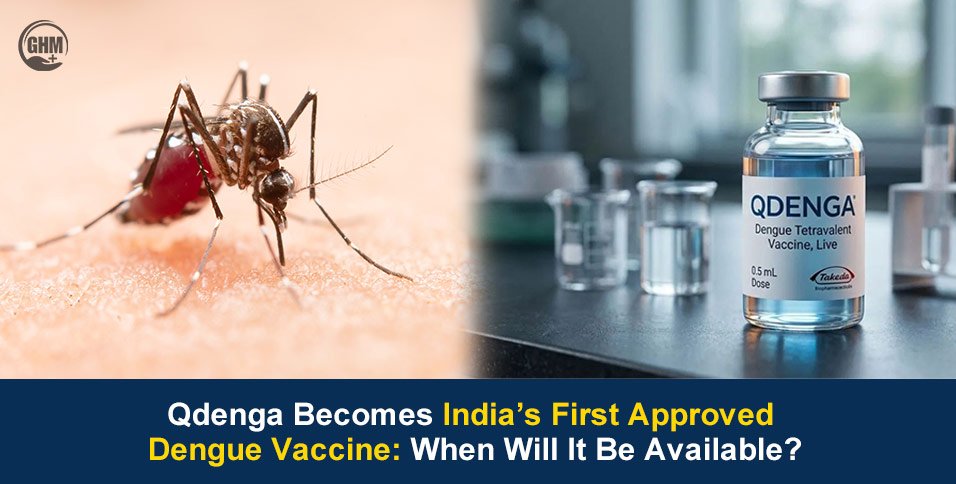
The Central Drugs Standard Control Organisation (CDSCO), under the supervision of the Drug Controller General of India (DCGI), has officially granted marketing authorization for dengue vaccine Qdenga (TAK-003). Developed by Japanese pharmaceutical company Takeda, Qdenga marks a historic milestone as India’s first approved dengue vaccine. The clearance covers individuals aged 4 to 60 years and is a critical response to the country’s accelerating burden of vector-borne disease.
What Is India’s First Approved Dengue Vaccine Qdenga?
Qdenga (TAK-003) is a live, attenuated tetravalent dengue vaccine. Manufactured using recombinant DNA technology, Qdenga uses a dengue virus type-2 genetic backbone to engineer protection against all four dengue virus serotypes (DEN-1, DEN-2, DEN-3, and DEN-4).
Unlike earlier global options for dengue vaccines, Qdenga can be administered regardless of prior virus exposure. It eliminates the need for complex pre-vaccination blood testing. This feature simplifies large-scale deployment in high-transmission settings where pre-screening is often impractical.
Who Can Receive Qdenga Dengue Vaccine In India?
The official DCGI Qdenga approval specifies clear vaccine eligibility criteria for administration:
- Age Group: Individuals between 4 and 60 years old (covering both children and adults).
- Infection History: Suitable for both seropositive (previously infected) and seronegative (never infected) individuals.
- Medical Guidance: Patients should consult healthcare professionals to evaluate individual eligibility before vaccination.
What is The Dosage Schedule of Qdenga Dengue Vaccine?
The clinical protocol for administering India’s first approved dengue vaccine Qdenga involves a precise regimen:
- Dose Volume: Two separate doses of 0.5 ml each.
- Delivery Method: Administered as a subcutaneous injection.
- Dosage Timing: The second dose must be given three months after the first.
Completing both doses of Qdenga dengue vaccine is essential to achieve long-term neutralizing antibody protection against all four serotypes.
How Effective is Takeda’s Dengue Vaccine Qdenga?
The CDSCO clearance for dengue vaccine followed a rigorous scientific evaluation under the Drugs and Cosmetics Act. The India approval for Takeda’s dengue vaccine relied on extensive clinical data:
- Global Clinical Trials: Supported by 19 studies involving over 28,000 participants across dengue-endemic countries like Brazil, Thailand, and Sri Lanka.
- Indian Phase III Trial: A local study (DEN-302) evaluated safety, tolerance, and immunogenicity specifically in Indian participants aged 4 to 60 years.
- TIDES Trial: The pivotal Phase III Tetravalent Immunization against Dengue Efficacy Study (TIDES) tracked over 20,000 children and adolescents. The trial demonstrated an 80.2% efficacy against confirmed dengue cases one year post-vaccination and a 90.4% reduction in dengue hospitalizations at 18 months. Seven-year follow-up data confirmed sustained protection.
Global Safety Record of Dengue Vaccine Qdenga
India’s first approved dengue vaccine, Qdenga, has established a strong international safety record:
- Approved in more than 40 countries, including the European Union, the UK, Indonesia, Malaysia, and Brazil.
- Achieved WHO prequalified dengue vaccine status, enabling procurement by global agencies such as UNICEF.
- Endorsed by the WHO Strategic Advisory Group of Experts on Immunization (SAGE) for use without pre-vaccination screening.
- Supported by real-world data from over 32 million doses distributed globally, showing a favorable post-marketing safety profile.
Why is Dengue Vaccination Important In India?
Dengue remains one of the fastest-spreading mosquito-borne viral infections. India faces a growing public health challenge due to expanding year-round transmission across urban and rural zones:
- Reported dengue cases in India surged 11-fold over the past two decades.
- Official records listed over 233,000 dengue cases in 2024, though epidemiologists estimate the actual infection burden spans millions annually.
- Climate shifts and urban density have created persistent breeding conditions for the Aedes aegypti mosquito vector.
India’s first approved dengue vaccine, Qdenga, could help the country to prevent dengue outbreaks and provide hope for the public health challenge.
When Will the Dengue Vaccine Qdenga Be Available in India?
Rollout plans for the Qdenga dengue vaccine in India are already underway:
- Expected Timeline: Takeda anticipates the vaccine will be available in India in the first half of 2027.
- Distribution: Initial availability will occur through private healthcare channels, while discussions regarding inclusion in public immunization programs continue.
- Manufacturing Expansion: To ensure adequate supply, Takeda has partnered with Indian manufacturer Biological E to expand production capacity up to 50 million doses annually.
What This Means for The Future of India’s Public Health?
The availability of India’s first approved dengue vaccine represents a significant milestone in regional disease management. While vaccination provides a key line of defense against severe disease and hospitalizations, health experts emphasize that it works best alongside robust mosquito vector control, community sanitation, and early clinical diagnosis.
Combined with strategic public health planning, this India Approval for Takeda’s dengue vaccine offers a long-awaited tool to mitigate seasonal outbreaks across the country.