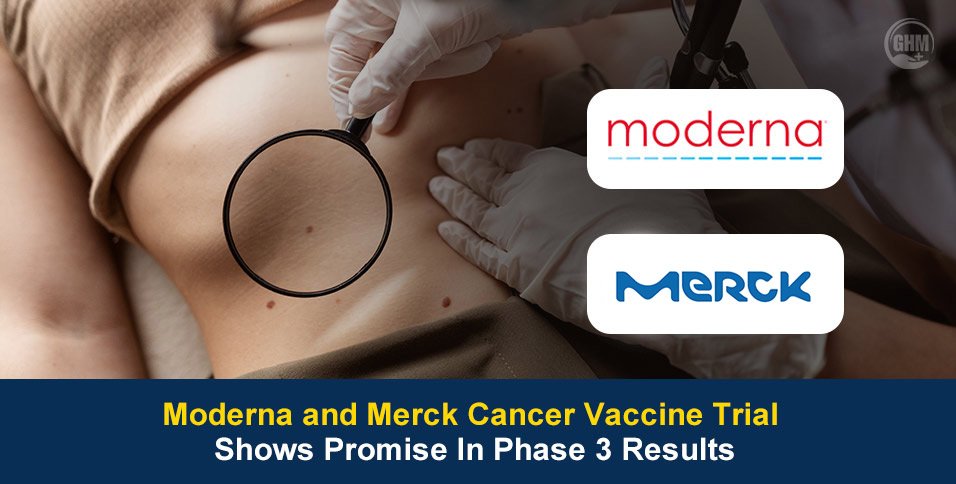
Merck and Moderna have announced a major advance in personalized cancer treatment after their investigational therapy met key goals in a late-stage melanoma study. The Moderna and Merck cancer vaccine trial, known as INTerpath-001, found that combining the personalized mRNA therapy intismeran autogene with KEYTRUDA improved important outcomes compared with KEYTRUDA alone.
The Phase 3 Moderna and Merck cancer vaccine trial involved patients with high-risk stage IIB-IV melanoma whose tumors had been completely removed through surgery.
Melanoma is one of the most dangerous forms of skin cancer. Even after successful surgery, patients with high-risk disease can face a substantial risk of recurrence. The Merck-Moderna melanoma vaccine approach aims to reduce that risk by adding a personalized immune response to existing treatment. This makes the positive Phase 3 melanoma vaccine trial particularly important because it is the first positive Phase 3 readout for an individualized neoantigen therapy and an mRNA-based cancer treatment of this kind.
How Does the Personalized Cancer Vaccine Work?
Despite the name, this melanoma cancer vaccine treatment is not a preventive vaccine like those used to protect against infectious diseases. The personalized cancer vaccine is designed as a treatment tailored to an individual patient’s tumor.
Scientists analyze a sample of the patient’s cancer to identify its unique mutations, sometimes described as the tumor’s molecular fingerprint. Intismeran autogene is then designed using synthetic messenger RNA, or mRNA, to target up to 34 cancer-specific neoantigens.
Neoantigens are markers created by mutations in cancer cells that can help the immune system distinguish tumor cells from normal cells.
The goal of this mRNA cancer vaccine is to train the immune system to recognize and attack cancer cells that may remain after surgery. KEYTRUDA, an anti-PD-1 immunotherapy, works differently by helping the body’s immune system detect and fight tumor cells.
Together, the approach represents a form of personalized mRNA cancer therapy rather than a one-size-fits-all treatment.
What Are The Moderna and Merck Cancer Vaccine Trial Results?
The Moderna and Merck cancer vaccine trial enrolled 1,137 patients with completely resected, or surgically removed, stage IIB-IV cutaneous melanoma. Researchers randomly assigned participants to receive either intismeran autogene plus KEYTRUDA or KEYTRUDA alone.
At a planned interim analysis, the Merck-Moderna melanoma vaccine combination showed statistically significant and clinically meaningful improvements. The combination met its primary endpoint of recurrence-free survival, meaning it extended the time before the cancer returned or a patient died. It also met a key secondary endpoint of distant metastasis-free survival, which measures the time before cancer spreads to distant parts of the body or death occurs.
The results also build on earlier Phase 2b findings. Five-year follow-up data presented at the 2026 ASCO Annual Meeting showed that the combination reduced the risk of recurrence or death by 49% and the risk of distant metastasis or death by 59% compared with KEYTRUDA alone.
Professor Georgina Long, the study’s principal investigator, described the findings as a significant moment for melanoma care, saying the treatment combination could reduce the risk of recurrence or death compared with KEYTRUDA alone.
Neither company has yet released the complete Phase 3 dataset of the Moderna and Merck cancer vaccine trial, including detailed figures on the reduction in recurrence risk. They plan to present the data at an upcoming international medical meeting and share it with regulatory authorities.
What Is the Next Step In Moderna and Merck Cancer Vaccine Trial?
According to the companies, the safety profiles of intismeran and KEYTRUDA were consistent with previous studies, with no new safety signals identified in the Moderna and Merck cancer vaccine trial.
However, the treatment remains investigational and is not yet approved for routine patient use. Researchers will continue following participants to assess overall survival and other outcomes.
The companies also plan to engage with regulators regarding potential filing submissions. In addition, the broader INTerpath clinical program includes Phase 2 and Phase 3 studies across melanoma, non-small cell lung cancer, bladder cancer, and renal cell carcinoma, with earlier research in pancreatic and gastric cancers.