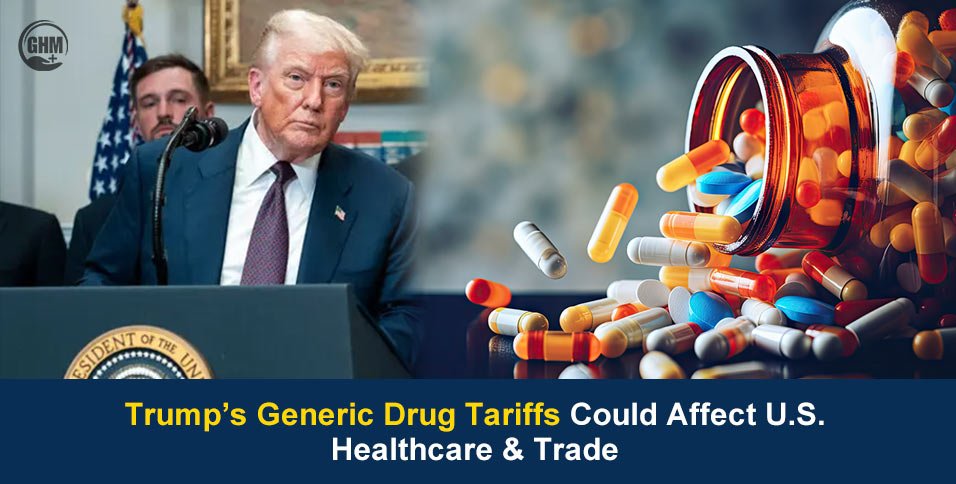
President Donald Trump has announced a phased tariff schedule on imported low-cost medicines, introducing a two-year grace period before imposing dramatic tax hikes on foreign manufacturers. Under the plan, Trump’s generic drug tariffs will remain at 0% for two years starting August 1, 2026. Beginning in August 2028, imported products will face a 100% duty, which will double to a 200% tariff by 2029.
This US pharmaceutical trade policy shockwave directly impacts the core of American healthcare, as FDA-approved generic drugs account for more than 90% of all prescriptions filled in the United States. By introducing these penalties, the Trump administration aims to force pharmaceutical companies to move their manufacturing operations onto American soil.
What Are Trump’s Generic Drug Tariffs?
Newly proposed Trump’s generic drug tariffs establish a clear, phased deadline for overseas suppliers. The administration intends to implement the measures under Section 232 of the Trade Expansion Act of 1962, a statute that allows unilateral tariffs to address national security risks tied to reliance on imports.
Key operational details of Trump’s generic drug tariffs strategy include:
- Targeted Scope: The tariffs apply specifically to imported off-patent, generic pharmaceuticals and do not alter existing policies for patented or branded medicines.
- Phased Escalation: Importers receive zero tariffs until August 2028, followed by a 100% tax in year three and a 200% tax starting in 2029.
- Formal Status: The administration signaled its strategy via social media posts, though a formal executive order had not been published at reporting time.
Why Is the U.S. Imposing These Generic Drug Tariffs?
The primary driver behind Trump’s generic drug tariffs is reshoring production to secure the domestic generic medicine supply chain. Currently, foreign nations dominate key supply lines; for instance, India supplies nearly 50% of generic medicines consumed in America, while China leads the production of raw active pharmaceutical ingredients (APIs).
This initiative aligns with broader US pharmaceutical trade policy and earlier executive actions. In April, the White House introduced a 100% duty on brand-name imports while leveraging a “most-favored-nation” pricing framework to lower consumer prices. Administration officials argue that reliance on overseas plants creates strategic vulnerabilities, justifying tariffs to protect national security.
How Will Trump’s Generic Drug Tariffs Impact Medicine Prices?
Healthcare analysts warn that imposing heavy import duties could drastically increase US prescription drug costs. Because generic drug manufacturers operate on razor-thin profit margins, absorbing a 100% or 200% tax is financially impossible for most suppliers.
If wholesalers refuse to absorb added expenses, manufacturers may stop producing low-margin items altogether. Such market exits threaten the availability of affordable medicines in the U.S., potentially leading to severe drug shortages and forcing patients to pay higher out-of-pocket prices for essential treatments.
In the past, Trump had announced a large-scale expansion of the TrumpRx prescription platform with generic drug discounts to lower medication costs for Americans.
What Are the Challenges In U.S. Pharmaceutical Tariffs?
Industry groups have reacted cautiously to the policy shift. John Murphy III, CEO of the Association for Accessible Medicines, noted that while generic drugmakers support domestic growth, structural purchasing and reimbursement hurdles must also be addressed.
“We need to understand more the specifics of the policy, but the generics industry is committed to pursuing policies that support and stabilize both the industry and the access necessary to ensure patients have reliable options for affordable medicines,” He stated.
Trade experts also question whether tariffs alone can shift production economics. Constructing U.S. chemical manufacturing facilities is extremely expensive and time-consuming. Furthermore, domestic plants would still rely on foreign APIs, limiting true independence. Meanwhile, major pharmaceutical companies that negotiated pricing deals under earlier trade actions retain specific exemptions.
What Happens Next?
The grace period gives overseas producers and trade partners until August 1, 2028, before punitive rates begin. During this two-year runway, foreign suppliers are expected to lobby Washington for carveouts, seek FDA contract-manufacturing arrangements, or invest in domestic plants. The ultimate impact of Trump’s generic drug tariffs will depend on formal executive orders, ongoing trade negotiations, and how rapidly drugmakers adjust their global supply chains.