Did you know that approximately 23% of U.S. adults experienced a mental illness in 2025?
Well, patients often feel isolated in their struggles, but that’s nearly 60 million people, which means no one is alone in this.
People struggling with mental health challenges like anxiety or addiction keep looking for ways to tackle them. While individual therapy offers personal focus, it can be really hard to start and finish the journey of recovery alone. This is when group therapy sessions should be considered, where shared experiences lead to faster breakthroughs.
In these sessions, group therapy activities provide a unique path toward recovery by combining professional guidance with the strength of community. While individual therapy offers personal focus, group sessions create a “brave space” where shared experiences lead to faster breakthroughs.
In the article below, we explore the most effective evidence-based group therapy activities that are transforming clinical practice today.
What Are The Group Therapy Activities?
Group therapy activities are structured exercises used within a therapeutic setting to facilitate communication, emotional expression, and skill-building. Recent reports from the World Health Organization (WHO) indicate that mental disorders account for 1 in 6 years lived with disability globally, emphasizing the need for scalable, effective treatments.
These therapy activities for mental health groups serve a specific purpose within a treatment program, moving beyond simple conversation to active, experiential learning.
Therapists utilize these techniques across various specialties, including:
- Addiction Recovery: To prevent relapse and identify triggers.
- Anxiety and Depression: To reframe negative thoughts and boost mood.
- Trauma and Grief: To normalize the pain of loss and build safety.
Have A Look At The Top 15 Group Therapy Activities For Adults
These evidence-based group therapy activities represent the gold standard in modern clinical practice. By moving beyond simple conversation, these exercises are designed to foster deep engagement and practical skill development.
| Activity Name | Focus Area | Key Outcome | |
| 1. | Check-In Circles | Reflection | Builds openness by sharing weekly challenges and wins. |
| 2. | Relapse Prevention | Addiction | Creates a “personal map” of triggers and coping strategies. |
| 3. | Cognitive Restructuring | CBT | Transforms negative thoughts like “I always fail” into factual wins. |
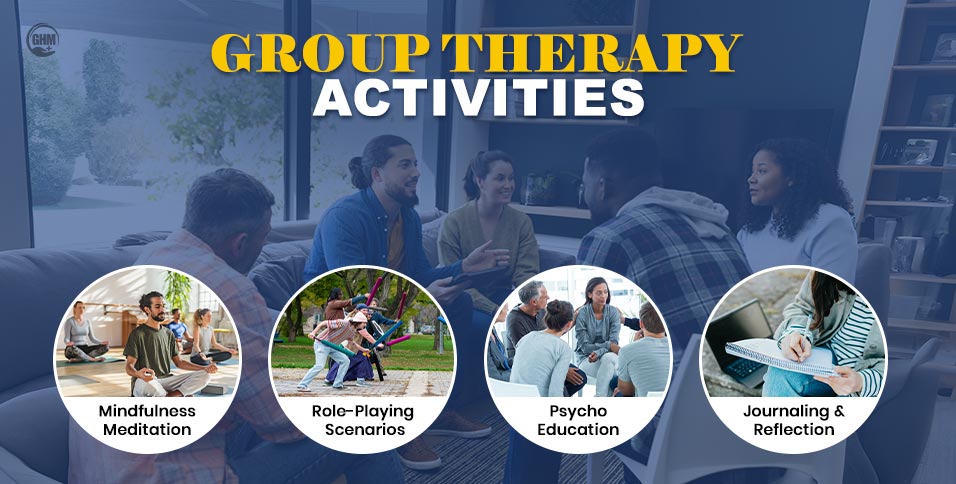
| 4. | Mindfulness Meditation | Stress | Uses body scans and breathing to manage cravings. |
| 5. | Role-Playing Scenarios | Assertiveness | Practices saying “no” to high-risk situations in real-time. |
| 6. | Emotion Identification | Intelligence | Uses emotion charts to label feelings like shame or anger. |
| 7. | Gratitude Sharing | Perspective | Redirects focus from negative events to personal strengths. |
| 8. | Goal-Setting Workshops | Motivation | Uses the SMART framework to create measurable targets. |
| 9. | Psychoeducation | Awareness | Teaches how addiction or trauma affects brain function. |
| 10. | Journaling & Reflection | Self-Awareness | Uses guided prompts to explore internal triggers. |
| 11. | Art Expression | Trauma | Helps members “draw” emotions when words are hard to find. |
| 12. | Stress Management | DBT | Practices “paced breathing” to regulate the nervous system. |
| 13. | Values Clarification | Alignment | Identifies core values to ensure behavior matches goals. |
| 14. | Trust-Building | Cohesion | Uses partner exercises to overcome interpersonal barriers. |
| 15. | Open Process Groups | Connection | Facilitates real-time peer feedback on current issues. |
Let’s Begin The 15 Therapy Activities For Mental Health Groups
1. Check-In Circles
Check-in circles serve as the foundational ritual for most mental health group activities. This activity requires each member to answer specific, structured questions like, “What was your biggest win this week?” or “Which coping skill did you lean on most?” By starting every therapy session with this predictable format, the group therapist creates a sense of safety and routine.
This process encourages participants to practice “emotional labeling,” a core skill in regulation. When a member articulates a challenge, they often find that others in the group have faced something similar.
2. Relapse Prevention Planning
To prevent patients from relapse, relapse prevention planning exercises are essential in addiction recovery group activities. This exercise involves participants creating a “personal map” that identifies specific high-risk triggers. Relapse triggers are usually categorized into people (unsupportive friends), places (old neighborhoods), and internal emotional states (loneliness or boredom).
The relapse rate for substance use is 40% to 60%, but this risk drops to less than 15% after five years of continuous recovery. Doing Relapse Prevention Planning in a group setting enables members to share their wisdom. While one person might struggle to see their relapse patterns, peers can offer insights based on their own lived experiences. This proactive planning reduces the cognitive load during moments of crisis.
3. Cognitive Restructuring Exercises
These (Cognitive Behavior Therapy) CBT group activities focus on the “Cognitive Triangle”—the interconnected relationship between thoughts, feelings, and behaviors. Participants learn to identify “automatic negative thoughts”, such as catastrophizing or all-or-nothing thinking.
In a group, a member might share a thought like, “I messed up one task at work, so I’m going to get fired.” The group then helps the individual examine the evidence for and against that thought. This collaborative reframing helps members develop a more balanced, realistic perspective.
This cognitive restructuring activity is highly effective for treating depression and anxiety, as it empowers individuals to reclaim control over their narrative.
4. Mindfulness and Grounding Meditations
Mindfulness group therapy provides physical and mental stabilization, especially for those dealing with high stress or trauma. Mindfulness exercises often include guided body scans, paced breathing, or “five senses” grounding (identifying five things you see, four you can touch, etc.). In a group environment, the collective silence and shared focus can actually deepen the meditative experience.
By practicing grounding meditations together, members hold each other in a space of calm, which can regulate the nervous system more effectively than practicing alone. This activity also serves as an excellent transition between high-intensity discussions and the end of a session.
5. Therapeutic Role-Playing Scenarios
Role-playing is one of the most dynamic therapy activities for adults because it allows for “active learning.” Participants act out real-life scenarios, such as asking a boss for a raise, setting a boundary with a family member, or refusing an offer of a substance. The group provides a safe laboratory where the stakes are low, but the emotional practice is real.
After each role-play, the members receive constructive feedback from their peers, which is often more impactful than a therapist’s advice. Therapeutic role-playing activity is particularly beneficial for those with social anxiety or those re-entering social circles after a period of isolation in recovery.
6. Emotion Identification and Literacy
Many adults enter therapy with a limited emotional vocabulary, often defaulting to “fine” or “bad.” This activity uses tools like the “Emotion Wheel” to help participants pinpoint exactly what they are feeling.
Is it “bad,” or is it actually “betrayed,” “exhausted,” or “inadequate”? By expanding their emotional literacy, group members gain better mastery over their reactions. In a group setting, members might take turns describing a physical sensation in their body (like a tight chest) while others help them identify the corresponding emotion, like anxiety.
7. Gratitude Sharing
While therapy often focuses on solving problems, support group activities like gratitude sharing focus on “wins more than losses”. In this exercise, members share three specific things they are grateful for that occurred since the last meeting. This practice shifts the brain’s “negativity bias,” which naturally leans toward scanning for threats and failures.
In a group, hearing the gratitude of others can be infectious and can uplift the entire room’s mood. It reminds participants that even in the midst of recovery or chronic illness, there are still elements of beauty and connection.
8. Goal-Setting Workshops
Vague goals like “I want to get better” are difficult to achieve. This workshop-style activity teaches members how to create SMART goals: Specific, Measurable, Achievable, Relevant, and Time-bound.
For example, a member might transform “I want to exercise” into “I will walk for 20 minutes on Tuesday and Thursday mornings for the next three weeks.”
The group environment adds a layer of accountability that is missing in individual goal-setting. Members check in on each other’s progress, offering encouragement when a goal is met and problem-solving when an obstacle arises.
9. Psychoeducation Session
Psychoeducation is a critical component of behavioral therapy exercises. In these sessions, the group therapist teaches the group about the biological underpinnings of their condition. This might include how trauma “rewires” the nervous system or how addiction hijacks the brain’s dopamine reward pathway.
Understanding the reasons behind their symptoms of mental health conditions helps members validate their experiences. Instead of seeing themselves as “broken” or “weak,” they begin to see themselves as individuals with a physiological condition that can be managed. In a group, members realize their struggles aren’t personal failings.
10. Journaling and Self-Reflection
Writing is a powerful tool for externalizing internal chaos. In these group counseling techniques, the therapist provides a specific prompt, such as “Write about a time you felt truly safe.” Participants write silently for 10 to 15 minutes, followed by an optional sharing period.
The act of writing forces the brain to organize thoughts into a linear structure, which can be incredibly grounding. Sharing these reflections with the counseling group allows members to see the common threads in their humanity. Often, a member will read a passage that perfectly captures the feelings of everyone else in the room, which is useful for introverted members.
11. Art and Creative Expression
Sometimes, the pain of trauma or recovery is too complicated for words. Psychotherapy group activities involving art—such as drawing, sculpting with clay, or creating a collage—allow for a non-verbal emotional release. Participants might be asked to “draw their anxiety” or “paint their future self.”
The focus is never on the quality of the art, but on the process of creation. When the group displays their work, it creates a visual gallery of the shared journey. This can be deeply moving and fosters a unique type of bond that verbal communication alone cannot achieve. It is especially helpful for those who have “blocked” memories or struggle with traditional talk therapy.
12. Stress-Management Skills Practice (DBT)
Stress-Management Skills Practice is a Dialectical Behavior Therapy group activity that focuses heavily on “distress tolerance.” The group learns how to get through a crisis without making it worse. The activity involves practicing specific physical techniques, such as “TIPP” skills (Temperature, Intense exercise, Paced breathing, and Paired muscle relaxation) to shift emotions and alter body chemistry.
The group practices these skills together so they become second nature. By practicing stress-management hacks in a group, members feel less “weird” about using them in public.
13. Values Clarification Exercises
Many people struggle with mental health because their daily actions are out of alignment with their core values. The values clarification activity involves using a list of values (e.g., honesty, adventure, family, service) and asking members to narrow them down to their top three.
Once identified, the group discusses how much of their current time is actually spent honoring those values. This activity provides a “moral compass” for recovery. It moves the focus from “stopping a bad behavior” to “building a life worth living.”
14. Trust-Building Activities
From all the group therapy activities, trust-building activities are perhaps the most important. This exercise includes “Partner Interviews,” where members pair up to learn one thing about each other they didn’t know before.
The goal is to break down the walls of isolation and suspicion that often accompany mental health struggles. As trust grows, the “group IQ” increases, and the group becomes more capable of handling intense emotions and providing deeper support.
Trust-building activities often involve a bit of humor or lightheartedness, which provides a much-needed break from the heavy work of therapy.
15. Open Process and Facilitated Feedback
In the open feedback, members share current feelings or reactions to other group members in real-time. It facilitates deep interpersonal learning and allows members to receive immediate, compassionate feedback from peers.
It is one of the most transformative therapy activities for adults because it mirrors the real world. Participants learn to give and receive feedback with grace, a skill that is vital for healthy relationships outside the therapy room. While it can be challenging, it allows individuals to unlearn old, toxic social patterns and replace them with healthy, authentic ways of connecting.
Additional Types of Group Therapy Activities
Broadening the scope of group therapy activities helps maintain high engagement over time.
- Icebreaker Activities
- Two Truths and a Lie: A fun way to reduce initial anxiety and build early connections.
- Example: Members share three items they would bring to a stranded island, revealing their priorities.
- Activities For Anxiety & Depression
- Affirmations: Once trust is established, members write positive qualities about each other on shared sheets of paper.
- Example: members help each other find positive alternatives to negative thoughts.
- Mindfulness-Based Activities
- Mindful Eating: Using a raisin or orange slice to practice total sensory awareness.
- Mindful Yoga: Integrating gentle movement with breathwork to ground the body.
Who Can Benefit From Group Therapy Activities?
While these activities are often associated with clinical settings, their reach is expanding. They are highly effective for:
- Adults in recovery seeking long-term sobriety.
- Individuals with chronic conditions managing daily stressors.
- Corporate wellness groups looking to improve team communication.
- Adolescents needing social skill development.
What Makes Group Therapy Better Than Individual Therapy?
Healing is rarely a solitary journey. As social creatures, humans are “hardwired” for attachment, making groups a potent source of change for the brain and nervous system.
Key benefits of Group Therapy include:
- Emotional Support: Members realize they are not alone, which cuts through the debilitating fog of loneliness.
- Peer Accountability: Seeing others succeed motivates participants to stick to their own recovery goals.
- Communication Skills: Groups offer a safe laboratory to practice active listening and respectful speech.
- Cost-Effectiveness: These sessions often provide high-quality care at a lower price point than individual sessions.
The Final Session
Structured group therapy activities are more than just games; they are tools that build resilience in people with mental struggles and foster community. By integrating techniques from CBT, DBT, and mindfulness, these group therapy exercises help individuals move from isolation to a state of shared strength.
Recovery is a journey best traveled together. As mental healthcare continues to evolve toward more collaborative models, these activities will remain at the heart of effective treatment.
If you found these activities insightful, please share this article with your community or with someone who might benefit from the power of group healing!
Frequently Asked Questions
- How long does a typical group therapy session last?
Most group therapy sessions run between 60 to 90 minutes, depending on the specific program goals.
- Can the group therapy activities be done virtually?
Yes. Modern telehealth platforms allow for many psychotherapy group activities to be conducted via video conferencing effectively.
- Are group therapy activities suitable for all phases of recovery?
Absolutely. Facilitators adjust the intensity and focus of activities based on whether a participant is in early treatment or maintaining long-term wellness.
- How do group therapy activities differ from individual therapy?
While individual therapy focuses on the deep-seated personal history between one client and a therapist, group therapy uses the “social laboratory” of peers to practice real-time communication and connection.
- How many people are usually in the therapy groups?
Most effective therapeutic groups range from 5 to 12 participants. This size is large enough to provide diverse perspectives but small enough to ensure everyone has a voice.