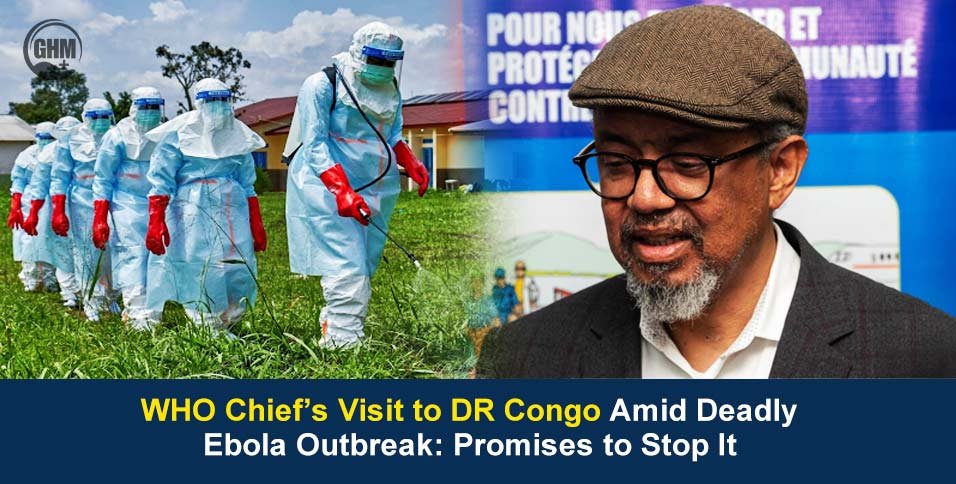
World Health Organization Director-General Tedros Adhanom Ghebreyesus arrived in the country this week as the Democratic Republic of the Congo (DRC) battles a worsening Ebola outbreak in its conflict-hit eastern region. During the WHO chief’s visit to DR Congo, he called for a temporary ceasefire so health workers can safely reach affected communities.
The Ebola outbreak, centered in Ituri province, has already triggered concern across Central Africa because it involves the rare Bundibugyo strain of Ebola, for which no approved vaccine or treatment currently exists. According to the United Nations, more than 900 suspected cases, 105 confirmed infections, and 10 confirmed deaths had been recorded in the DRC as of late May. Uganda has also reported confirmed cases and one death linked to the outbreak.
Tedros emphasized that WHO teams are already on the ground and working closely with Congolese authorities and humanitarian partners to stop the virus from spreading further.
“We are working under the leadership of the Government of DRC, together with all relevant partners, united around one goal: to stop this outbreak and protect your communities,” he said.
WHO Chief Calls for Ceasefire in Congo Amid Conflicts
During the WHO chief’s visit to DR Congo, he made a direct appeal to armed groups operating in eastern DRC. Violence and instability have made it extremely difficult for medical teams to travel safely and deliver treatment. Armed groups continue to fight over control of mineral-rich territories, forcing thousands of civilians to flee their homes.
“That is why today I am making a direct appeal to all warring parties in this region: please, declare a ceasefire,” Tedros said during his visit.
The WHO chief stressed that even a temporary halt in fighting could save lives by allowing healthcare workers to access remote communities and transport medical supplies.
Eastern Congo has faced decades of armed conflict, displacement, and weak healthcare infrastructure. These conditions have complicated efforts to contain infectious diseases in the past, including previous Ebola outbreaks.
DR Congo Ebola Outbreak Raises Global Health Concerns
The current DR Congo Ebola outbreak is the country’s 17th recorded Ebola epidemic since the virus was first identified there in 1976. The outbreak has mainly affected Ituri province, though smaller clusters have also appeared in North and South Kivu.
Health officials fear the virus may have spread undetected for weeks before authorities confirmed the outbreak earlier this month. The World Health Organization warned that the true number of infections could be much higher than current figures suggest.
The Ebola outbreak is especially concerning because it involves the Bundibugyo strain, which differs from the more common Zaire strain seen in earlier epidemics. Unlike the Zaire strain, there are currently no approved vaccines or antiviral treatments specifically designed for the Bundibugyo Ebola strain.
The WHO advisory groups have already recommended launching Ebola vaccine trials and treatment studies to help control the outbreak, but according to the WHO, an Ebola vaccine could take months.
During the WHO chief’s visit to DR Congo, he said that the WHO is trying to rebuild trust within affected communities by working closely with local leaders, health staff, and young people to spread accurate public health information.
Ebola Vaccine Trials and International Response Expand
As the Ebola outbreak in Congo continues to grow, international agencies are scaling up emergency support. WHO and UNICEF have already delivered tonnes of medical and humanitarian supplies to Bunia, the capital of Ituri province.
The African Union’s health agency also announced that experimental Ebola vaccine trials could begin later this year. Scientists hope the trials may eventually lead to an effective response against the Bundibugyo strain.
At the same time, neighboring countries are increasing cross-border Ebola surveillance to prevent regional spread. Uganda has strengthened monitoring efforts and temporarily tightened border controls after reporting additional Ebola cases.
The United States has also introduced entry restrictions for infected travelers and announced plans to support treatment efforts for American citizens in the region.
WHO Chief’s Visit to DR Congo Signals Long-Term Commitment
During the WHO chief’s visit to DR Congo, he repeatedly emphasized that the WHO’s involvement would not end once the outbreak is contained. He promised continued support for strengthening healthcare systems in vulnerable communities across eastern Congo.
“Together, we will overcome this outbreak,” he said after arriving in Kinshasa.
Public health experts say the coming weeks will be critical. Rapid testing, early supportive care, community cooperation, and secure humanitarian access will likely determine whether the outbreak can be contained before it spreads further across the region.
The WHO chief’s visit to DR Congo has therefore become more than a diplomatic mission. It represents an urgent global effort to stop a deadly virus while navigating the difficult realities of armed conflict, displacement, and fragile healthcare systems in one of Africa’s most vulnerable regions.