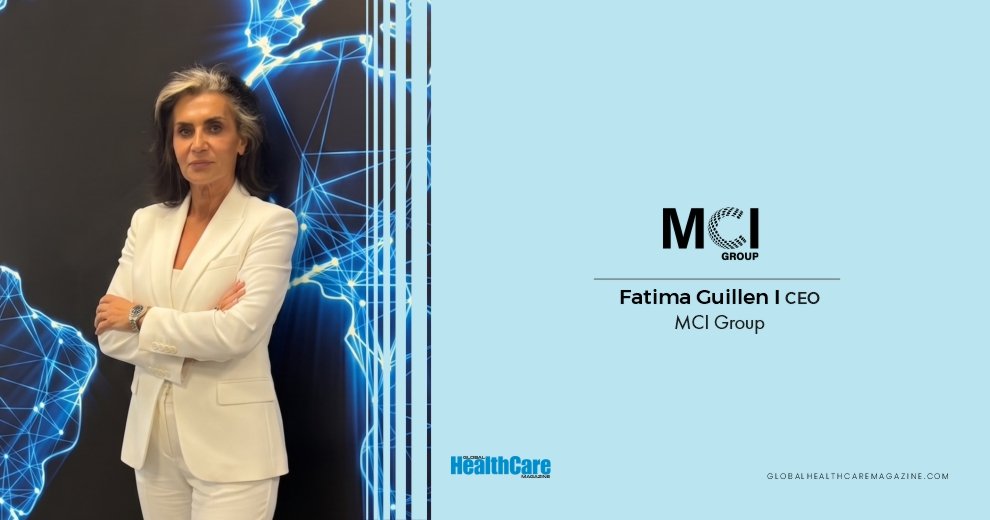
There is a particular helplessness that settles over a person when they fall ill far from home. The language is unfamiliar. The hospital corridors feel foreign. The insurance paperwork is incomprehensible. And somewhere across an ocean, the people who love them cannot help. In those moments, a patient needs more than just medicine; they need someone who already knows exactly what to do. Fatima Guillen understood this long before she had the organization to act on it.
“Early in our professional journeys, Dr. Pablo Gonzalo and I witnessed the difficulties patients faced when requiring medical assistance far from home,” she says. “The real challenge was coordination: fragmented systems, disconnected stakeholders, and a lack of accountability when it mattered most.”
That observation became the founding conviction of an organization that would spend three decades redefining international healthcare risk management. That organization is MCI Group. And the woman at its helm, as CEO, is Fatima Guillen.
Madrid, and a Shared Conviction
MCI Group did not begin as a grand corporate design. It began as a response. Fatima and Dr. Pablo Gonzalo founded MCI Assist in Madrid with a clear-eyed understanding of what international medical assistance was fundamentally missing: structure, responsibility, and what Fatima calls, with calm precision, “a human-centered approach,” far beyond basic clinical knowledge and goodwill.
What started as a small initiative in Spain’s capital has grown, across thirty years, into an international organization that supports clients worldwide, reaching even the most remote locations through a trusted network of providers and strategic partners, spanning Europe and Latin America.
But Fatima is quick to reframe what that expansion actually means.
“Growth was never the objective,” she says. “It was the result of hard work and of addressing a fundamental issue: fragmentation.”
In an industry that tends to celebrate scale as achievement in itself, that clarity is quietly radical.
From Fragmentation to Integration
Insurers operated within their own frameworks. Healthcare providers within their. Assistance companies were expected to bridge the two, often without the authority or alignment to do so effectively. Patients fell through the gaps. MCI’s answer was to actively dismantle that fragmentation rather than just working around it.
The organization built an integrated model combining medical expertise, operational coordination, and financial control into a single system, aligned under one guiding principle: decisions must be driven by medical criteria, supported by operational excellence, and sustained by financial responsibility and compliance.
Today, MCI Group comprises five specialized entities: MCI Assist, MCI Latam, MCI Finance, Medical Claims International, and MCI Academy. Each carries a distinct function. Together, they form a coordinated ecosystem designed to manage healthcare risk end-to-end, from the initial patient contact to the final financial resolution.
“These entities do not operate in isolation,” Fatima explains. “Every step is connected and aligned.” Rather than a disparate portfolio of companies, MCI functions as a single, living system.
When a Patient Needs Help Now
There is a version of healthcare risk management that lives entirely in contracts and compliance documentation. And then there is the version that lives in the first hours of a medical emergency abroad, when a real person is frightened, in pain, and impossibly far from home.
MCI operates in both. But the second version is what animates Fatima most deeply.
When a patient faces a critical situation abroad, MCI immediately activates, assessing the case, coordinating with local providers, and ensuring care without delay. The organization holds deep specialization in medical repatriation and in-flight escort services, managing complex international transfers that demand both clinical precision and formidable logistical coordination.
But Fatima is insistent that logistics are only part of the story.
“Communication becomes as important as coordination. Clarity, reassurance, and human connection are fundamental responsibilities.”
“At MCI, every case represents a person, not just a process.”
Partners, Not Adversaries
One of the most persistent tensions in international healthcare is the perceived conflict between insurers and providers. Insurers want to contain costs. Providers want to deliver care. These objectives, it is widely assumed, are in opposition. Fatima rejects this framing entirely.
“At MCI, we have always rejected this adversarial mindset. Clients and providers are not opposing forces, but partners within the same ecosystem.”
When decisions are grounded in clinical evidence and supported by transparent communication, cost containment does not undermine quality. It reinforces it. Efficient resource allocation leads to better outcomes for patients and more sustainable systems for all stakeholders.
This is the synergy MCI has been building and proving for three decades.
What Thirty Years Actually Looks Like
MCI Group has expanded across Europe and Latin America, built a formidable global provider network, earned multiple ISO certifications, and established itself as a recognized leader in international healthcare risk management. These are milestones worth naming. But when asked what truly reflects thirty years of impact, Fatima names something no certification can capture.
“Our greatest achievement is trust. Trust from clients who rely on us to manage complex medical cases. Trust from providers who collaborate with us in delivering care. Trust built through consistency, transparency, and responsibility.”
Trust must be earned organically over time, decision by decision. It cannot be compressed into a campaign or shortcut by strategy. It requires an organization to show up consistently across thousands of cases and dozens of markets, and do the right thing, every time. Thirty years of exactly that is what MCI Group has built.
The Road Ahead
The future Fatima describes is shaped by two forces that might appear to be in tension: technology and humanity.
“Our focus is to strengthen our integrated model by combining medical expertise with technology and analytics, while preserving the human-centered approach that defines us.”
The global healthcare landscape is becoming more interconnected, more data-driven, and more demanding. MCI’s response is to embrace both the efficiency technology offers and the genuine empathy care requires as the organization continues expanding globally.
The guiding principles remain exactly what they have always been: rigor, reliability, and empathy. The tools evolve. The conviction beneath them does not. After thirty years, one idea remains at the center of everything Fatima Guillen has built.
“People are the heart of healthcare, beyond just systems and processes.” This is the foundation of MCI Group and the future being built rigorously from Madrid to the world.
Quote
“Clarity, reassurance, and human connection are fundamental responsibilities.”
“Trust is earned over time, decision by decision. Our greatest achievement is trust.”