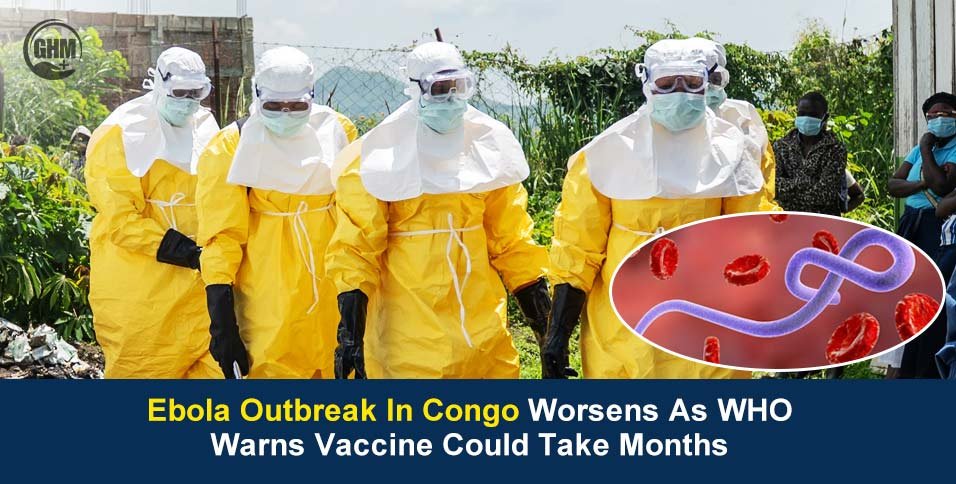
A new Ebola outbreak in Congo had triggered urgent health warnings across Central Africa. But now, it has intensified sharply as health officials warn the virus may already have spread across borders, while vaccines for the current strain remain months away. The suspected cases in the Democratic Republic of Congo (DRC) have surged to nearly 600, with 139 suspected deaths.
From the recent WHO briefings, 51 Ebola cases have now been laboratory confirmed in eastern Congo, while neighboring Uganda has reported two confirmed cases, including one death linked to travel from the DRC.
The rapidly evolving Ebola outbreak In Congo is centered in Ituri province, particularly in the mining towns of Mongwalu and Rwampara, though officials say the virus has also spread into North Kivu province.
Ituri Province Ebola Outbreak Expands Beyond Congo Borders
The worsening Ituri province Ebola outbreak has raised concerns about broader regional transmission due to heavy cross-border movement between Congo, Uganda, and South Sudan.
The Africa Centres for Disease Control and Prevention (Africa CDC) previously warned that mining activity and population mobility were increasing the risk of wider spread. Those concerns intensified after Uganda confirmed imported infections in Kampala.
WHO Director-General Dr. Tedros Adhanom Ghebreyesus said the agency now considers the outbreak a high regional risk, though it has not classified the situation as a pandemic emergency.
“WHO assesses the risk of the epidemic as high at the national and regional levels and low at the global level,” Tedros said during a media briefing in Geneva.
The Ebola outbreak has already prompted enhanced surveillance, tighter border health screenings, and regional emergency coordination meetings involving African health agencies and international partners.
WHO Says Ebola Vaccine May Take Up to Nine Months
A major challenge in controlling the outbreak is the likely involvement of the rare Bundibugyo strain of Ebola, a species not seen in more than a decade.
According to WHO guidance, there is currently no approved vaccine specifically targeting the Bundibugyo strain.
WHO adviser Dr. Vasee Moorthy said two experimental vaccine candidates are under development, but neither has completed clinical trials. He warned it could take six to nine months before a vaccine becomes available.
“One possible vaccine currently under development would be the equivalent of the only vaccine currently available to prevent the spread of Ebola,” Moorthy explained, adding that further testing is still required.
The Bundibugyo strain has only caused two known outbreaks previously, in Uganda in 2007 and DR Congo in 2012, making it far less studied than the more common Zaire strain.
The most recent Ebola outbreak in Africa was detected in Kasai province, killing 45 people before authorities declared it over in late 2025. The 2026 Ebola outbreak marks Congo’s 17th recorded Ebola epidemic since the virus was first identified in the country in 1976.
Ebola Virus Disease Symptoms Continue to Overwhelm Clinics
The current health emergency in Congo is placing severe pressure on already fragile healthcare systems in eastern DRC.
Congo’s local health workers told international media that hospitals and treatment centers are becoming overwhelmed with suspected Ebola patients. Some facilities reportedly lack adequate protective equipment for frontline staff.
Humanitarian organization Médecins Sans Frontières (MSF) emergency manager Trish Newport described the situation as increasingly chaotic. “We are full of suspect cases. We don’t have any space,” she expressed.
The Ebola virus spreads through direct contact with infected bodily fluids or contaminated surfaces.
Common symptoms of Ebola virus disease include:
- Fever
- Severe fatigue
- Muscle pain
- Vomiting and diarrhea
- Headaches
- Bleeding in advanced stages
Because early symptoms of Ebola resemble malaria and typhoid, which are both common in Congo, experts believe the outbreak may have spread undetected for weeks before confirmation.
The first known case of Ebola involved a nurse in Bunia who developed symptoms and died on April 24. Her body was later transported to Mongwalu, one of the major hotspots of the Ebola outbreak.
Conflict and Global Funding Cuts Complicate Ebola Response
The ongoing Ebola outbreak in Africa is unfolding against a backdrop of armed conflict, mass displacement, and declining international health funding. Ituri province remains heavily affected by militia violence, which has weakened healthcare access and disrupted disease surveillance systems.
The global public health funding cuts may have contributed to slowed outbreak detection and response capacity in the region. Public health experts warned that reduced international support — especially from the USA, including cuts to USAID programs and global disease monitoring efforts has left local healthcare systems struggling to respond effectively.
Africa CDC Director-General Dr. Jean Kaseya urged countries to avoid “fear-driven” travel bans and instead focus on controlling the outbreak at its source. “The fastest path to protecting all countries in the world is to aggressively support outbreak control at the source,” he said.
Summery
Despite improvements in disease surveillance and emergency response systems, recurring outbreaks continue to expose vulnerabilities in African regional healthcare systems. The current outbreak presents new challenges because of the rare strain involved, regional spread, and limited vaccine readiness.
As health officials race to contain the Ebola Outbreak In Congo, regional coordination is becoming increasingly important. Authorities are expanding surveillance, monitoring border crossings, and preparing healthcare systems in neighboring countries for possible new infections.
For now, fast action, transparent communication, and international support will be essential in the coming weeks to prevent the crisis from escalating further across Central Africa.