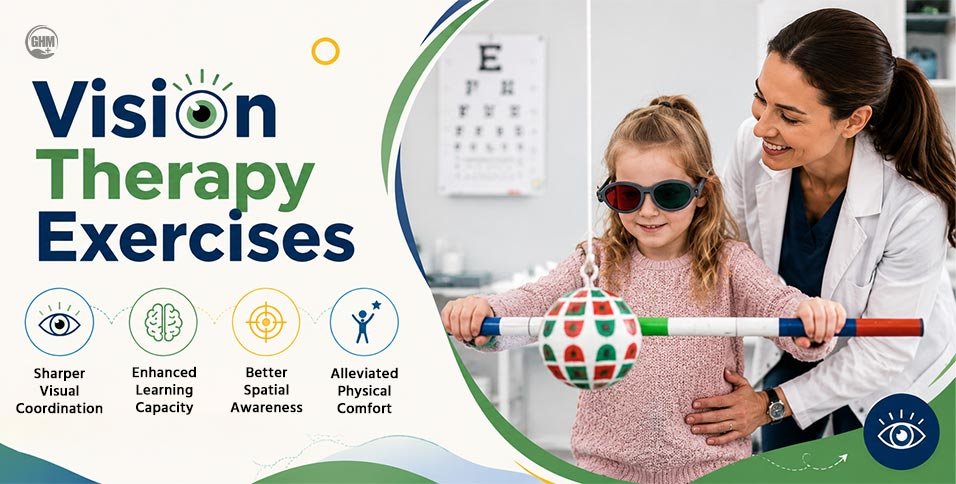
Vision problems today go far beyond blurry eyesight. With screen time increasing worldwide, many children and adults struggle with eye coordination, focusing difficulties, headaches, and digital eye strain that glasses alone may not fully address. Studies estimate that between 50% and 90% of digital device users experience some form of digital eye strain. This is where vision therapy exercises may help, which are designed to strengthen the connection between the eyes and the brain.
Vision therapy exercises offer a powerful solution to improve tracking, focusing, and binocular vision skills. This customized visual skills training acts like physical therapy for your eyes and brain. By practicing targeted eye muscle coordination activities, you can significantly improve how your eyes work together.
Consequently, these eye exercises are also used to treat conditions such as convergence insufficiency, amblyopia (lazy eye), and certain eye coordination disorders.
While you should always consult an optometrist for a professional vision therapy program, you can easily perform several eye exercises at home to support your progress.
This article explains the 10 vision improvement exercises and their benefits that you can practice on your own to support visual comfort, improve coordination, and enhance daily visual performance.
10 Vision Therapy Exercises You Can Try at Home
1. Pencil Push-Ups
Pencil push-ups is a highly effective convergence insufficiency exercise. This drill trains your eyes to move inward together when looking at nearby targets.
- Step 1: Hold a pencil out at arm’s length directly in front of your face.
- Step 2: Focus your gaze on a single letter or symbol on the pencil.
- Step 3: Move the pencil slowly toward your nose while keeping the image single and clear.
- Step 4: Once the image doubles or becomes blurry, move it back to the starting position.
For optimal binocular vision training, try performing this lazy eye exercise for 15 minutes a day, five days a week.
2. Near and Far Focusing
Alternating between different distances helps build your visual focus, improvement, and flexibility. Therefore, this accommodation training keeps your eye lenses flexible and responsive.
- Step 1: Hold your thumb about 10 inches away from your face.
- Step 2: Focus clearly on your thumb for 15 seconds.
- Step 3: Shift your gaze to an object 20 feet away for another 15 seconds.
- Step 4: Cycle back and forth between the targets several times.
3. Figure Eight Eye Tracking Exercise
If you want to enhance your eye movement control, the figure-eight routine is a perfect choice. This visual exercise gently stretches and tones the muscles controlling your gaze.
- Step 1: Imagine a large figure-eight turned on its side about 10 feet away on the floor.
- Step 2: Trace this imaginary shape smoothly with this eye tracking exercise for 30 seconds.
- Step 3: Reverse the movement and trace it in the opposite direction for another 30 seconds.
4. Brock String Exercise
The Brock string vision therapy setup is a classic tool for improving eye coordination. It provides immediate feedback on how well your eyes align.
- Step 1: Tie a 15-foot white string to a doorknob and hold the other end tightly under your nose.
- Step 2: Space out three colored beads: one close (6 inches), one middle (3 feet), and one far.
- Step 3: Focus on each bead sequentially, ensuring you see a single bead where the strings intersect to form an ‘X’ or ‘V’ shape.
This convergence training helps eliminate double vision by forcing both eyes to point at the exact same spot.
5. Barrel Card Exercise
The barrel card exercise specifically targets eye alignment training. It is especially helpful for people dealing with exotropia or outward eye turning.
- Step 1: Hold a card lengthwise against your nose with three colored barrels drawn on each side.
- Step 2: Look at the largest barrel farthest away until the green and red images merge into one.
- Step 3: Hold for 5 seconds, then move your focus to the middle and smallest barrels.
Ultimately, this convergence therapy teaches your eyes to work together as a cohesive team.
6. Palming Exercise
Digital screens can exhaust your eyes, but this eye relaxation exercise offers rapid relief from digital eye strain.
- Step 1: Rub your hands together vigorously until they feel warm.
- Step 2: Close your eyes gently.
- Step 3: Cup your warm palms over your eyes without applying pressure.
- Step 4: Breathe deeply and enjoy the soothing darkness for five minutes.
This simple eye fatigue remedy calms the optic nerve and relaxes surrounding tissues.
7. Conscious Blinking Exercise
When we look at smartphones or laptops continuously, our blink rate plummets. This reduction causes a gritty feeling and triggers computer vision syndrome.
- Step 1: Close your eyes completely and pause for two seconds.
- Step 2: Squeeze your eyelids tightly for an extra moment to stimulate protective oil glands.
- Step 3: Open them up and repeat this process several times.
Conscious blinking exercise serves as an excellent dry eye prevention habit by instantly spreading a fresh tear film over your cornea.
8. 20-20-20 Rule
If you spend hours at a desk, you need an easy eye strain relief technique. The 20-20-20 rule is a highly reliable eye break technique to prevent computer eye fatigue.
- Step 1: Set a timer for every 20 minutes of close-up work.
- Step 2: Take a brief 20-second break from your screen.
- Step 3: Look at an object at least 20 feet away to relax your internal focusing muscles.
9. Dot Card Exercise
Dot card therapy is another wonderful method for daily convergence practice. It ensures stable outcomes in binocular vision exercise.
- Step 1: Hold a stiff card with a line of dots drawn down the center right against your nose.
- Step 2: Tilt the card downward slightly.
- Step 3: Focus on the farthest dot for 5 seconds, watching the other dots double into an ‘A’ shape.
- Step 4: Walk your eyes closer, dot by dot, holding each focus steadily.
10. Reading, Mazes, and Puzzle Activities
You can turn visual tracking activities into fun eye coordination games for both adults and kids. For instance, working on complex puzzles or tracking words across a page engages fast, jumping eye movements called saccades.
If you are working with children, patch their stronger eye and have them color precisely within the lines. This practice forces the weaker eye to lock onto fine details, boosting overall visual processing.
Conditions That May Benefit from Vision Therapy Exercises
Vision therapy exercises target specific visual problems. Research shows that these exercises offer the highest success rates for binocular vision disorders. However, understanding which eye issues respond to these targeted exercises can help you determine if they apply to your situation.
Because these vision training activities retrain the brain-eye connection, both children and adults may benefit from them depending on the underlying condition.
Vision therapy exercises help the following visual dysfunctions:
- Convergence Insufficiency: A common binocular vision disorder where the eyes struggle to turn inward together while focusing on near objects.
- Amblyopia (Lazy Eye): Performing dedicated lazy eye treatment exercises forces the brain to process images from the weaker eye.
- Strabismus (Crossed Eyes): Targeted crossed eye exercises help align the eyes properly and improve muscle coordination.
- Eye Tracking Disorders: Vision therapy exercises improve saccades and pursuits, making it easier to follow moving objects or lines of text.
- Digital Eye Strain: Relieves the physical stress placed on your eyes during prolonged device usage.
- Visual Fatigue During Reading or Screen Use: Reduces frequent headaches, blurred vision, and physical tiredness caused by near tasks.
Scientific clinical evidence is strongest for treating binocular vision disorders, such as convergence insufficiency.
Furthermore, vision therapy exercises are not a cure for structural refractive errors like myopia (nearsightedness), hyperopia (farsightedness), or astigmatism. You will still require prescription lenses or contacts for those conditions.
Benefits of Vision Therapy Exercises
Engaging in a consistent vision therapy program yields several practical, evidence-backed health perks:
- Sharper Coordination: Teaches both eyes to aim and track together smoothly.
- Alleviated Physical Comfort: Drastically reduces reading-related headaches, neck strain, and general eye fatigue.
- Enhanced Learning Capacity: Stops children from skipping lines or words while reading, which directly improves reading comprehension.
- Better Spatial Awareness: Boosts your overall depth perception for safer driving, daily tasks, and sports performance.
By pairing these targeted vision therapy exercises with practices like wearing appropriate corrective lenses, managing screentime, and attending regular eye examinations, you can establish long-term healthy vision habits. General health practices like proper diet and sleep also contribute to healthy vision.
When to See an Eye Care Professional
While home eye exercises are convenient, you should never use them to self-diagnose severe eye issues. Book a comprehensive eye exam with an optometrist or a pediatric ophthalmologist if you experience:
- Frequent, unexplained headaches or dizziness after near tasks.
- Double vision or sudden, unprovoked eye flashes.
- Persistent squinting, head-tilting, or closing one eye to focus.
A trained specialist ensures your eye coordination exercises are perfectly safe and tailored to your specific pathology.
End Note
In summary, vision therapy exercises offer a proven, non-invasive way to build stronger visual skills and eliminate discomfort. Whether you are trying pencil push-ups to curb eye strain or using the 20-20-20 rule at work, consistency is your key to success. Remember, these eye exercises perform best when combined with professional medical guidance.
Have these exercises helped ease your screen fatigue? If they did, share this article with your friends and family to help them protect their eyesight too!
Frequently Asked Questions
- Can vision therapy exercises throw out my need for glasses?
No. Vision exercises strengthen coordination and tracking, but they do not alter the physical shape of your eyeball to fix refractive errors like nearsightedness or astigmatism.
- How long does it take to see results from eye exercises?
Eye exercises will not improve your vision overnight. Most structured programs require several weeks or months of daily, diligent practice to yield permanent changes in brain-muscle coordination.
- Does vision therapy treat reading disorders like dyslexia?
No, science shows that dyslexia is primarily a language and phonetic processing issue rather than an eye tracking problem. However, vision therapy can resolve co-occurring eye-teaming issues that make reading physically uncomfortable.
- What deficiency causes blurred vision?
Deficiencies in Vitamin A, Vitamin B12, and Vitamin D are the primary nutritional causes of blurry vision. A lack of Vitamin A can lead to dry eyes and poor night vision, while severe B12 deficiency may result in blurred or disturbed vision.