Communication is an essential part of everyday life. The ability to communicate effectively plays a major role in maintaining relationships, independence, and overall well-being. However, many adults experience challenges with speech, language, or voice due to medical conditions, injuries, neurological disorders, or age-related changes. These difficulties can affect confidence, social interactions, and quality of life.
This is where speech therapy for adults can make a significant difference. While speech therapy is often associated with children, it is equally valuable for adults facing communication or swallowing difficulties. Surprisingly, voice disorders affect approximately 3-9% of the general population at any given time.
Through personalized assessment and evidence-based interventions, speech therapy can help adults improve speech clarity, language skills, cognitive communication, voice quality, and swallowing function.
In this guide, we will explore how speech therapy for adults works, the conditions it treats, the techniques used, and the benefits it can provide for long-term communication success and improved quality of life.
What Is Speech Therapy for Adults?
Speech therapy for adults is a specialized healthcare intervention designed to assess, diagnose, and treat communication and swallowing disorders. Qualified professionals known as speech-language pathologists (SLPs) direct these customized programs.
While pediatric speech therapy primarily focuses on developmental milestones, adult intervention typically addresses acquired difficulties or refines existing professional communication. Speech-language pathologists target several core clinical areas for adult speech therapy:
- Speech Production: Improving clarity, articulation, and motor coordination.
- Language Comprehension: Enhancing how a person processes, reads, writes, and understands spoken words.
- Voice Disorders: Correcting chronic hoarseness, pitch issues, and vocal fatigue.
- Cognitive Communication: Strengthening memory, focus, organization, and problem-solving abilities.
- Swallowing Function: Reorienting the throat and tongue muscles to prevent choking.
How Does Speech Therapy for Adults Work?
Here is exactly what you can expect during the procedure of speech therapy for adults:
1. Initial Clinical Assessment
The speech-language pathologist first collects a detailed medical history. Next, they conduct standardized testing to gauge the patients’ baseline speech clarity, cognitive processing, and linguistic understanding.
2. Personalized Treatment Plan
The specialist designs a customized treatment plan according to the diagnosis. This plan outlines explicit, measurable goals, such as mastering certain speech sounds or increasing vocal volume by a set decibel level.
3. Structured Therapy Sessions
During one-on-one appointments, the patient performs speech therapy exercises. The clinician provides real-time, constructive feedback while utilizing visual and physical cues to optimize the patient’s vocal form.
4. Consistent Home Practice
The brain relies heavily on repetitive practice to forge new neural connections. Therefore, the therapist will assign specific daily vocal tasks to solidify progress in speech between office visits.
5. Progress Monitoring
The SLP will regularly reassess the patient’s vocal skills. They will adjust the difficulty of the speech exercises as the patient’s capabilities improve, ensuring the speech therapy treatment remains highly effective.
Signs You May Need Speech Therapy as an Adult
Recognizing the symptoms of a speech impairment is the first step toward recovery. You should consider booking a professional evaluation if you experience any of the following warning signs:
- Slurred, garbled, or exceptionally slow speech.
- Frequent difficulty retrieving familiar words during conversations.
- Stuttering, sound repetitions, or a disrupted conversational flow.
- Trouble following spoken instructions or tracking rapid discussions.
- Chronic vocal weakness, breathiness, or ongoing hoarseness.
- Memory lapses that directly hinder your daily workplace communication.
- Frequent coughing, throat-clearing, or pain while eating or drinking.
Conditions Treated with Adult Speech Therapy
Neurological illnesses, physical trauma, or structural changes can fundamentally alter how we speak and swallow. Healthcare clinics routinely utilize speech therapy for adults to treat a wide array of conditions.
1. Stroke and Aphasia
A sudden stroke can damage the language centers of the brain, leading directly to a condition called aphasia. Patients with aphasia struggle to express thoughts, comprehend speech, read, or write. Targeted language therapy helps patients with language retrieval and comprehension and rebuilds broken neural pathways.
2. Traumatic Brain Injury
Physical trauma to the head often disrupts cognitive processing. Individuals recovering from a brain injury frequently require cognitive-communication training to improve short-term memory, emotional regulation, and attention span.
3. Parkinson’s Disease and Neurological Disorders
Degenerative conditions like Parkinson’s disease often weaken the respiratory muscles. As a result, individuals may develop a very quiet, breathy, or monotonous voice. With speech therapy for adults, specialized vocal strengthening protocols can help patients maintain vocal volume.
4. Voice Disorders
Professionals who rely heavily on their voices, such as teachers, singers, and corporate executives, often suffer from vocal abuse or structural strain. Speech therapy teaches proper breath support to alleviate painful muscle tension dysphonia.
5. Stuttering and Fluency Disorders
The struggle of talking with fluency does not automatically vanish after childhood. Many adults seek speech rehabilitation to master pacing techniques, manage speech anxiety, and smooth out behavioral blocks.
6. Dysarthria and Apraxia
Dysarthria involves physical muscle weakness that causes slurred speech. Conversely, apraxia of speech is a motor-planning disorder where the brain struggles to coordinate the precise sequence of tongue and lip movements. Patients struggling with dysarthria or apraxia get the help of speech therapy for adults to improve.
7. Dysphagia (Swallowing Disorders)
Difficulty swallowing safely poses a severe medical risk, including aspiration pneumonia. To treat dysphagia, speech therapy is used, which helps strengthen throat muscles and ensure safety.
Speech-language pathologists design targeted swallowing rehabilitation exercises to ensure patients can consume food and liquids safely.
8. Professional Communication Needs
You do not need a medical diagnosis to benefit from expert speech therapy. Many individuals seek therapy for elective accent modification, public speaking training, or executive communication coaching to advance their corporate careers.
Common Techniques Used In Adult Speech Therapy
Speech-language pathologists use diverse, evidence-based speech therapy techniques to address specific physical and cognitive deficits.
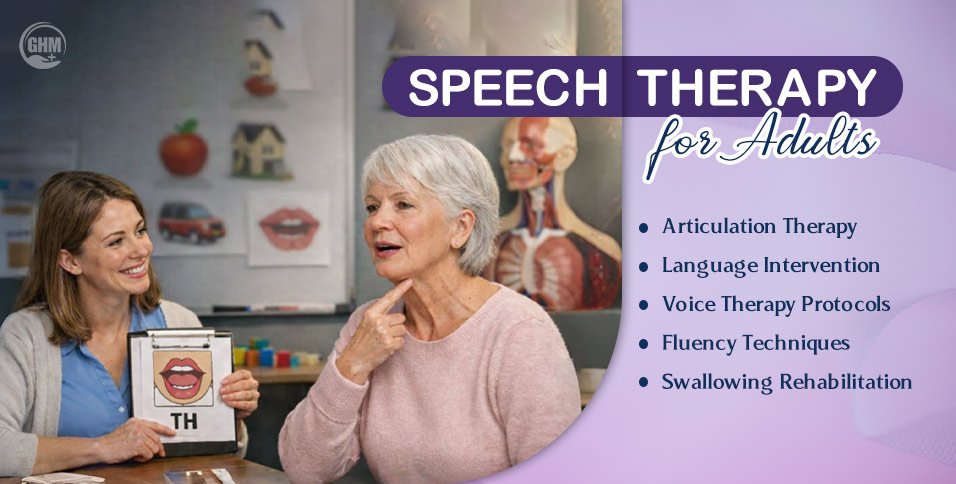
- Articulation Therapy: Focuses on positioning the jaw, lips, and tongue correctly to master specific consonant and vowel sounds.
- Language Intervention: Employs word-retrieval games, sentence-building activities, and reading exercises to combat aphasia.
- Cognitive Communication Training: Utilizes structured problem-solving tasks and memory drills to help patients organize their thoughts logically.
- Voice Therapy Protocols: Teaches flow phonation and resonant voice exercises to maximize vocal projection while minimizing throat strain.
- Fluency Techniques: Introduces controlled breathing patterns and deliberate pausing to manage adult stuttering.
- Swallowing Rehabilitation: Employs structural exercises to fortify the soft palate and tongue base, ensuring safe swallowing.
- Lee Silverman Voice Treatment (LSVT LOUD): A specialized program for Parkinson’s patients that focuses exclusively on increasing vocal loudness.
- Expiratory Muscle Strength Training (EMST): Utilizes a calibrated, handheld breathing device to strengthen the throat muscles used for coughing and swallowing.
Benefits of Speech Therapy for Adults
Investing time and energy into professional speech therapy yields profound, life-altering improvements.
Key Speech Therapy Benefits include:
- Clearer Articulation: People will understand you easily during casual conversations or professional presentations.
- Heightened Social Confidence: Overcoming a speech impediment reduces social isolation and eliminates conversational anxiety.
- Career Advancement: Enhancing your public speaking skills allows you to communicate ideas authoritatively in the workplace.
- Restored Autonomy: Regaining linguistic abilities after a stroke allows you to manage daily errands independently.
- Safer Dietary Intake: Swallowing therapy dramatically lowers your choking risks, making mealtime enjoyable again.
The Duration of Speech Therapy Treatment
There is no universal time period for adult speech rehabilitation. Clinical duration of speech therapy for adults depends on:
- The overall severity of the initial injury or condition.
- The nature of the underlying diagnosis (e.g., an acute injury versus a progressive neurodegenerative condition).
- The total frequency of your weekly appointments.
- Your personal dedication to completing daily home practice assignments.
While some individuals experiencing minor vocal fatigue may see a massive improvement within a few weeks, survivors of severe traumatic brain injuries might require consistent therapy for months or even years to fully maximize their capabilities.
Practicing Speech Therapy At Home
Practicing speech therapy at home serves as a critical pillar of long-term recovery. While a patient must always work under the direct guidance of a certified therapist to avoid reinforcing bad habits, independent exercises amplify the results.
Excellent home speech therapy exercises include,
- reading articles aloud to practice speech pacing
- performing articulation drills in front of a mirror
- playing strategic word games like crosswords to boost vocabulary
Additionally, many modern patients utilize digital teletherapy speech services, allowing them to complete exercises via smartphone speech therapy applications on their own flexible schedules. Following healthcare technology shifts, approximately 30% of speech therapy services are now delivered via telepractice.
End of The Session
Speech therapy for adults is a powerful clinical resource that radically transforms communication and swallowing functions at any age. Whether you are recovering from a sudden medical event, managing a long-term neurological condition, or simply aiming to refine your speech, getting professional help can give you optimal results.
The human brain possesses an incredible, lifelong capacity to adapt and learn new patterns. Do not let communication hurdles hold you back from living a vibrant, connected life. Consider scheduling a consultation with a qualified speech-language pathologist today to lead an independent and confident life.
If you found this guide helpful, please share it with your friends, family members, or caregivers who may be navigating these communication challenges!