There is a type of mind that does not announce itself by volume or spectacle. It announces itself, quietly and unmistakably, through outcomes. You recognize it in the architecture of a decision made before the crisis arrived, in the elegance of a system that keeps working long after its designer has moved on, in the numbers that shift, year after year, in exactly the right direction.
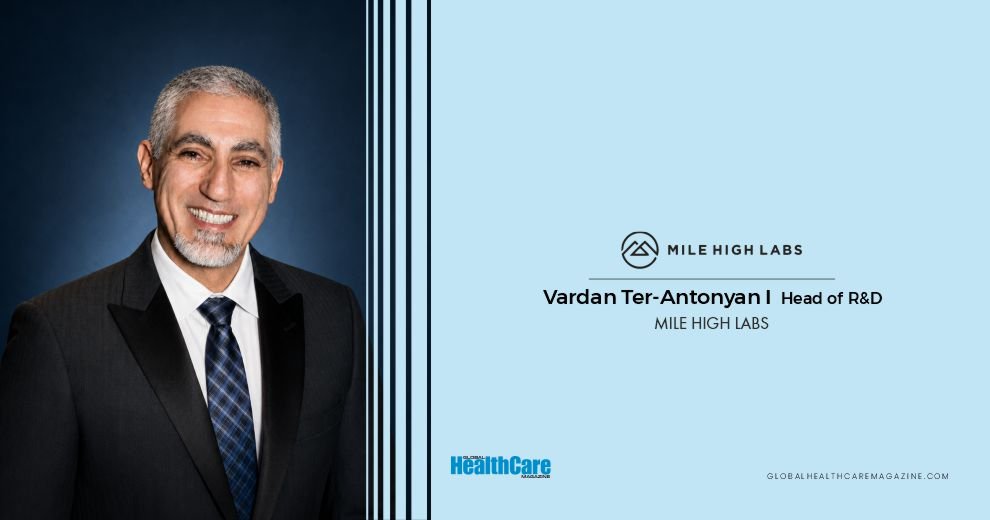
Vardan Ter-Antonyan, currently Head of R&D at Mile High Labs, possesses this kind of mind. He is a scientist, an executive, an inventor, a published author, a keynote speaker, and a Lean Six Sigma Master Black Belt. More than the sum of those titles, however, he is someone who has spent over two decades asking the same essential question in every room he has walked into: how do we make this work, reliably, at scale, and profitably?
The answers he has found, and the results they have produced, are what place him firmly among the most consequential R&D and life sciences leaders working today.
The World That Made Him
To understand Vardan, it helps to understand where he began. He grew up in post-Soviet Armenia, in a household shaped by his father, an experimental physicist whose influence ran deeper than career advice. It was a worldview, really. A way of approaching problems with precision, of trusting evidence over assumption, of understanding that disciplined thinking is not merely a professional skill but a way of being in the world.
That formation took him to Yerevan State University, where he studied Physics with a focus on Nuclear Physics and cosmic ray detection. It is the kind of scientific training that demands a tolerance for the invisible and the immeasurable. You are not working with things you can hold. You are working with phenomena that only reveal themselves through careful methodology, patient observation, and exacting analysis.
He then made a pivotal shift, moving toward Molecular Biophysics at the University of South Florida, where his research centered on iontophoretic transdermal drug delivery. The scale changed from cosmic to cellular, but the discipline was identical: understand the system, control the variables, measure the result. It was rigorous, applied science at its most demanding. From there, he entered the pharmaceutical industry as an Assistant Scientist. And from that entry point, he built.
Twenty Years, One Consistent Direction
What followed was a career that moved steadily and deliberately through some of the most demanding sectors in life sciences: pharmaceuticals, over-the-counter products, dietary supplements, and medical devices. Over more than two decades, Vardan advanced from bench scientist to Chief Science Officer, accumulating not just titles but something far more valuable: a composite, lived understanding of how science-driven organizations actually function, and precisely where they tend to fail.
Along the way, he earned a Lean Six Sigma Master Black Belt, a credential that sits at the demanding intersection of operational discipline and measurable business performance. He became an inventor with issued patents. He authored peer-reviewed scientific publications. He delivered a keynote at the 2nd Global Conference on Nanotechnology and Nanoscience, organized by the Scientific Guild.
These are not the achievements of someone who found one lane and stayed in it. They are the credentials of a person who kept expanding his conception of what a scientist could and should be.
Leading R&D at Mile High Labs
At Mile High Labs, Vardan sits at the center of one of the most demanding intersections in life sciences today: a highly regulated cannabinoid market that requires both scientific precision and commercial agility in equal, unrelenting measure. His work there is the clearest expression of everything his career has been building toward.
When he arrived, the challenge was one that fast-growing companies know well. Commercial momentum had outpaced the systems built to support it. Lab-scale formulations were not consistently translating to manufacturing. Regulatory expectations were evolving faster than development workflows could accommodate. The pressure to move quickly was in constant, grinding tension with the requirement to move correctly.
“We addressed gaps between lab-scale formulations and manufacturing scalability by integrating R&D, QA/QC, and manufacturing earlier in development,” he explains, “improving tech transfer and consistency.”
The results of that integration were not modest. Annual operating costs fell by 47% through Lean Six Sigma implementation and deliberate process redesign. Annual revenue grew by 67% over three years, driven by the launch of new high-value products and ingredients. These are not incremental adjustments. They represent a fundamental shift in how the organization functions.
At the core of this transformation was Vardan’s insistence on building a compliance-driven innovation framework that could manage evolving regulations while maintaining development speed. R&D at Mile High Labs, under his direction, shifted from a reactive function into a market-focused, cross-functional system where scientific development directly supports scalable products, regulatory alignment, and revenue growth simultaneously.
A Pattern That Repeats
What makes Vardan’s work at Mile High Labs particularly striking is that it is not an isolated success story. The pattern holds across companies, sectors, and stages of organizational development.
At Front Range Labs, he eliminated the operational backlog entirely through the application of Lean Six Sigma principles and doubled annual revenue within three years.
At Green Compass Global, a deliberate program of new product launches, carefully aligned with market demand, produced a 50% increase in annual revenue.
At Infinity Laboratories, he carried full P&L responsibility, managed budgets exceeding $2 million, and oversaw budgeting, forecasting, and performance reporting. He delivered results directly to the Board of Directors.
Across different organizations, different regulatory environments, and different points on the growth curve, the throughline is consistent. When Vardan is brought in to build, fix, or scale a science-driven business, the numbers move in the right direction.
The Methodology: Why Systems Win
None of this is accidental, and Vardan is unusually clear about why.
“A common misconception is that R&D success is primarily about scientific novelty,” he says. “In reality, scalable innovation depends on manufacturability, cost structure, and regulatory alignment.”
This is the distinction that separates his approach from conventional R&D thinking. In most scientific organizations, research happens first, and the practical questions of manufacturing, compliance, and cost arrive much later. The result is something the life sciences industry knows painfully well: promising lab results that quietly fail at scale.
Vardan rejects this model. In its place, he builds what he describes as cross-functional systems, structures where scalability, regulatory compliance, and market requirements shape formulation decisions from the very beginning of the development process, not as an afterthought once the science is complete.
“What distinguishes my methodology is its systems-level focus,” he explains, “linking scientific design directly to manufacturability, cost efficiency, and bioavailability optimization, ensuring products are not only scientifically sound but also commercially viable at scale.”
His integration of Lean Six Sigma with scientific R&D is central to this. The methodology provides structured tools for reducing variability, improving process consistency, and identifying inefficiencies before they compound. Applied within an R&D context, it ensures that innovation is not only rigorous. It is also fast, repeatable, and built for scale from day one.
The Human Work of Alignment
There is a dimension of Vardan’s leadership that does not show up easily in operating cost percentages or revenue growth figures. It is the work of alignment, the remarkably difficult task of getting highly specialized teams to operate as a coherent system rather than parallel, occasionally competing silos.
R&D teams speak in formulations and data. Manufacturing teams speak in throughput and yield. Commercial teams speak in margins and market timing. Quality teams speak in compliance and risk mitigation. These are not naturally harmonious languages.
“I build cross-functional alignment by focusing on shared outcomes rather than departmental objectives,” Vardan explains. “This starts by establishing a common product and commercialization roadmap that integrates R&D, operations, quality, supply chain, and commercial priorities from the outset.”
He describes how regular, structured checkpoints maintain that alignment over time and allow trade-offs to be resolved quickly, before they harden into organizational friction. It is a practical, unsentimental approach to a problem that defeats many technically brilliant leaders.
This capacity for alignment was tested most acutely during a period when commercial demand at one organization accelerated sharply while regulatory expectations and manufacturing constraints were simultaneously shifting. Development timelines compressed. Internal coordination frayed. The pressure was substantial.
Vardan responded by tightening cross-functional communication between R&D, QA/QC, and manufacturing, implementing structured decision-making frameworks to prioritize high-impact programs, and transitioning from a sequential development model to an integrated, parallel workflow that reduced bottlenecks and improved responsiveness across the board.
“That experience reinforced the importance of staying calm under pressure,” he reflects, “and focusing on system-level solutions rather than isolated technical fixes.”
The result was both operational stability and continued innovation, achieved at the same time, under difficult conditions.
Beyond the Lab: Author, Inventor, Voice
Alongside his executive career, Vardan has built a body of work that extends his thinking far beyond any single organization or industry segment.
His book, C-Suite Bible, reflects the same integrated philosophy that defines his professional practice. The belief, carefully developed over two decades, that effective R&D leadership is not only about scientific execution. It is equally about communication, strategic alignment, and the ability to connect scientific outcomes directly to business decision-making at the executive level.
“As a keynote speaker and author of C-Suite Bible, I further refined my ability to communicate technical and strategic concepts to diverse audiences, including executives and non-scientific stakeholders,” he notes.
He is also the founder of Ter-Antonyan Consulting LLC, a reflection of his broader commitment to bringing science-driven operational thinking to organizations beyond his immediate executive roles. He keeps that work deliberately in the background, however, preferring to let the results speak louder than the vehicle that delivers them.
He is also the host of The Vardan Ter-Antonyan Show, a podcast that continues to explore the intersection of science, leadership, and business for a broader audience. His work as an inventor and author of peer-reviewed scientific publications keeps all of it grounded in the evidence-based thinking that has been his foundation since his days studying cosmic rays in Armenia.
Together, these pursuits reveal something important about how Vardan understands the full scope of his role. He is not only building products and R&D pipelines. He is contributing to a larger, ongoing conversation about what it actually means to lead science-driven organizations with both rigor and purpose.
The Future He Is Preparing For
“I believe the future of R&D will become increasingly data-driven, cross-functional, and focused on translational science that rapidly converts research into scalable, patient- and consumer-centered solutions,” he says.
He points specifically to AI, advanced formulation science, and integrated development systems as forces that will fundamentally reshape how products are designed and brought to market. The organizations that will thrive, in his view, are those that can move fluidly between the scientific and the commercial, with speed, rigor, and clear intention guiding both.
It is, in many ways, a description of the professional life he has already been living for more than two decades.
Outside of work, he finds balance in continuous learning and time with his family. His personal philosophy carries the same integration that defines everything else about him: “Meaningful innovation happens when scientific rigor, disciplined execution, and long-term vision work together with integrity and purpose.”
For a person who began his journey tracking cosmic rays at Yerevan State University and went on to build systems that transformed the economics of life sciences companies across the United States, that is not an aspiration for the future. It is a description of the work he has already done, and a reliable guide to the work still ahead.
Quotes
Also Read: The 10 Most Impactful R&D and Life Sciences Leaders to Watch in 2026