Veterinary documentation has a way of stealing the best part of the job. Every minute spent typing notes is a minute not spent with the animal on the table or the owner who is worried about it.
Heidi was built to hand that time back, and it is shaped around the realities of veterinary work. Here are nine things that set it apart, each drawn from what Heidi publishes about itself.
The common thread is fit. A scribe that understands species, conversations and the documents a clinic actually produces is far more useful than a generic transcription tool bolted onto veterinary work.
1. Species-aware terminology across small animal, equine, exotic, and large animal
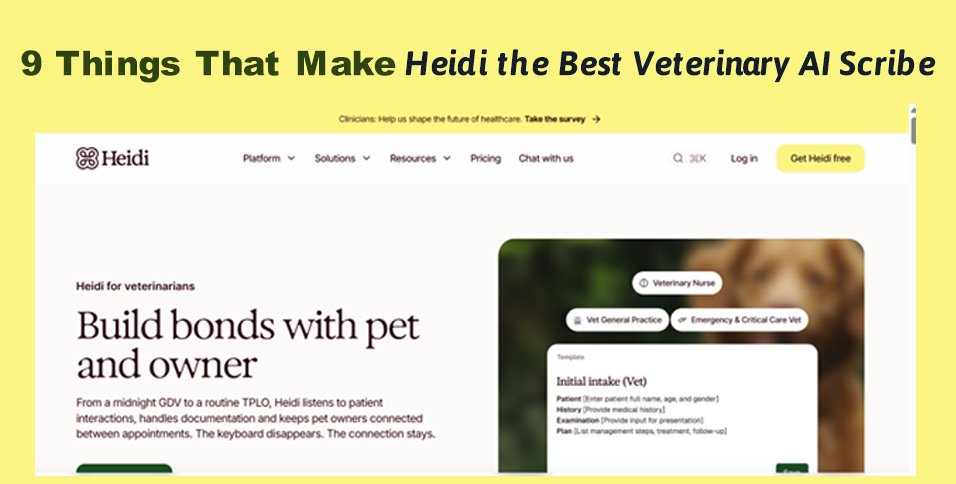
A scribe is only useful if it understands what you are actually treating. As a veterinary AI scribe, Heidi is tuned to any species, from a midnight GDV to a routine TPLO.”
That flexibility is what lets a single tool serve an entire practice. The same platform adapts to small-animal, equine, exotic, and large-animal work rather than forcing every case into one mould.
It carries through to the clinical support too. Heidi Evidence gives species-relevant answers in session, so the information matches the patient in front of you instead of defaulting to generic advice.
For a mixed practice, that adaptability is a real advantage. One tool that moves comfortably between species saves you from stitching together separate systems for different parts of the caseload.
2. Conversation handling for owner-plus-family visits
A veterinary consultation is rarely a quiet one-on-one. The owner speaks for the patient, often with family members chiming in, while you examine an animal that would rather be anywhere else.
Heidi is designed to listen to that whole interaction and turn it into a structured note. You stay focused on the pet and the people in the room while the conversation is captured for you.
The result is a record that reflects what was actually discussed. Nothing important gets lost because someone was holding a nervous patient instead of typing.
It also means you can give the owner your full attention. Eye contact and reassurance do more for a frightened client than a clinician staring at a screen ever could.
3. Custom templates by visit type: wellness, surgical, behavioural, end-of-life
No two visit types call for the same note, and Heidi does not pretend otherwise. You can start from a community template or build your own, tuned to any species and workflow.
That means you can shape a format for each kind of appointment you run. Wellness checks, surgical cases, behavioural consults and end-of-life visits can each have a template that fits how you actually work.
Crucially, you stay in control of the output. Tell Heidi what you want and where you want it, and the note comes out sounding like you wrote it because you shaped every part of it.
4. Discharge summaries written in plain language for the owner
A clinical note and an owner handout are two very different documents. Heidi generates discharge summaries alongside your SOAP notes, ready before the next patient walks in.
That lets you send owners home with instructions they can genuinely follow. Clear, readable summaries reduce confusion and the follow-up calls that come with it.
It also protects the animal’s recovery. When owners understand the aftercare, they are far more likely to get it right at home.
And because the summary is generated alongside the clinical note, it costs you no extra time. The owner-facing document is ready at the same moment your record is.
5. Referral letters drafted in the time it takes to wash up
Referrals are important but time-consuming, and they often get written long after the patient has left. Heidi generates referral letters as part of its documentation, so the draft is ready almost as soon as the consult ends.
That turns a lingering admin task into something handled on the spot. You can review and send while the details are still fresh, rather than carving out time later.
The receiving clinic benefits as well. A prompt, complete letter means the next vet has the full picture before the animal arrives.
It also reflects well on your practice. A referral that lands quickly and reads clearly signals a clinic that is organised and easy to work with.
6. Heidi Remote for offline ambulatory work
Plenty of veterinary care happens far from a desk, and Heidi accounts for that directly. Heidi Remote is a 21-gram wearable microphone that works fully offline.
That makes it ideal for ambulatory and large-animal work in barns, fields and stables. With on-device encryption, your documentation does not depend on a quiet room or a reliable signal.
It removes one of the oldest reasons records fall behind. The note is captured wherever care happens, then syncs once you are back online.
7. Connection to the practice management systems you already run
Software that sits apart from your existing tools only adds friction. Heidi is built to work across the systems you already use and connects with major records platforms.
That means your notes flow into the records you already keep rather than living in a separate silo. Your established workflow stays intact while the documentation burden lifts off it.
The payoff is adoption without disruption. There is no need to rebuild your processes around the tool, because the tool fits around them.
It also keeps your records cleaner over time. When notes land in the right place automatically, less gets lost, duplicated or forgotten in the rush of a busy day.
8. Multi-language for non-English-speaking clients
Pet owners do not all speak the same language, and care should not depend on whether they do. Heidi works in more than 110 languages, which makes it genuinely useful in multilingual communities.
That reach supports clearer communication on both sides of the consult. You can serve a wider range of clients with confidence rather than relying on a shared language to get the details right.
It quietly broadens who your practice can help. Language becomes one less barrier between a worried owner and the care their animal needs.
In diverse cities and regions, this can set a clinic apart. Owners tend to return to a practice where they felt genuinely understood rather than rushed through a language gap.
9. Independent audit under ISO 42001, with HIPAA, GDPR and APP compliance
Trust in an AI tool has to be earned with more than promises. Heidi holds certification under ISO 42001, the international standard for AI management systems, alongside ISO 27001 and SOC 2.
It also aligns with HIPAA, GDPR and the Australian Privacy Principles. For a practice handling sensitive client information, that combination of independent assessment and recognised compliance is reassuring.
Heidi backs this up with clear data handling too. It states that it does not use your data to train its AI, no audio recordings are kept, and records can be deleted permanently when you are done.
For practice owners, that mix of audited standards and plain data rules lowers the risk of adopting AI. You are not taking the vendor’s word for it; you are relying on an independent assessment.
How to test Heidi against your hardest visit type
The best way to judge a scribe is to throw your toughest case at it. Pick the visit type that usually generates the messiest notes, whether that is a chaotic multi-pet household or a complex surgical workup.
Run Heidi across a few of those consults and read the output critically. Look at whether the terminology is right, whether the structure matches how you work and whether the owner-facing documents are genuinely usable.
Because there is a free plan, this costs you nothing but a little attention. Sign up, use it on real visits and let the quality of the notes and the time returned decide for you.
Try it across a range of cases rather than a single easy one. A tool that holds up on your messiest appointment will more than handle the routine ones that fill most of the day.
Conclusion
What makes Heidi stand out is not one feature but how well the whole package fits veterinary life.
It understands the species you treat, captures the conversations you actually have and produces the documents both you and your clients need.
Layer on offline capture, broad language support and serious independent security credentials, and the case becomes hard to ignore.
Heidi handles the documentation so your attention can stay where it belongs, on the animal and the owner who came in trusting you to help.