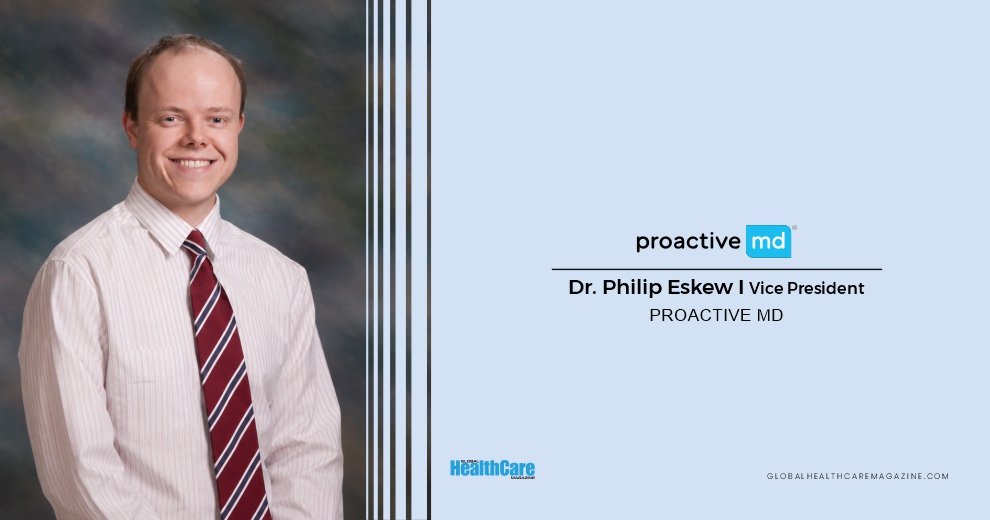
At a desk in Greenville, South Carolina, and across clinics, policy forums, and healthcare organizations spanning multiple states, Dr. Philip Eskew has spent nearly two decades proving that medicine and law are not separate disciplines but two lenses trained on the same patient. He currently serves as Vice President of Clinical Development and General Counsel for Proactive MD, an on-site primary care company headquartered in Greenville, a post he has held since February 2016.
He is also the Founder and CEO of DPC Frontier, the open access legal and policy research site he founded in February 2015 to serve a movement that, at the time, had almost nowhere else to turn for reliable guidance. The site’s own current biography identifies February 2015 as its founding date, although an AOCOPM biography describes the organization as founded in 2014.
Dr. Eskew is board certified by the American Osteopathic Association in family medicine and osteopathic manipulative treatment, correctional medicine, and addiction medicine, and he holds a Certificate of Added Qualification in occupational medicine. His clinical interests, by his own description, are broad. His legal interests, by contrast, are narrow and deliberate, concentrated almost entirely on the regulatory architecture of direct primary care.
The Making of a Policy Mind
Long before he wore either title, Dr. Eskew was cutting his teeth in Washington. In the summer of 2009, as an Osteopathic Health Policy Intern with the American Association of Colleges of Osteopathic Medicine, he met with officials from the National Institutes of Health, the Office of the Surgeon General, the Health Resources and Services Administration, the Food and Drug Administration, and the Department of Education, all while the country debated healthcare reform in real time.
That internship produced a research paper, Finding a Faster Route to Practice: From Medical Student to Board Certified Physician, published in the West Virginia Medical Journal in May/June 2010. The paper examined accelerated pathways into practice, including three-year medical-school models and combined medical-school/residency approaches.
From April 2010 to March 2012, he served as National Political Affairs Director of the Student Osteopathic Medical Association, authoring monthly political development briefings, building out the organization’s political affairs webpage and blog, and leading student workshops on health policy and medicolegal review at SOMA conventions.
He wrote an article, “Tracking the 112th Congress: SOMA’s Call to Action,” for TheDO Online, where the article addressed issues including residency funding and the patient-centered medical home, attended the AMPAC Campaign School and the ACP Leadership Day in Washington, and was reappointed for a second term, during which he also served as SOMA’s voting member in the AOA’s House of Delegates and chaired its Resolutions Committee. In that same window, he served as National Operations Chair of Omega Beta Iota, the national osteopathic political action honor society.
Residency and a Prize-Winning Paper
Dr. Eskew began his family medicine residency at Danville Regional Medical Center in Virginia in June 2012, where he sat on the DRMC Credential Committee and, along the way, took first place in the ACLM Post-Doctoral Writing Competition for a paper titled “Obtaining Medical Licensure Without Federal Graduate Medical Education Funding.” In March 2014, he transferred to UPMC Pinnacle Lititz in Pennsylvania to finish his training, graduating in June 2015. During his third year, he moonlighted part-time in urgent care at Patient First in Mechanicsburg.
That same June, he was named a Robert Graham Center Visiting Scholar through the American Academy of Family Physicians, a four-week, on-site health policy fellowship supported by a grant from the Pisacano Leadership Foundation. Working under Dr. Andrew Bazemore and Dr. Kathleen Klink, he continued his direct primary care research, which led to the 2015 publication of a study examining the distribution and cost of DPC practices across the United States in the Journal of the American Board of Family Medicine.
Wyoming, and the Work Behind Prison Walls
Beginning in July 2015, Dr. Eskew began serving as a site medical director for multiple state prisons in Wyoming, and he continues to practice broad-scope family medicine, with much of that work taking place in correctional medicine. It was demanding, largely unseen work, the kind that shapes a physician’s understanding of access in ways a private clinic rarely can. His continuing clinical work also means that correctional medicine is not simply a chapter in his past but an active part of his present practice.
Building DPC Frontier
DPC Frontier was created as an open-access resource for physicians navigating the legal and policy questions surrounding direct primary care. It provides detailed legal and policy guidance free of charge to physicians who might otherwise pay thousands of dollars elsewhere for less comprehensive information. The organization’s founding belief, carried forward without passwords or dues, holds that price transparency and honesty are critical to the patient-physician relationship, and that direct primary care can meet what is often called the triple aim of access, cost, and quality.
Proactive MD, and the Present
Since February 2016, Dr. Eskew has built Proactive MD’s provider educational curriculum from the ground up, developing more than 100 CME outlines and lectures for a company that operates on-site clinics for employers nationwide. He also continues to provide direct patient care, alongside his leadership responsibilities, while volunteering as general counsel to the Direct Primary Care Coalition, drawing on his accounting and legal backgrounds to work through questions of federal tax and insurance law.
He has also remained active in healthcare policy and accreditation work. Earlier in his career, he served as a voting member of the American Osteopathic Association’s Bureau of Healthcare Facilities Accreditation; the AOA terminated the Bureau’s operations in 2019 after the accreditation program’s deeming authority transitioned to the Accreditation Association for Hospitals and Health Systems.
The Work Behind the Record
Over the course of his career, Dr. Eskew has delivered more than 80 continuing education presentations for organizations including the AOA, the ACOFP, the AOCOPM, the AAFP, the AAPS, the Docs4Patient Care Foundation, the New York State Bar Association, and the National Commission on Correctional Healthcare.
His research has appeared in the Journal of American Physicians & Surgeons, the Journal of the American Board of Family Medicine, Family Practice Management, the Journal of Legal Medicine, and the West Virginia Medical Journal. His policy training runs deep, including an AOA Health Policy Fellowship, the AOA’s Training in Policy Studies program, the AAFP’s Robert Graham Center Visiting Scholars program, and AACOM’s Osteopathic Health Policy Internship program.
Today, the work remains active rather than archival. DPC Frontier continues to publish legal and policy analysis, while Eskew remains active in clinical medicine, healthcare policy, and professional education. In 2026, the American Medical Association also featured him discussing direct primary care and the physician’s transition from residency into practice.
For Dr. Eskew, direct primary care, correctional medicine, occupational medicine, and healthcare policy are not separate careers but different rooms in the same house, and for two decades he has worked, brick by brick, to make sure that house has good bones.