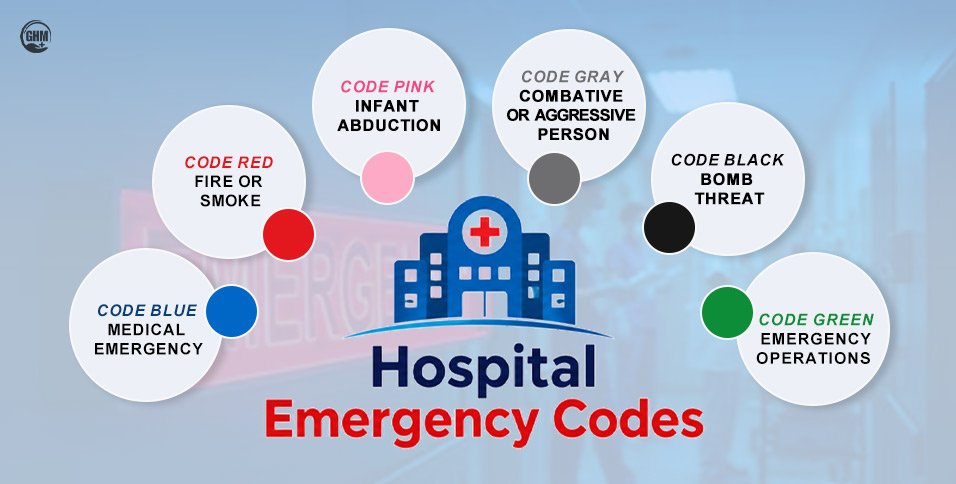
While watching Grey’s Anatomy, you must have heard Dr. Meredith Grey scream “Code Blue” a million times. You probably know it’s a life-or-death situation. The nurses are on alert and running around in a rush. But do you know there are many other such colour codes that hospitals use in emergency alerts? However, these hospital emergency codes are not universal. Different hospitals and locations use different colour codes, but the most common ones are quite similar everywhere.
Hospital staff participate in regular orientation sessions, educational workshops, and realistic simulations tailored to each emergency code. These drills ensure that every clinical and administrative team member understands their precise role, chain of command, and required actions under pressure.
Code Blue, Code Red, and Code Black — these hospital emergency codes are vital communication tools that hospital staff use to handle critical situations rapidly and discreetly. Understanding these various hospital emergency codes will help you when you ever find yourself in such a situation.
Read this guide to learn these colour codes for hospitals so you, as a patient, can keep calm so you stay prepared, and stay alert in such situations.
Common Hospital Emergency Codes and Their Meanings
Emergency code meanings vary between hospitals and regions. Different healthcare facilities often assign different meanings to the same color. The List of hospital emergency codes below describes commonly used meanings, rather than a universal system.
1. Code Blue: Medical Emergency
Code Blue typically signals a life-threatening medical emergency, most often associated with cardiac arrest or respiratory failure. Trained clinical teams rapidly respond to a hospital emergency code blue, with CPR, defibrillation, and advanced life support. Some hospital systems use separate designations for adult, pediatric, and neonatal emergencies.
2. Code Red: Fire or Smoke
Hospital emergency Code Red indicates an actual or suspected fire, smoke, or a related alarm. Staff instantly initiate established fire-safety procedures, isolate affected areas, and prepare for evacuation if necessary.
- Code Pink: Infant Abduction
Hospital emergency Code Pink is used when a suspected infant, below the age of 12 months, is abducted from a nursery or maternity ward. Security teams immediately lock down the facility, restrict access, monitor surveillance feeds, and check exits.
- Code Purple: Child Abduction
Emergency Code Purple is used to alert the hospital of a missing or abducted child above the age of 12 months. Hospitals respond to Code Purple by restricting movement, increasing security presence, and monitoring exits closely.
- Code Orange: Hazardous Material Spill or Release
Code Orange signals a hazardous-material incident involving chemicals, biological hazards, or other dangerous substances. Affected zones in hospitals are quickly isolated, evacuated, or scheduled for professional decontamination.
- Code Gray: Combative or Aggressive Person
Code Gray in medical emergency is used to alert people of a combative or potentially combative person who does not have a weapon. Security personnel respond to Code Gray by de-escalating the situation. While patients and visitors should avoid confrontation and follow staff directions in a Code Gray situation.
- Code Silver: Weapon or Active Shooter
Hospital emergency code Silver is used for an active shooter, a person with a weapon, or a hostage situation. Hospitals immediately activate security protocols and law enforcement procedures, while occupants must seek safety and follow facility instructions.
- Code Black: Bomb Threat
Hospital emergency code Black indicates a bomb threat inside or near the facility. Trained security personnel and local emergency authorities manage the response through coordinated inspections and controlled movement.
- Code White: Pediatric Medical Emergency
In many systems, Code White identifies a severe, life-threatening pediatric medical emergency. Hospitals use Code White as a separate alert because treating infants and children requires specialized pediatric equipment and clinical expertise.
- Code Green: Emergency Operations or Missing Patient
The Hospital emergency Code Green alert features particularly variable meanings depending on the facility. Code Green may commonly indicate the activation of an emergency operations plan, a mass-casualty response, or a missing high-risk patient.
Why Do Hospitals Use Medical Emergency Codes?
Hospitals rely on emergency color codes instead of plain-language announcements for several critical operational reasons.
- Faster Communication
Hospital emergency codes provide a short, standardized signal that alerts relevant personnel instantly. Staff recognize the exact nature of the emergency and immediately begin their assigned response.
- Coordinated Response
Hospital emergency codes connect diverse departments, including clinical services, security, facilities management, and administration. Each emergency triggers predefined roles and procedures.
- Reduce Unnecessary Panic
Hospital emergency codes communicate urgent events to staff members without broadcasting alarming details over public loudspeakers. This discretion prevents panic among patients and visitors in waiting areas.
- Protect Patients and Visitors
Hospital emergency codes support organized, rapid responses during situations such as medical crises, fires, security threats, and hazardous material incidents.
Are Hospital Emergency Codes Standardized?
No. Hospital emergency codes are not universally standardized. Different hospitals, healthcare systems, states, and countries can assign entirely different meanings to the exact same color.
For example, an anonymous survey of 304 employees across five healthcare facilities revealed that participants could correctly identify local emergency codes only 44% of the time.
This lack of uniformity creates safety risks when healthcare workers move between different facilities. To address these inconsistencies, organizations standardized regional codes. A broader national and international movement toward uniformity continues to grow.
Some Hospitals Are Moving From Emergency Color Codes to Plain Language
To modernize communication and reduce confusion, many healthcare systems are shifting away from traditional color codes toward plain-language alerts. Legacy codes can easily overlap; for instance, Code Pink traditionally means an infant abduction, but some facilities use it to indicate an infant cardiorespiratory arrest. Failing to distinguish between a security lockdown and a clinical resuscitation code can lead to disastrous outcomes.
Major organizations, including the American Hospital Association, the Federal Emergency Management Agency (FEMA), the Joint Commission, and numerous state hospital associations, recommend plain-language overhead paging to maximize clarity and speed up emergency responses.
What Should Patients and Visitors Do When They Hear Hospital Emergency Codes?
When a hospital emergency code echoes through a hallway, patients and visitors play a straightforward role in maintaining safety,
They Should:
- Stay calm and alert.
- Do not attempt to interpret or act on the code yourself unless you possess professional training.
- Stay clear of emergency responders, clinical teams, and specialized equipment.
- Follow all instructions given by hospital staff immediately.
- Avoid entering restricted or locked-down areas.
- Ask staff members for clarification if you feel uncertain about what to do.