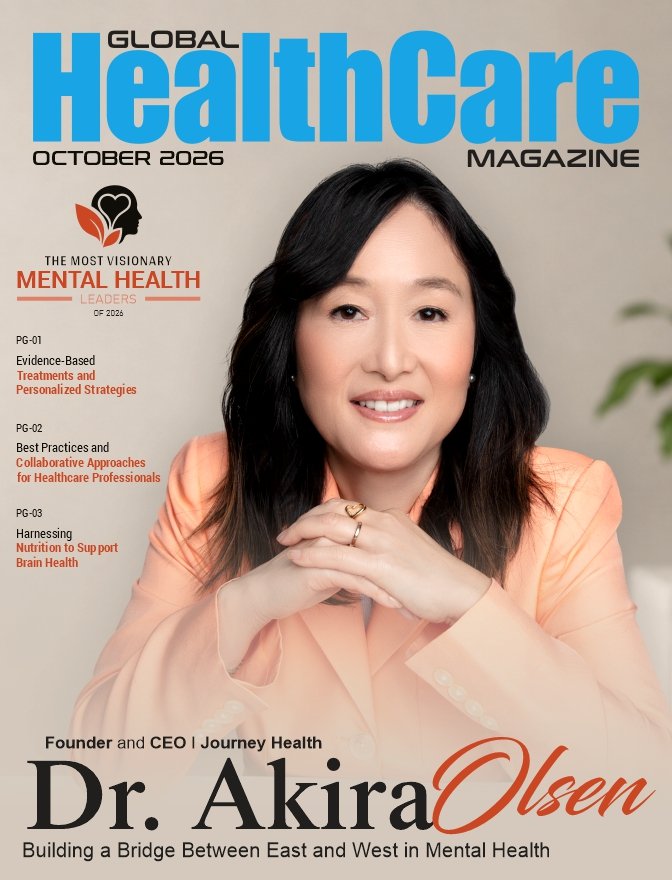
A therapy room in Burlingame keeps its silences differently than most rooms do. It is a silence built for listening rather than for filling, the kind that allows a difficult sentence to sit on the table a while before anyone has to pick it up. Dr. Akira Olsen has spent more than two decades sitting inside that particular kind of quiet, first as a psychology intern learning how to hold it, and now as the Founder and CEO of Journey Health, the digital mental health clinic she built to carry that same attentiveness far past the walls of any single office.
Dr. Olsen, a licensed clinical psychologist who holds a PsyD, an MA, and an EMBA, was named a 2024 Marquis Who’s Who Honoree, recognized for her contributions to youth and family mental health treatment and education across California and the country. But titles, in her case, tell only a fraction of the story. What distinguishes her is the way her practice moves in several directions at once: clinical, cultural, educational, and entrepreneurial, all of it circling back to a single conviction: that healing is not an event but a discipline, practiced daily, in rooms both literal and digital.
Two Worlds, One Practice
Dr. Olsen grew up in Tokyo, where she studied art and kendo, the Japanese martial art of fencing that trains a practitioner to unite breath, focus, and physical precision into a single act. That discipline became an early influence on the way she understands the relationship between mind and body, a perspective that continues to inform her clinical work. During her graduate studies, she moved through a wide range of therapeutic traditions, Jungian, existential, humanistic, mindfulness-based, and transpersonal among them, alongside both Western and Eastern approaches to Buddhist meditation. That early, deliberate exposure to multiple schools of thought became the scaffolding for a career spent refusing to choose a single lens.
Fluent in both English and Japanese, she has carried that bicultural fluency directly into her clinical offerings. Her later academic training layered Western, evidence-based protocols onto that foundation. Between 2018 and 2022, she served as a clinical researcher at Stanford University School of Medicine and as clinical faculty and a supervisor at Palo Alto University and the PGSP-Stanford Psy.D. Consortium. There, she oversaw more than eighty psychology trainees and interns, developed a program that added psychoeducational and referral resources reaching 350 patients, and led outreach initiatives across the state of California aimed at improving healthcare access for people managing complex medical, psychiatric, and substance use conditions.
Two Decades in the Room
Before the titles accumulated, there was simply the work: sitting across from one client, then the next, learning what actually helps. Dr. Olsen’s earliest clinical years were spent at the Ann Martin Center, from 2004 to 2008, where she provided psychodynamic psychotherapy and psychoeducation to children and their parents while carrying a weekly caseload of twenty clients. She moved from there to the Homeless Children’s Network, where between 2007 and 2010 she delivered psychotherapy, counseling, and psychodiagnostic testing to children and families living in shelters, supportive housing, and a substance abuse rehabilitation center, maintaining twenty to thirty clients at a time while also designing community health education programs and managing their budgets.
The years that followed built outward from that foundation. As a per diem psychologist at Stanford University School of Medicine from 2018 to 2019, she conducted CAPS assessments for a PTSD research study at the VA hospital, writing reports that fed directly into the research itself. At StarVista, during that same period, she supervised trainees across several county-contracted programs, among them GIRLS, Camp Glenwood, Institution, and Insights, while managing electronic medical records across six programs in total. From 2021 to 2023, she also served as a clinical psychologist at OCTAVE, expanding her work into telehealth and multicultural mental health care across California. From 2023 to 2025, she served as a clinical psychologist at LifeStance Health, continuing her work with diverse and underserved populations.
The Family Court and the Private Practice
Since March of 2010, Dr. Olsen has run her own hybrid practice, Dr. Akira Olsen, Psychologist Inc., offering in-person and virtual services, along with forensic evaluations, to children, teens, families, and adults across the San Francisco Bay Area, in both English and Japanese. That practice now spans more than sixteen years. From April 2017 to June 2025, she also served as a Family Court Panel Psychologist for San Mateo County, providing child-parent therapy, family therapy, co-parenting support, and brief assessments in cases where a family’s future is being decided in a courtroom rather than a therapy office. It is exacting, high-stakes work, the kind that leaves little room for the abstractions that sometimes creep into clinical theory. She has also served as a Board Member and Diversity Chair for the San Mateo County Psychological Association, extending her influence from the therapy room into the profession’s own institutional life.
Beyond the Consulting Room
Clinical work, for Dr. Olsen, has never stood alone. Since August of 2024, she has served as Founder and Program Director of WARM Education, Training & Consulting, a program offering mental health education, assessment, and therapy focused specifically on trauma and ADHD, prevention, and solution development, delivered through programs built for individuals, parents, educators, and businesses. Under that banner sits Warm Lounge, a membership community dedicated to ADHD mental health education, where members access educational content, connect with experts, and build a supportive network around a condition too often left unaddressed until it becomes a crisis.
More recently, since January of 2026, she has written as an Executive Contributor for Brainz Magazine, publishing thought leadership at the intersection of psychology, artificial intelligence, and human-centered care. Her contributions there translate clinical expertise into frameworks that scale, feeding into a broader, global conversation about mental health systems, prevention, and innovation. Her insights and public education efforts have reached audiences through iHeartRadio and Fox, and in 2026 she was named Influencer Magazine UK’s Humanitarian of the Year for her broader body of work.
A Roadmap Called The Journey to Self
In the middle of all this activity, Dr. Olsen wrote a book. The Journey to Self: Practical Exercises for Building a Positive Relationship with Yourself and Transforming Your Mental Health is organized around eighteen interconnected pillars of psychological and whole-life wellness, beginning with self-awareness and self-care and moving outward through self-compassion, healthy boundaries, trauma healing, self-forgiveness, relationships, the use of time, and, notably, the connection between financial wellbeing and mental health, a subject most self-help literature avoids entirely.
“The most important relationship you’ll ever build is the one with yourself,” she said of the book’s central premise. Each chapter draws on established modalities, Cognitive Behavioral Therapy, Dialectical Behavior Therapy, Acceptance and Commitment Therapy, EMDR, somatic therapy, and mindfulness-based practice, translating clinical protocol into exercises built for people with no therapeutic background at all. The self-compassion work draws on Kristin Neff’s research; the gratitude practices lean on the positive psychology of Martin Seligman and Robert Emmons; the trauma chapter is grounded in Bessel van der Kolk’s research on how the body carries and eventually releases what the mind cannot process alone.
What runs beneath all of it is Dr. Olsen’s refusal to let wellness be treated as a single, isolated category. “Wellness isn’t just one thing. It spans mind, body, heart, relationships, and finances,” she explained, and the book’s structure reflects that belief directly, folding financial stress, a persistent driver of anxiety and relational conflict, into a therapeutic conversation that too often leaves it out. The exercises themselves are built small on purpose: a ten-minute body scan, a sixty-second emotion check-in repeated three times daily, a five-minute journaling practice before bed. None of it asks for hours a person does not have. “Healing begins when we stop performing wellness and start actually practicing it,” she said, distinguishing between the two in a single sentence that captures much of her clinical philosophy.
Journey Health: Care Across a Lifespan
The book and the clinic grew from the same root. Journey Health, which Dr. Olsen founded in September of 2025 and continues to lead as CEO, is an integrative digital care clinic based in Burlingame, California, built around the conviction that people continue to grow and heal at every stage of life, not only during crisis and not only in youth. The clinic provides mental health support, including therapy, psychoeducation, and community programs, across the full human lifespan, from birth through the end of life.
That lifespan model also extends to families facing critical illness, including those navigating cancer diagnoses, caregiving demands, anticipatory grief, and loss, through individual therapy, family sessions, and group support. Alongside its clinical care, Journey Health offers psycho-spiritual support focused on meaning-making, presence, and compassionate accompaniment.
It is, in a sense, the natural extension of everything that came before it: the kendo discipline, the bilingual practice, the family court work, the years of supervising trainees, the WARM Education programs, the book’s eighteen pillars, all of it converging into a single clinical philosophy built around whole-person mental health and wellness, accessible and evidence-based care, the integration of science with mindfulness, and community support for lasting wellbeing.
The Long Practice of Coming Home
Dr. Olsen’s career resists easy summary because it was never built to be summarized. It was built the way kendo is built, through repetition, through small daily practices compounding over years into something durable. A weekly caseload of twenty clients in a nonprofit office in 2004 does not look, on paper, like the origin of a digital health company. But Dr. Olsen’s own account of the work suggests she never saw much distance between the two. “I have practiced these exercises myself, even briefly, every day for decades,” she said of the tools she now offers others, a sentence that reads less like marketing language and more like a clinician reporting back from her own long experiment. The evidence she cites is not only academic. It is the accumulated testimony of the people she has treated, across shelters and family courts and telehealth screens and now a company built to hold all of it at once.
Quote