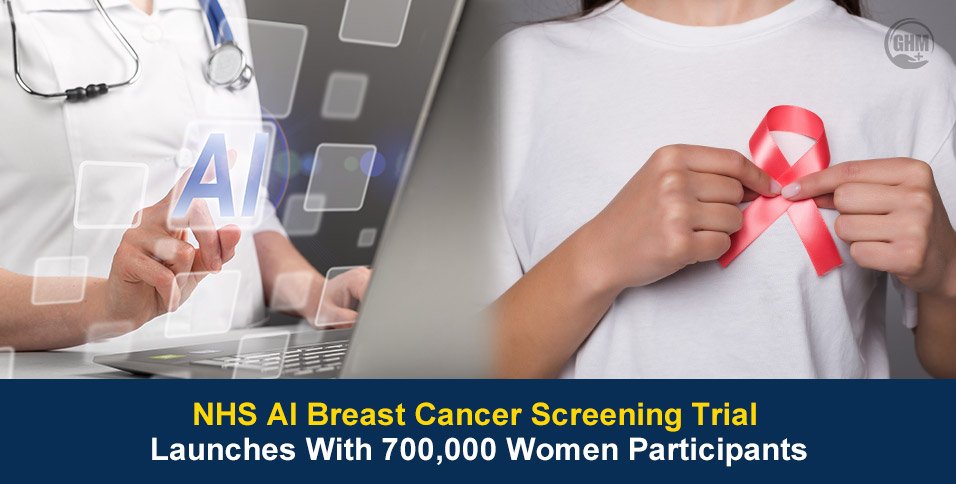
Nearly 700,000 women across the UK are expected to be invited to participate in a major NHS AI breast cancer screening trial designed to investigate whether artificial intelligence (AI) can detect breast cancer earlier. The three-year study, known as EDITH (Early Detection using Information Technology in Health), will operate across 30 breast screening centres. Recruitment has started at Cambridge University Hospitals, where researchers will test whether AI-assisted mammogram reviews can improve early breast cancer detection, reduce radiologists’ workloads and maintain patient safety.
What Is the NHS AI Breast Cancer Screening Trial?
The EDITH trial is a large-scale research project examining how artificial intelligence in mammography could support the NHS breast screening programme.
The University of Warwick, the University of Cambridge and Cambridge University Hospitals NHS Foundation Trust are working with NHS England for this AI breast cancer screening trial. The National Institute for Health and Care Research (NIHR) is funding the research.
According to the Health Research Authority, the study aims to recruit approximately 660,000 women from 30 breast screening centres.
Researchers in the NHS EDITH trial will compare standard screening with AI-assisted approaches to evaluate cancer detection accuracy, clinical outcomes and the potential costs and benefits of introducing AI into routine screening.
How Will Artificial Intelligence in Mammography Work?
Currently, two trained NHS specialists examine each mammogram, which is an X-ray image of the breast used to identify possible signs of cancer.
The NHS AI breast cancer screening trial will investigate whether AI can support this process through two approaches:
- AI as a second reader: A human specialist examines the mammogram first, followed by AI, which checks for suspicious areas that the specialist might have missed.
- AI as an initial reader: AI assesses the mammogram first and identifies whether it shows a higher or lower risk of cancer before specialists review it.
Researchers will compare these approaches with the existing two-human-reader system.
Importantly, AI for breast cancer detection will not be used independently. Human specialists will review the images, and final decisions will follow standard clinical assessment and arbitration procedures.
Why Is the NHS Testing AI for Breast Cancer Detection?
The early breast cancer detection trial comes as the NHS faces increasing pressure on its radiology workforce and growing demand for diagnostic services.
Breast screening requires considerable specialist time because radiologists must examine large numbers of mammograms, although fewer than 1% show signs of cancer.
The NHS AI breast cancer screening trial aims to investigate whether AI can help address several challenges:
- Radiologist shortages: AI could reduce the time specialists spend reviewing routine screening images.
- Earlier detection: AI may identify subtle changes in breast tissue that are difficult to detect.
- Reduced waiting times: More efficient image assessment could help patients receive results sooner.
- Improved clinical capacity: Radiologists could spend more time supporting patients who need further investigations and treatment.
Breast cancer remains a major health concern in the UK, with approximately 59,000 cases diagnosed annually.
What Are the Potential Benefits and Risks of AI Screening?
AI-assisted breast cancer screening could improve diagnostic efficiency, but researchers must establish that the technology is safe and reliable before wider NHS adoption.
One major concern in AI for breast cancer detection is false-positive results, where screening identifies a possible abnormality that later investigations do not confirm as cancer. These results can lead to additional tests, unnecessary anxiety and further clinical workload.
Researchers will also investigate overdiagnosis, which occurs when screening detects slow-growing cancers that might never have caused symptoms or affected a woman’s health.
The findings from the NHS AI breast cancer screening trial will help determine whether AI improves screening without creating additional risks for patients.
Who Can Participate in the NHS EDITH Trial?
The EDITH trial will run for approximately three years, with researchers also monitoring participants through screening records and cancer registries for a further four years. The NHS breast cancer screening programme generally invites women aged 50–71 for mammograms every three years.
Eligible women attending participating screening centres will receive information about EDITH through their screening invitation letters. Women can opt out if they do not want AI to assist with reviewing their mammograms.
The trial will not change the screening appointment itself. It will evaluate how specialists assess the collected images.
If successful, the NHS AI breast cancer screening trial could influence the future use of AI in healthcare and breast cancer screening. However, wider implementation will depend on evidence demonstrating safety, accuracy and clinical effectiveness.