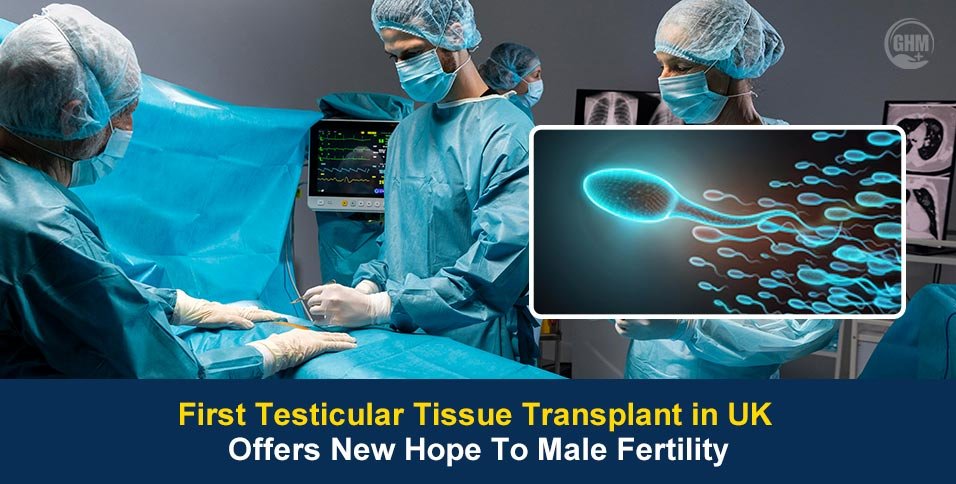
Doctors at the University of Edinburgh have performed the first testicular tissue transplant in UK, giving a 19-year-old man a potential new route to fertility after chemotherapy affected his sperm production. The pioneering procedure involved transplanting his own frozen testicular tissue, which doctors had preserved before cancer treatment.
This fertility procedure, performed by NHS Lothian, is the first of its kind in the UK and only the second reported human procedure worldwide. Doctors will now monitor the patient to determine whether the transplanted tissue can produce sperm.
The first testicular tissue transplant in UK builds on more than a decade of University of Edinburgh fertility research focused on preserving fertility in boys who face treatments that may cause permanent infertility.
What Happened in the First Testicular Tissue Transplant in UK?
The 19-year-old patient had testicular tissue removed and frozen in 2023, when he was 16, before receiving high-dose chemotherapy as part of treatment for a serious blood disorder. He later underwent a bone marrow transplant.
Chemotherapy can permanently damage the cells responsible for sperm production. Three years after his treatment, tests showed that the patient had no sperm in his semen.
In August 2026, doctors at NHS Lothian transplanted some of his previously preserved tissue back into his body leading to the first testicular tissue transplant in UK. The patient has recovered well and remains under close medical monitoring.
The patient, who has chosen to remain anonymous, said the testicle transplant procedure had given him “genuine hope for the future,” while acknowledging that doctors do not yet know whether it will work.
Why Is the UK Testicle Transplant Procedure a Major Development?
The first UK testicular tissue transplant represents a potential advance in fertility preservation for children and young people undergoing cancer treatment.
Researchers at the University of Edinburgh have spent more than 10 years developing a programme to collect and preserve testicular tissue before potentially sterilizing treatment. The project began in 2015 with funding from Children with Cancer UK and later received additional support for the transplantation study.
More than 1,200 patients in the UK and 3,100 worldwide have now had testicular tissue stored for potential future clinical use.
The University of Edinburgh fertility research also builds on earlier laboratory and animal studies. Research in non-human primates showed that frozen testicular tissue could be transplanted after sterilizing chemotherapy. Mature sperm produced from the transplanted tissue were subsequently used in assisted reproduction, resulting in a live birth.
Earlier in 2026, doctors in Belgium reported the first human demonstration of the approach. Testicular tissue frozen before puberty was transplanted back into the patient and subsequently produced mature sperm.
How Can Frozen Testicular Tissue Help Restore Fertility?
The transplanted tissue contains spermatogonial stem cells. These are specialized cells that can produce sperm from puberty onwards.
The approach aims to preserve these cells before chemotherapy damages them. The basic process for sperm production after chemotherapy to work involves:
- Removing a small amount of testicular tissue before fertility-damaging treatment.
- Freezing and storing the tissue for potential future use.
- Transplanting the preserved tissue back after treatment.
- Monitoring the tissue for evidence of renewed sperm production.
The approach could be particularly important for younger boys. Semen freezing is an established form of male fertility preservation for adolescent and adult males.
But prepubertal boys do not yet produce sperm and therefore cannot use this option. As a result, there is currently no established clinical method that can reliably restore fertility in boys who undergo treatments that permanently damage sperm-producing cells.
Will the First Testicular Tissue Transplant in UK Restore Fertility?
It is too early to know whether the first testicular tissue transplant in UK will restore fertility for the UK patient.
Doctors plan to examine part of the transplanted tissue after about eight months to determine whether it has started producing sperm. The results will help researchers assess whether the technique can become a wider fertility-preservation option.
Rod Mitchell, professor of developmental endocrinology at the University of Edinburgh and consultant paediatric endocrinologist at NHS Lothian, described the development as “a big step toward helping boys whose treatments damage their fertility.”
For now, the first testicular tissue transplant in UK remains an experimental procedure. However, its outcome could provide important evidence for the future of male fertility preservation.