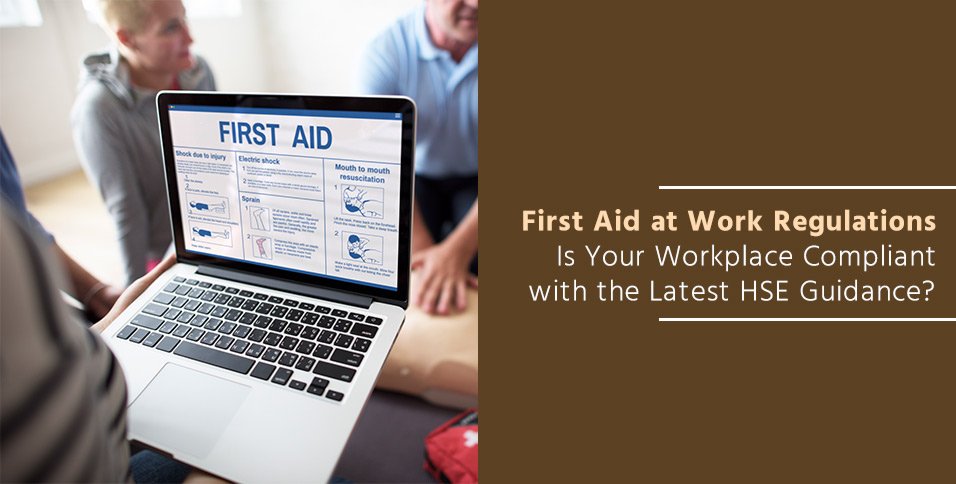
A first-aid box on the wall does not prove a workplace is ready for an emergency. Employers have to decide what help may be needed, who can provide it and whether that help will still be available during shifts, absences and unusual work patterns. That is the practical standard behind the Health and Safety (First-Aid) Regulations 1981.
HSE’s current L74 guidance was updated in 2024 and remains the key reference point in 2026. The amendments did not create a new set of legal duties, but they sharpened two areas that employers can easily overlook: mental health when assessing first-aid needs and arrangements for life-threatening bleeding where the risk is credible. For organisations that have not reviewed their arrangements for several years, those changes are a useful reason to check whether the old plan still fits the workplace.
Start with a first-aid needs assessment
The Regulations require employers to provide adequate and appropriate equipment, facilities and personnel so employees can receive immediate attention if they are injured or taken ill at work. HSE does not set one fixed number of first-aiders for every business because the right provision depends on the circumstances.
A needs assessment should look at the work itself, the hazards present, the size and distribution of the workforce, shift patterns, previous incidents and the distance from emergency medical services. Lone workers, travelling staff and people working across several floors or buildings can change the answer. So can hazardous machinery, chemicals, work at height or a history of serious injuries.
Where the assessment shows that trained first-aiders are required, employers should match training to the level of risk. A Basic First Aid at Work course can support staff who need practical emergency skills, but the employer still has to decide whether basic provision is enough for the hazards on site. Higher-risk work may justify broader first-aid competence or additional training for specific injuries.
Check cover, not just headcount
A common weakness is to count trained people without checking whether they are actually available when needed. A business may have several certificate holders on paper and still have no effective cover on a night shift, in a remote warehouse or during annual leave.
HSE’s guidance asks employers to consider planned and unplanned absences. It also points out that first-aid provision needs to be available whenever people are at work. That makes rota planning part of first-aid compliance. Multi-site employers should look at each location rather than assume a central arrangement covers everyone.
The distinction between an appointed person and a first-aider also matters. An appointed person can take charge of arrangements, maintain the kit and call the emergency services, but that role does not automatically make them competent to provide first aid beyond their training.
Review what is in the kit
There is no universal statutory contents list for a workplace first-aid kit. HSE advises employers to use the needs assessment to decide what is required. A low-risk office will need different provision from a fabrication shop, laboratory or site where cuts, burns or eye injuries are foreseeable.
Kits should also be checked. Sterile items expire, stock gets used and supplies can migrate away from where people expect to find them. If the workplace is spread across several buildings or floors, one centrally stored box may be technically present but practically useless when an incident occurs.
The 2024 update to L74 also gives more attention to life-threatening bleeding. Employers do not need specialist trauma equipment everywhere. They do need to consider whether their activities create a realistic risk and, if so, what equipment and competence would be appropriate.
Do not treat mental health as a separate topic
HSE now expressly asks employers to take account of employees’ mental health when considering first-aid needs. This does not mean every first-aider must become a mental health specialist. It means the assessment should reflect how people may become unwell at work and what support is realistically needed until professional help is available.
The same principle applies to employees with known medical needs where information has been voluntarily shared. A severe allergy, epilepsy or angina may affect emergency planning. Employers should handle personal information carefully and only make arrangements that are proportionate and agreed.
Decide whether an AED belongs in your plan
Automated external defibrillators are now common in offices, shopping centres and public venues, which can create the impression that every employer is legally required to have one. HSE is clear that health and safety law does not impose a general duty to provide an AED in every workplace.
The first-aid needs assessment should drive the decision. If an employer chooses to provide one, workers need to know where it is and how the arrangement works. AED Training can give staff the confidence to use a defibrillator alongside CPR, while routine checks should confirm that pads, batteries and the unit itself remain ready for use.
AED provision is most useful when it is integrated into the emergency plan rather than treated as a piece of equipment bought once and forgotten. Clear access, signage, maintenance and communication all affect whether it can be used quickly.
Keep training and certificates current
For first aid at work purposes, HSE says certificates last three years. It also strongly recommends annual refresher training to help first-aiders maintain basic skills. Employers should have a simple way to track expiry dates and arrange requalification before competence lapses.
Training providers no longer need HSE approval. Since 2013, employers have been responsible for selecting a competent provider, and HSE updated its guidance on that selection process in 2024. Course content, trainer competence, assessment methods and quality assurance all deserve attention when choosing a provider.
Use incidents to test the system
A real emergency often exposes weaknesses that a written policy misses. After an incident, employers should check how quickly help arrived, whether equipment was easy to locate, whether emergency services received clear directions and whether first-aid cover was adequate for the shift.
HSE’s October 2026 prosecution of a Lancashire fabrication company after a worker lost part of his thumb is a reminder of how quickly an ordinary task can turn into a serious injury. First aid does not replace risk control, but a serious injury still demands a fast, organised response while professional treatment is arranged.
Conclusion
First-aid compliance is built around suitability rather than a standard shopping list. Employers need to assess their own risks, provide enough trained people and equipment, maintain cover whenever work takes place and review the arrangement when work, staffing or incident history changes.
For businesses relying on a plan written several years ago, the sensible step in 2026 is to compare it with current HSE guidance and the workplace as it operates today. A well-stocked cabinet matters. Knowing that the right person can reach an injured or unwell worker quickly matters more.