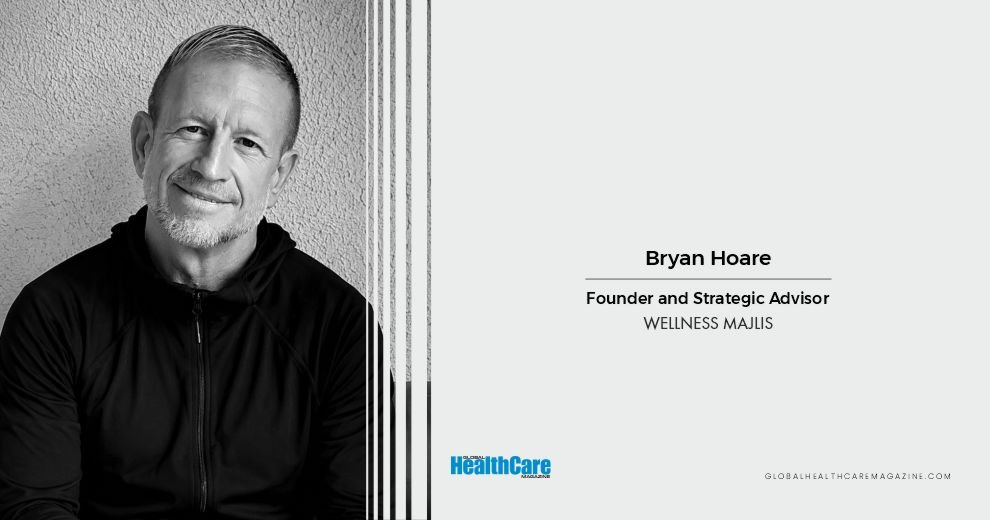
Bryan Hoare’s early professional work centred on human performance and coaching, supported by an M.Sc. in Exercise and Nutrition Science with a strong grounding in physiology, respiratory physiology, biochemistry, performance, ageing and adaptation to exercise. His later MBA focused on leadership, organisational behaviour, human resources and team performance, adding a second perspective on how people function within relationships, organisations and culture.
“In practice, physiology, behaviour and context rarely separate neatly,” Bryan explains. “A person can be physically capable and psychologically overwhelmed; clinically stable but socially disconnected; or highly informed yet unable to change a damaging behaviour.”
His work has since integrated exercise science, elite sport, clinical healthcare, and wellness in luxury hospitality, with a focus on the whole person and the conditions that support human capability over time.
From the Wellness Majlis to Journeyman
The Wellness Majlis is a programme Bryan Hoare developed at Naufar Hospital, under Qatar’s Ministry of Public Health, where psychiatry, psychology, nursing, physiotherapy, occupational therapy, family therapy and other disciplines worked together. The biopsychosocial model provided a practical way to understand health and recovery across biological, psychological and social dimensions.
The Wellness Majlis created space for patients, clinicians and operational teams to speak openly about the care experience and people’s personal journeys. One mechanism the team found particularly useful was using the forum to compare professional assumptions with lived experience. “We had to listen carefully across those perspectives to refine how we worked,” he says.
Journeyman takes that principle further by helping people move when they feel stuck, taking clients on a literal journey to somewhere new and creating an opportunity in that new environment to work on their motivations and capabilities, make better decisions, and establish healthier behaviours.
Wellness and Longevity in Context
Having worked across 22 countries and diverse wellness environments, Bryan has seen how difficult it is to defend universal assumptions and ideals about what wellness and longevity should look like.
“The wellness industry often discusses longevity as though it begins with optimisation,” he says.
“Much of the historic increase in lifespan came through public-health measures such as sanitation, safer childbirth, vaccination, better nutrition and control of infectious disease, followed by improvements in preventing and treating cardiovascular disease, cancer and metabolic illness.”
Work across more than twenty countries also makes universal assumptions difficult to defend. Human needs recur across cultures: belonging, safety, autonomy, purpose, relationships, recognition and meaning. However, the conditions around those needs vary enormously.
“Agency, our ability to make and act on choices, operates inside circumstances,” he explains. Income, family, culture, healthcare access, social expectations and environment all influence what someone can realistically do.
Strategy, Judgement and Experience Design
For Bryan, strategy begins with the individual, the desired outcome and the level of intervention the situation actually warrants. “What are we trying to improve, what is limiting us, and what combination of behaviour, expertise, environment or treatment is likely to make a useful difference?” he asks.
At the premium end of the market, access to care is rarely the main constraint. People can already reach sophisticated diagnostics, physicians, practitioners and technologies; the greater need may be judgement about what makes a difference, what works together and how much is enough.
Each additional intervention carries cost and complexity. The strongest models depend on good judgement and coordination, creating enough human value to justify the resources required to deliver them.
That same principle shapes Bryan’s work as a Founder and Strategic Advisor.
“My role often requires translating between disciplines that naturally see different parts of the same problem,” he says. “Clinical expertise, behavioural science, operations, leadership and commercial strategy can all be individually strong while failing to connect when the model reaches the person it is intended to serve.”
His practical work ranges from operating models and service pathways to building workforce competence, clarifying responsibilities, strengthening commercial positioning and aligning leadership teams. At those interfaces, he helps different specialists see how their work fits together and turn a good idea into something an organisation can deliver consistently.
His teams have included multidisciplinary clinical teams, coaches, therapists, operators, designers, commercial leaders, owners and boards across healthcare, hospitality, private clubs and destination wellness.
“Strong specialists can still work in parallel. The challenge is to connect the multidisciplinary team (MDT), operational delivery and commercial activation so that everyone understands their role, communication and referral are clear, and the person receiving the service experiences one coherent model rather than several disconnected opinions.”
Behaviour, Recovery and Long-Term Health
Bryan’s work increasingly focuses on behaviour change and long-term health capability.
“Most people already know many of the behaviours associated with better health. The harder problem is consistently making those choices and sustaining them when life becomes busy, stressful or disrupted.”
With industry colleague Jeremy McCarthy, Bryan has developed an evidence-informed framework, The Longevity Protocol, which draws on behavioural science, exercise physiology and organisational psychology to help people build healthier behaviours they can sustain over time rather than follow briefly and then abandon.
Recovery is central to this approach because illness, injury, grief, travel, work pressure and major life changes interrupt routines. “Sustainable health depends partly on whether someone can recognise that disruption, adapt to it and re-establish the behaviours that support them.”
What Endures
Bryan looks at impact in two ways: measurable performance and what endures. His work has contributed to improvements in membership, utilisation, revenue, participation and length of stay, but some of the strongest evidence appears much later.
“Ideas and training approaches I introduced have remained in use long after my departure. Former team members still contact me for guidance more than twenty years later, and senior managers, owners and founders have brought me back to work with them repeatedly across different organisations and stages of their careers.”
“When I return to places years later, and teams are still using the ideas, remembering the work and genuinely pleased to reconnect, that continuity is important to me.”
For him, impact is therefore not limited to what can be measured at the point of delivery. It also lies in whether an idea, capability or way of working continues to shape people and organisations long after the original engagement has ended.
From Prediction to Functional Ability
Looking ahead, Bryan expects medicine to become much better at prediction. “Genomics, imaging, continuous sensing and artificial intelligence will identify risk earlier and allow care to become more precise and individualised.” Better prediction still leaves the question of what constitutes a good outcome.
WHO’s work on healthy ageing focuses on functional ability: the capabilities that allow people to be and do what they value, including maintaining relationships, making decisions and contributing to society.
The Global Flourishing Study, led collaboratively by researchers at Harvard and Baylor, examines health alongside meaning, relationships and other dimensions of a life going well across culturally diverse populations.
More recent research is beginning to widen the unit of concern from the individual towards relationships, communities, institutions and natural systems. That work remains early, and some of its proposed mechanisms have yet to be established empirically. “The task is to connect better biological knowledge with people’s ability to use it, and with environments that make that possible.”
What Endurance Sport Taught Him About Recovery
Bryan has maintained more than four decades of involvement in high-performance sport, including Ironman, ultra-running, long-distance cycling and world-championship endurance sport. “High-level sport offers a direct education in adaptation,” he says. “It also shows how easily athletes can confuse suffering with progress.” Decades of international competition involved a great deal of experimentation with training, fatigue and recovery, and some of that training was unnecessarily hard.
Later, he discovered that he had lived and competed for decades with an undiagnosed congenital atrial septal defect, a hole in the heart. That experience challenged any simple assumption that high physical capability is evidence of underlying health.
After closure, he then had to rebuild basic function in a way he had never previously experienced. “Having to rebuild that function changed my understanding of resilience. My recovery required patience, judgement and a willingness to work from where my body actually was, rather than where years of previous performance suggested it ought to be.”
He learned patience and humility, “neither of which had always been my strongest qualities as an athlete.”
Wellbeing Beyond the Individual
For Bryan, the purpose of good health may ultimately be much broader than individual optimisation.
“The purpose of good health may be to help us participate more fully in life: to function, think, care, connect, contribute and make useful decisions.” He also recognises that many of the uncertainties people face cannot be solved through personal optimisation alone.
“We are living through forms of uncertainty that individuals cannot resolve through personal optimisation alone.” War, climate disruption, misinformation, the threat of nuclear weapons and the possible consequences of advanced AI are all part of that. Bryan also points to responsibilities for how some of these risks are created and managed, particularly in how powerful technologies such as AI are developed, governed and used.
People still need enough agency to act where action is possible, remain connected to others, and continue functioning constructively when fear and uncertainty narrow attention or encourage withdrawal.
UNESCO describes Futures Literacy as a capability for understanding how we use imagined futures and engaging more intelligently with uncertainty. Personal agency depends partly on whether people have the ability and circumstances to act; relationships and shared purpose can strengthen communities; communities and institutions can expand opportunity for the people within them.
The premium market is one place where organisations can test and develop these ideas, although it cannot substitute for public health or wider social action. People with significant resources often adopt new approaches early, and some also make decisions affecting businesses, employees, investment, institutions and communities.
Better judgement, stronger decision-making and a broader understanding of wellbeing can influence more than the individual.
“Our work in wellbeing should help people become more capable of living with one another. At a time when powerful forces can pull people apart, strengthening our ability to think clearly, care for others, cooperate, adapt and contribute may matter as much as anything we can measure biologically.”