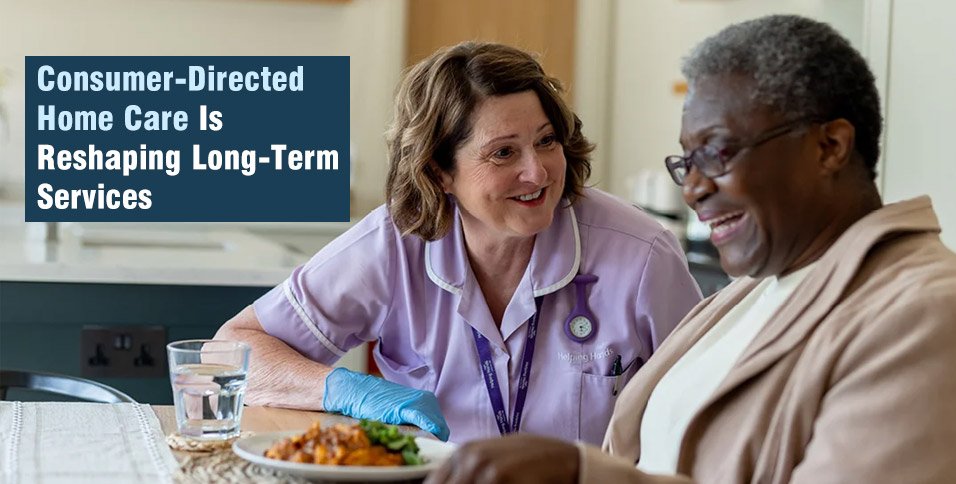
The long-term care landscape in the United States is undergoing a significant structural shift. For decades, the dominant model for home and community-based services placed agencies at the center of care delivery, with patients assigned caregivers based on workforce availability. Consumer-directed care, the model that puts the care recipient in charge of selecting and directing their own caregiver, has grown steadily for two decades and is now offered by nearly every state with a Medicaid home care program. For healthcare leaders, understanding this shift is increasingly important as policy, workforce, and patient preference all push in the same direction.
The Scale of the Shift
According to KFF’s 2025 survey of Medicaid home care officials across all 50 states, all reporting states except Alaska now allow Medicaid enrollees to self-direct their home care in at least some circumstances, and all of those states allow enrollees to select, train, and dismiss their caregivers. This is not a niche program. It represents a fundamental redesign of how publicly funded home care is structured, placing authority and decision-making with the person receiving care rather than with systems built around institutional convenience.
Why Consumer Direction Has Grown
Consumer-directed care emerged from the disability rights movement of the 1980s and 1990s, which challenged the assumption that professionally directed care was inherently superior to self-directed care. The evidence has since supported that challenge. Studies consistently find higher patient satisfaction, better alignment between care and personal preferences, and improved outcomes in consumer-directed models compared to agency-assigned arrangements. The model also addresses workforce shortages by expanding the pool of eligible caregivers to include trusted family members and community members.
The Economic Case for Family Caregivers as Paid Providers
AARP’s most recent valuation of unpaid family caregiving put the economic value of that work at over one trillion dollars annually. Paying family caregivers through Medicaid self-directed programs converts some of this unpaid labor into a formal, compensated employment arrangement, with meaningful effects. Caregivers who receive financial compensation report lower burnout rates. Paid arrangements reduce the likelihood that a care recipient will require nursing home placement, which carries a median cost of over $110,000 per year for a semi-private room according to Genworth’s 2025 Cost of Care Survey, compared to the far lower cost of community-based care.
Administrative Infrastructure: The Critical Enabling Factor
Consumer direction does not succeed without robust administrative support. Fiscal intermediaries handle payroll, tax withholding, and compliance functions that most families cannot manage alone. Home care agencies specializing in Medicaid consumer-directed programs manage enrollments, maintain compliance with state Medicaid requirements, and provide ongoing support to care recipients and their chosen caregivers. The quality of this administrative infrastructure is a primary determinant of whether a self-directed care arrangement succeeds or collapses under administrative burden.
State Program Variation: Complexity Healthcare Leaders Must Navigate
While the consumer-directed model is broadly available, its specific implementation varies significantly across states. Michigan’s Home Help program excludes spouses and parents of minor children as paid caregivers. Maryland’s Community First Choice and CPAS programs are more permissive, allowing spouses under self-directed arrangements in some cases. Missouri’s Consumer Directed Services program under MO HealthNet excludes spouses and legal guardians. Healthcare leaders advising patients, designing programs, or developing partnerships in this space must account for state-level variation in rules, pay rates, and administrative processes.
The Policy Headwinds: Federal Medicaid Cuts
The 2025 federal budget reconciliation law is projected to reduce federal Medicaid spending by approximately $911 billion over the next decade, with home and community-based services among the most likely areas to face reductions as states manage federal funding gaps. For healthcare leaders, this creates both urgency and strategic consideration. Families who enroll in consumer-directed programs now can access currently available benefits. The longer-term policy trajectory creates meaningful uncertainty for the home care sector.
Implications for Healthcare Organizations
Hospitals, health systems, and post-acute care networks that understand consumer-directed Medicaid programs can improve discharge outcomes by directing appropriate patients and families to these resources. Social workers and case managers who know which programs exist and how to refer to them are more effective advocates for patients with complex long-term care needs. And organizations that build partnerships with home care agencies specializing in Medicaid self-directed programs can strengthen their continuum of care for an aging patient population.
Conclusion
Consumer-directed home care is no longer an emerging model. It is the dominant structural direction of publicly funded home care in the United States. Healthcare leaders who understand how these programs work, where they operate, and what they can accomplish for patients and families are better positioned to lead in an era defined by an aging population and a constrained institutional care sector. For families currently navigating these options in Michigan, Maryland, or Missouri, Family Love Care provides specialized guidance through the enrollment process.