In the first months of life, much of a baby’s care happens at home, in the hands of parents. Two daily tasks matter more than many people expect: keeping the baby’s nose clear and keeping feeding equipment clean. Both are simple, but both are easy to get wrong when parents are tired and short on time.
This guide explains why these two areas matter, how to handle them safely, and how modern home devices can make them easier. It is general information for parents and caregivers, not a substitute for advice from a pediatrician.
Why newborn nasal care matters
Young infants breathe mainly through their noses. They also cannot clear mucus on their own by blowing their noses. Even a mild cold or dry air can leave the nose blocked, and a blocked nose can make feeding and sleeping harder.
Common causes of a stuffy nose in babies include:
- Common colds and other mild viral infections
- Dry indoor air, especially with heating or air conditioning
- Milk or spit-up reaching the nasal passages
- Dust and other irritants in the home
In most cases, gentle care at home is enough. Many pediatricians suggest a few drops of saline to loosen mucus, followed by gentle suction if needed.
Choosing a tool for nasal suction
For many years, the rubber bulb syringe was the standard tool. It is cheap, but it is hard to control the suction, and the inside is hard to clean and dry. Today, many families use electric devices instead.
When parents look for safe and gentle nasal suction for newborn babies, a few features make a real difference:
| Feature | Why it matters |
|---|---|
| Adjustable suction levels | Lets parents start on the gentlest setting |
| Soft silicone tips | Comfortable contact at the nostril |
| Anti-backflow design | Keeps mucus from flowing back into the device |
| Parts that come apart | Makes thorough cleaning possible |
| Calming light or sounds | Can help keep the baby still and relaxed |
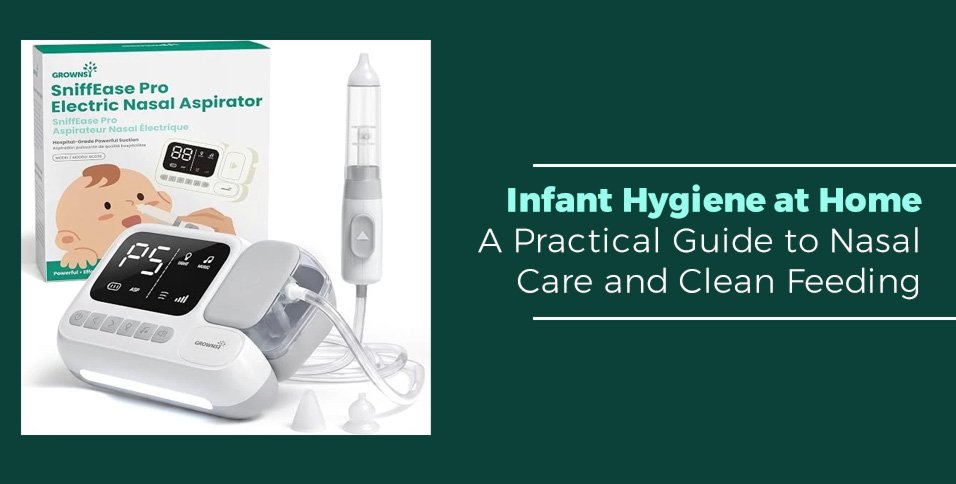
Grownsy’s electric nasal aspirators, for example, offer adjustable suction, from 3 to 9 levels depending on the model, along with soft silicone tips and an anti-backflow guard. Some models also play lullabies or have a soft light.
Safe-use tips:
- Use saline drops first if your pediatrician recommends them.
- Start with the lowest suction level.
- Place the tip at the opening of the nostril only. Never push it deep inside.
- Keep sessions short, and limit how often you suction in a day.
- Clean and dry every part after each use.
When to call a doctor: Contact a healthcare provider if a baby has trouble breathing, breathes very fast, has a fever (especially under three months of age), feeds poorly, or has congestion that does not improve.
Why clean feeding equipment matters
Babies’ immune systems are still developing. Milk residue left in bottles, nipples or pump parts can allow germs to grow. This is why health guidance stresses careful cleaning of all feeding equipment, and many health bodies advise sterilizing it, especially for babies under three months, premature babies and babies with weaker immune systems.
The basic routine is the same whether it is done by hand or by machine:
- Take apart bottles, nipples, rings, valves and pump parts.
- Rinse soon after feeding, before milk dries.
- Wash in hot, soapy water or a suitable machine.
- Sanitize or sterilize as recommended for the baby’s age and health.
- Dry completely in the air, not with a shared towel.
- Store in a clean, covered place.
How home devices can help
Done by hand several times a day, this routine takes a lot of time. A feeding bottle washer machine brings washing, steam sterilizing, drying and covered storage into one countertop unit. Grownsy’s bottle washers, for example, hold up to eight bottles along with pump parts. According to the brand, they use 26 water jets, 212°F steam and hot-air drying, and keep items in HEPA-filtered storage for up to 72 hours.
From a hygiene point of view, the main benefits are consistency and full drying. Every cycle follows the same steps, and nothing is left wet on a rack. Parents should still take items fully apart, follow the maker’s instructions and descale the machine as advised.
Building simple daily habits
- Keep a clean, dedicated space for feeding equipment.
- Wash hands before preparing feeds and before nasal care.
- Clean the nasal aspirator right after each use.
- Replace worn nipples and tips when they crack or change shape.
- Keep humidity comfortable in the baby’s room, as dry air can make congestion worse.
Conclusion
Nasal care and clean feeding are two of the most basic parts of infant hygiene at home. With the right technique and a few well-designed tools, parents can handle both gently and safely. Home devices can save time and add consistency, but they work best alongside regular check-ups and clear advice from a pediatrician.