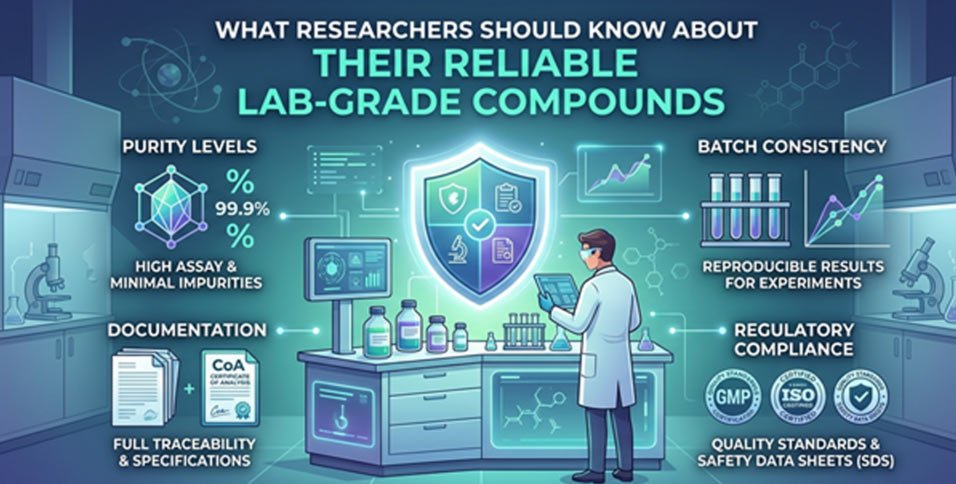
When scientific research depends on the quality of its inputs, compound integrity is not a minor detail. It is the foundation on which valid results are built. Whether a study involves amino acid sequencing, metabolic pathway analysis, or peptide behavior under controlled conditions, the compounds used must meet strict laboratory standards. Yet many researchers, especially those new to procurement and experimental design, underestimate how much compound quality affects the reliability of their data.
This article covers what every researcher should understand about sourcing, evaluating, and working with lab-grade compounds in a responsible and scientifically sound way.
Why Compound Purity Is Central to Research Integrity
Purity is not simply a number on a certificate. It reflects the entire manufacturing process behind a compound, from synthesis to storage. In laboratory science, even a small percentage of impurities can skew assay results, interfere with receptor binding studies, or produce inconsistent outcomes across experimental replications.
The Role of Analytical Testing
Reputable suppliers rely on third-party analytical testing to verify purity and composition. Common methods include:
High-Performance Liquid Chromatography (HPLC): Widely used to separate and quantify components in a sample. It gives researchers a clear picture of what percentage of the material is the target compound versus unwanted byproducts.
Mass Spectrometry (MS): Confirms molecular identity by measuring mass-to-charge ratios. When combined with HPLC, it forms LC-MS, one of the gold standards for verifying compound authenticity.
Nuclear Magnetic Resonance (NMR) Spectroscopy: Provides structural confirmation by analyzing how atomic nuclei interact with magnetic fields. NMR is particularly valuable for detecting structural isomers that other methods might miss.
Researchers should always request Certificates of Analysis (CoA) from suppliers before using any compound. A CoA should include purity percentage, testing methodology, batch number, and storage conditions.
Evaluating Suppliers and Sourcing Standards
Not all suppliers operate with the same commitment to quality control. In research settings, sourcing decisions carry real consequences for data validity and reproducibility.
What to Look for in a Research Compound Supplier
A trustworthy supplier will be transparent about their manufacturing processes, analytical testing procedures, and storage protocols. They should willingly provide documentation and avoid vague or unverifiable claims.
For example, institutions studying bioactive sequences in controlled environments often look to established providers that specialize in verified compounds. Platforms like Oasis Labs Research Peptides represent the kind of source researchers examine when they need clearly documented, lab-grade materials with traceable purity standards. The emphasis should always be on documentation, transparency, and peer-reviewed synthesis methods.
Storage and Handling as Quality Factors
Even a perfectly synthesized compound can degrade if stored incorrectly. Researchers should pay attention to:
Temperature sensitivity: Many compounds, particularly those with complex molecular structures, require refrigeration or freezing to maintain stability over time.
Light exposure: UV-sensitive compounds must be stored in amber vials or dark environments to prevent photodegradation.
Moisture control: Lyophilized compounds are highly hygroscopic and should be reconstituted only when ready for use, under controlled humidity conditions.
Proper handling is not optional. Degraded compounds do not behave predictably, and using them introduces variables that undermine experimental controls.
Understanding Batch Consistency and Reproducibility
One challenge that often surfaces in long-term studies is batch-to-batch variability. Even when two batches come from the same manufacturer, differences in synthesis conditions, raw material sourcing, or purification steps can result in measurable differences in compound behavior.
How to Address Variability in Research Design
Researchers can mitigate batch variability by:
Ordering sufficient quantities for an entire study upfront, so all experiments use the same lot number. Documenting batch numbers in lab notebooks and publications, which supports reproducibility for other research teams. Running internal quality checks before beginning a new experimental series, including comparative HPLC runs between batches if significant time has passed.
These practices reflect broader principles of Good Laboratory Practice (GLP) and are increasingly expected in peer-reviewed publication workflows.
Peptides in Research: A Precise and Demanding Category
Peptides represent one of the more technically demanding categories of research compounds. They are short chains of amino acids linked by peptide bonds, and their biological activity in cell-based or in vitro assay systems depends heavily on their structural integrity.
Sequence fidelity is critical. A single incorrect or missing amino acid can render a peptide inert or cause it to behave in unexpected ways. This is why mass spectrometry verification is particularly important for peptide compounds, not just purity testing.
Researchers sourcing peptides for in vitro studies or receptor-based screening should look specifically for suppliers who confirm both sequence accuracy and purity. Resources such as Oasis Labs Research Peptides are evaluated by researchers on exactly these criteria, with attention to whether documentation includes sequence confirmation alongside standard purity metrics.
Regulatory Context and Responsible Research Practices
Laboratory compounds, including synthetic peptides, exist within a regulatory environment that varies by jurisdiction. Researchers need to stay current on import regulations, institutional review board requirements, and any applicable biosafety classifications.
Beyond compliance, there is an ethical dimension to research quality. Using unverified compounds not only risks producing flawed data, it can waste institutional resources and contribute to a body of literature that others cannot replicate. In fields where reproducibility is already a recognized challenge, compound quality is a variable that researchers have direct control over.
Takeaway for Research Teams
Reliable results begin with reliable materials. Compound purity, proper documentation, verified sourcing, and careful handling are not administrative burdens but scientific necessities. Researchers who treat compound procurement as seriously as experimental design will find their data more consistent, their publications more credible, and their time in the lab more productive.
Building a relationship with suppliers who prioritize analytical transparency is one of the most practical investments a research team can make.
Important Note: All peptides and related compounds referenced in this article are intended strictly for research and laboratory study purposes only. They are not approved for human use, consumption, or medical application. Any use outside of a controlled laboratory setting falls outside the scope of this content.