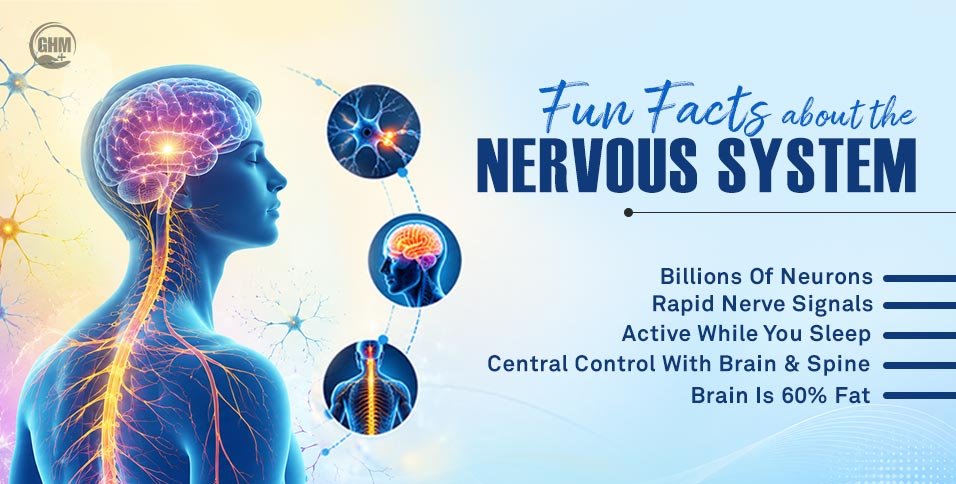
Your nervous system works continuously behind the scenes, managing everything you do even when you are not consciously thinking about it. Comprising the brain, spinal cord, and an extensive network of nerves, this intricate biological network allows your body to communicate, process information, and regulate both conscious and unconscious functions.
The nervous system influences your daily movements, memory retention, sensory experiences, breathing rhythm, digestion, and sleep quality. There are more such fun facts about the nervous system that might surprise you.
This article explains some interesting nervous system facts, where you’ll learn more about the brain, the human body, and its functions.
7 Fun Facts About the Nervous System That May Surprise You
1. Your Brain Contains Billions of Neurons
Neurons are specialized nerve cells designed to transmit electrical and chemical information throughout the body. The human brain contains an astonishing number of these cells. The brain holds approximately 86 to 100 billion neurons. Each individual neuron forms thousands of connections with other cells, contributing to a staggering total of potentially 1 quadrillion connections overall. This massive neural network powers every thought, feeling, and action.
2. Some Nervous System Functions Are Voluntary, Others Aren’t
Your nervous system expertly manages both conscious actions and unconscious survival processes. The somatic nervous system handles voluntary movements that you control consciously, such as walking, turning your head, or picking up an object. Meanwhile, the autonomic nervous system governs involuntary functions that happen automatically without your direct thought, including your heartbeat, breathing rate, and digestion. This clear division allows people to interact purposefully with their environment while essential internal processes run seamlessly in the background.
3. Your Gut Has Its Own Extensive Nerve Network
One of the interesting facts about the nervous system is that, apart from processing food, the digestive tract also houses its own dedicated nerve center known as the enteric nervous system (ENS). This complex web of nerves is embedded directly within the walls of the digestive organs. It controls essential tasks like breaking down food, absorbing nutrients, and eliminating waste. Although the enteric nervous system operates locally, it remains closely connected to the rest of the body and receives regulation from both the sympathetic and parasympathetic nervous systems.
4. Your Brain Is Active Even While You Sleep
A common misconception suggests that people only use a small fraction of their brain, but neurological science confirms that you use your entire brain. Furthermore, sleep does not mean your brain completely switches off. The brain remains active throughout the night, monitoring your environment, consolidating memories, and maintaining vital neural pathways. Getting adequate rest is essential to keep these neural pathways healthy and functioning at their best.
5. Your Brain Is About 60% Fat
While it sounds surprising, fat makes up approximately 60% of the human brain, earning it the title of the fattiest organ in the human body. These specialized fatty acids are crucial for optimal brain performance and structural integrity. Supplying your body with healthy, brain-boosting nutritional fats helps support this high concentration of fatty tissue and maintains smooth cognitive functioning.
6. Your Brain Uses About 20% of Your Body’s Energy
A fascinating brain and nervous system fact is that the human brain accounts for only about 2% of total body weight, yet it has remarkably high energy demands. The brain consumes roughly 20% of the body’s total energy supply. The brain runs continuously on approximately 20 watts of power, which is roughly equivalent to the energy needed to power a standard light bulb. Sustaining this level of continuous metabolic activity requires proper nutrition and adequate rest.
7. Music Can Change Brain Activity
Music serves as a powerful stimulus that activates the brain’s reward processing centers. Listening to favorite songs triggers the release of feel-good chemicals like dopamine and oxytocin. Dopamine release helps form positive emotional associations between specific memories and music. Additionally, music helps reduce the production of the stress hormone cortisol, lowering blood pressure and heart rate. Music therapy also aids in neurological rehabilitation by helping patients build new neural pathways for speech and language comprehension.
Animals Can Have Very Different Nervous Systems
The evolutionary design of nervous systems varies dramatically across the animal kingdom.
- Jellyfish: These creatures possess no central brain at all, relying instead on a diffuse nerve net that has allowed them to survive successfully for more than 500 million years.
- Octopuses: An octopus features a highly distributed nervous system where roughly half of its total neurons reside in its arms, allowing each limb to independently sense, explore, and react.
- Axolotls: These remarkable amphibians can regenerate parts of their nervous system, successfully regrowing spinal cord tissue, nerves, and portions of the brain.
- Sponges: Sponges are unique multicellular animals that do not possess a nervous system.
Conclusion
Understanding fun facts about the nervous system highlights how extraordinary this biological communication and control network truly is. From billions of active neurons and high energy demands to gut networks and musical responses, your nervous system works tirelessly behind the scenes to keep you alive, healthy, and connected.
Appreciating the complexity of this internal command center reminds us to support our health through balanced nutrition, low stress, and adequate sleep.
Frequently Asked Questions
- What is the longest nerve in the human body?
The sciatic nerve is the longest nerve in the human body, running from the lower back down through the foot and measuring up to two centimeters in diameter.
- Does your brain stop working when you sleep?
No, the brain remains active during sleep to maintain neural pathways, process information, and monitor the internal environment.