You schedule a routine eye exam, the doctor confirms your vision is 20/20, and yet you still walk out with daily headaches, constant dizziness, or the nagging feeling that something just isn’t right. Sound familiar?
Thousands of people every year are told their eyes are perfectly fine, while they quietly struggle with blurry vision, difficulty reading, balance problems, and overwhelming fatigue. The culprit behind these seemingly unconnected symptoms is often a little-known condition called binocular vision dysfunction (BVD).
Binocular vision dysfunction is a condition where the two eyes are misaligned and fail to work together as a coordinated team, forcing the brain into a constant struggle to reconcile conflicting visual signals. The consequences touch nearly every area of daily life… from reading and driving to balance and emotional well-being.
According to research, between 21% and 38% of the general population has some form of binocular dysfunction. Yet most people, and many standard eye exams, miss it entirely.
In this guide, you will find everything you need to know about BVD: what it is, why it happens, how it is diagnosed, and the treatment options that can genuinely improve your quality of life.
What Is Binocular Vision Dysfunction?
In binocular vision dysfunction, the eyes are positioned slightly apart, which means each eye captures a slightly different image of the world. These two images travel along separate visual pathways to the brain, which then merges them into a single, clear, three-dimensional picture.
This seamless blending process is called fusion, and it underpins an individual’s ability to judge distances, see depth (stereopsis), and track moving objects smoothly.
For this system to work properly, both eyes must point at exactly the same target at the same time. Even a fraction of a degree of misalignment is enough to disrupt the entire process.
BVD is not a single disease. It is an umbrella term covering a range of conditions that affect eye teaming, coordination, and visual processing, conditions that standard vision screening is not designed to catch.
Common Symptoms of Binocular Vision Dysfunction
Many patients spend years chasing diagnoses for headaches, anxiety, or balance disorders before anyone looks at their vision.
Because the eyes influence so many functions in the brain and body, the symptoms of binocular vision dysfunction can be surprisingly diverse.
Visual Symptoms
- Blurred or fluctuating vision, especially when switching between near and far distances
- Double vision (seeing two of the same object, either constantly or intermittently)
- Light sensitivity and discomfort in bright environments
- Difficulty focusing on screens or printed text for extended periods
- Trouble judging distances when parking, stepping off curbs, or catching objects
Physical Symptoms
- Frequent headaches and migraines, particularly after visually demanding tasks
- Eye strain and fatigue that worsens as the day progresses
- Dizziness and vertigo, especially in visually busy environments
- Motion sickness in cars, shopping malls, or crowded spaces
- Neck, shoulder, and upper back pain from unconsciously tilting the head to reduce visual confusion
Reading and Learning Difficulties
- Losing your place frequently while reading
- Skipping lines or rereading the same line without realizing it
- Reduced reading comprehension despite good intelligence or effort
- Rapid reading fatigue after just a few minutes
Emotional and Cognitive Effects
- Poor concentration and a short attention span
- Heightened anxiety in visually busy or unfamiliar environments
- Reduced confidence during activities that require accurate visual judgment
What Causes Binocular Vision Dysfunction?
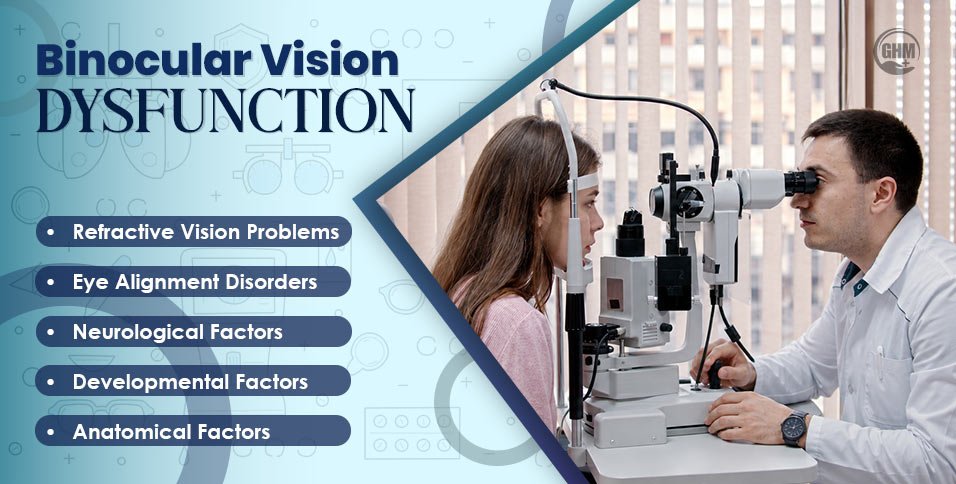
BVD can develop from a variety of visual, neurological, physical, or developmental factors. Understanding the root cause is essential for building an effective treatment plan.
1. Refractive Vision Problems
Uncorrected or poorly corrected refractive errors are among the most common triggers of vision dysfunction. Nearsightedness (myopia), farsightedness (hyperopia), and astigmatism all place unequal demands on each eye, making smooth binocular coordination more difficult. Age-related changes in focusing ability (presbyopia) can also introduce new binocular strain in adults over 40.
2. Eye Alignment Disorders
Strabismus, a condition in which one eye turns inward, outward, upward, or downward, is one of the most visible causes of BVD. Amblyopia (commonly called lazy eye) can also disrupt normal binocular development. Eye muscle imbalances, even those too subtle for a standard eye test to detect, frequently underlie BVD in people who have never been told they have an alignment problem.
3. Neurological Factors
The neurological system plays a central role in binocular coordination. Concussions and traumatic brain injuries are among the neurological causes of BVD. Strokes, migraines with aura, nerve disorders affecting eye movement, and other neurological conditions can all disrupt the precise signals that keep the eyes working in sync.
A study found that up to 60% of patients with persistent post-concussion symptoms had undiagnosed binocular vision dysfunction, making BVD assessment a crucial step after any head injury.
4. Developmental and Anatomical Factors
Some individuals are born with subtle facial asymmetry or structural differences in the orbit (the bony socket surrounding the eye) that naturally tilt one eye slightly out of alignment. These congenital differences can cause binocular vision challenges from birth, though they may not produce noticeable symptoms until the visual demands of reading or screen work increase in school or the workplace.
Conditions Commonly Mistaken for Binocular Vision Dysfunction
Because BVD produces such a wide spectrum of symptoms, it is frequently misdiagnosed as something else entirely. Conditions commonly confused with binocular vision dysfunction include:
- ADHD and attention difficulties
- Dyslexia and other reading-related learning disabilities
- Chronic fatigue syndrome
- Anxiety and panic disorders
- Vestibular (inner ear balance) disorders
- Migraine disorders
- TMJ (jaw joint) dysfunction
Many individuals spend years managing symptoms and rotating through specialists before anyone considers a specialized visual assessment.
If persistent headaches, dizziness and vision issues have resisted conventional treatment, BVD may be the missing piece, and a comprehensive binocular vision evaluation could finally provide answers.
How Is Binocular Vision Dysfunction Diagnosed?
Standard eye exams are designed primarily to measure how clearly each eye can see at a distance. They are not designed to evaluate how the two eyes collaborate. According to research, it is entirely possible to see 20/20 with each eye individually while still having significant binocular vision dysfunction. This is why many people with BVD are repeatedly told that their eyes are “fine” until they see a specialist trained in binocular vision assessment.
Diagnosis of BVD requires going well beyond the standard eye chart test. A thorough, specialized evaluation is necessary.
- Comprehensive Eye Examination
The process begins with a detailed review of the patient’s symptoms, their duration, and how they affect daily functioning. A thorough medical history, including any history of head injury, neurological conditions, or learning difficulties, helps the clinician identify patterns that point toward BVD.
- Binocular Vision Testing
Specialized binocular vision tests assess eye alignment under varying conditions, smooth and accurate eye movement tracking, depth perception and stereopsis (the ability to perceive three-dimensional depth), visual processing speed and accuracy, and the eyes’ ability to converge and diverge on demand. These tests go far beyond what is checked during a standard prescription update.
Treatment Options for Binocular Vision Dysfunction
The right treatment for BVD depends on the underlying cause and severity of symptoms. Most people see meaningful improvement with one or a combination of the following approaches.
1. Prism Lenses
Specially crafted prism lenses are currently the most widely used and most immediately effective treatment for BVD. These prism glasses for BVD contain tiny amounts of optical prism that redirect light before it reaches the retina, effectively compensating for the eye misalignment. It allows the brain to fuse the two images without strain.
Many patients notice a reduction in headaches, dizziness, and double vision within days of wearing microprism glasses. The prescription is typically refined over time as symptoms improve.
2. Vision Therapy
For many patients, particularly children, athletes, and those recovering from concussions, a structured vision therapy program offers lasting improvement by retraining the brain and eyes to work together efficiently. Vision therapy goes beyond simple exercises: it is a customized, clinically supervised program involving a range of activities designed to improve eye coordination, focusing flexibility, and the brain-eye communication pathway.
3. Managing Underlying Conditions
When binocular vision dysfunction is linked to a neurological condition, traumatic brain injury, or a diagnosed eye alignment disorder such as strabismus, treating that underlying condition is a critical part of managing BVD.
In some cases, surgical correction of significant eye misalignment may be considered.
4. Lifestyle Adjustments
Alongside clinical treatment, practical lifestyle changes can meaningfully reduce visual strain. Appropriate screen height and distance, using anti-glare screen filters, taking regular visual breaks, and managing screen time all reduce the daily burden on the visual system.
Can Binocular Vision Dysfunction Be Prevented?
While not all forms of binocular vision dysfunction can be prevented, particularly those arising from genetic factors or neurological conditions, you can prevent it from significantly affecting quality of life.
Preventive measures to reduce the risk of Binocular Vision Dysfunction:
- Schedule comprehensive eye examinations every one to two years, even if your vision seems clear.
- Ensure children have binocular vision assessments before starting school and at regular intervals throughout their education.
- Use appropriate protective eyewear during contact sports and activities with a risk of head injury.
- Seek a specialized vision evaluation after any concussion or traumatic brain injury, even a mild one.
- Do not dismiss these signs of binocular vision dysfunction; they warrant professional assessment.
Do not wait for symptoms to become severe. Early intervention consistently leads to better outcomes, and a binocular vision specialist can assess your situation accurately and outline a treatment path tailored to your needs.
End Note
Binocular vision dysfunction is far more widespread than most people realise. It is a condition that quietly undermines vision, balance, learning, and emotional well-being — often while standard eye tests report everything as normal. The good news is that once it is properly identified, BVD is very much treatable.
The right intervention can produce genuine, life-changing improvements. If someone has been living with unexplained headaches, dizziness, reading struggles, or balance issues, a comprehensive binocular vision evaluation is a logical, potentially transformative next step.
Your eyes may be telling you something that standard tests have missed, and it is worth listening.
This article is intended for informational purposes only. Always consult a qualified eye care professional for diagnosis and treatment specific to your individual situation.
Frequently Asked Questions
- Can you test Binocular Vision Dysfunction at home?
Yes, you can test Binocular Vision Dysfunction at home using quick, actionable tests like the 5-Minute Cover Test and the Thumb Jump Test, which assess whether covering one eye relieves dizziness, eye strain, or misalignment.
- Can prolonged screen use worsen binocular vision dysfunction symptoms?
Extended screen time does not cause binocular vision dysfunction, but it can intensify existing symptoms. Long hours spent focusing on digital devices may increase eye strain, headaches, blurred vision, and difficulty concentrating. Taking regular visual breaks and maintaining proper screen ergonomics can help reduce discomfort.
- Are contact lenses effective for binocular vision dysfunction?
Traditional contact lenses may correct refractive errors such as nearsightedness or farsightedness, but they typically do not address eye alignment problems associated with binocular vision dysfunction. In some cases, specialized treatment approaches, including prism glasses or vision therapy, may be more beneficial.
- Is binocular vision dysfunction hereditary?
Some conditions associated with binocular vision dysfunction, such as eye alignment disorders and certain refractive errors, can run in families. Having a family history does not guarantee that someone will develop BVD, but it may increase the likelihood of experiencing related vision issues.
- Can binocular vision dysfunction return after treatment?
Yes, in some cases of binocular vision dysfunction, symptoms can recur if the underlying condition changes, if treatment is discontinued prematurely, or after new eye or neurological injuries. Regular follow-up visits with an eye care professional can help monitor vision changes and maintain long-term results.