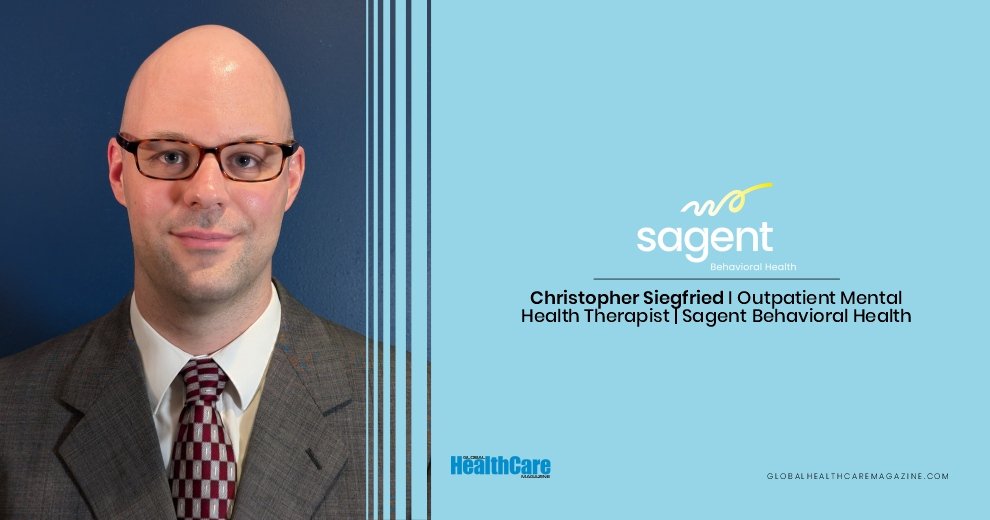
A dropout rate can tell you a great deal about a person, if you happen to be the kind of person who notices such things. At the University of Saint Thomas, in a Mechanical Engineering program that once held Christopher Siegfried’s full attention, roughly seventy percent of incoming freshmen either left the program or changed their major entirely. Most students would have shrugged at the number and moved along with their coursework. Christopher did not. He sat with the statistic the way another person might sit with a puzzle, turning it over, wondering what it was hiding.
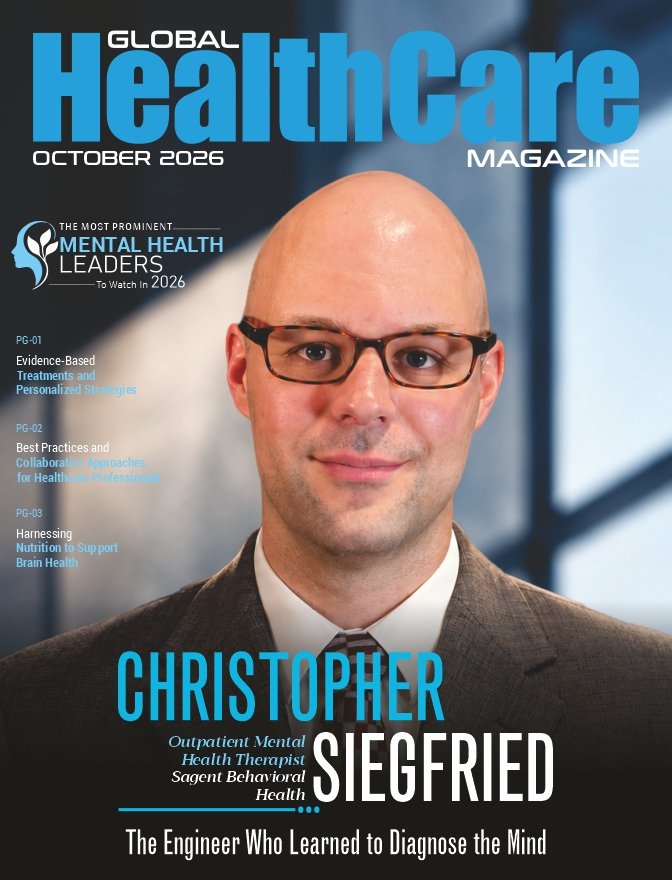
That single conversation, with the head of the engineering program, became the hinge on which an entire career swung. Today, Christopher Siegfried works as an Outpatient Mental Health Therapist at Sagent Behavioral Health, though the phrase barely captures the range of what he does, or how he arrived there.
An Engineer’s Curiosity, Redirected
Christopher describes his path into mental healthcare as “a bit of a novel story,” and it is hard to disagree. He did not begin in psychology. He began in blueprints and load calculations, in a discipline built on precision and right angles. But the question that engineering could not answer – why did so many students abandon a field they had chosen for themselves? – pulled him somewhere else entirely.
He was, by his own account, more interested in the psychological component of the reason for this statistic than in actually learning Engineering. And yet he did not discard what engineering had given him. The analytical rigor stayed. Only the subject matter changed; the mindset remained remarkably similar. It is the kind of transformation that sounds simple in a sentence and took years to actually live.
Learning the Landscape at Sagent Behavioral Health
Before Sagent Behavioral Health became his professional home, Christopher built a career that touched nearly every corner of clinical practice. He administered and analyzed assessment instruments. He provided therapy to adolescents in a day treatment setting, work that requires equal parts patience and improvisation. He spent time at an outpatient program with lodging for substance use treatment, and helped adults untangle the often confusing question of which mental health benefits actually fit their situation.
“It feels good to be able to help people out,” he says, “and to know how to help in a variety of different types of situations.” There is something almost architectural in the way he describes this breadth, as though each clinical setting were another room added to a house he was slowly constructing, room by room, until there was no situation left that felt unfamiliar.
The Suit That Fits: Confronting a Common Misconception
Ask Christopher what misconception troubles him most in mental healthcare today, and he does not hesitate. It is the tendency to conflate training with education. In staff meetings, he has watched providers go around the room, each one proposing to treat a client using their own specialty, rather than tailoring an approach to the person actually sitting in front of them. The result, he says, is disagreement instead of integrating different perspectives into an eclectic approach tailored to the individual client.
His metaphor for this is deceptively simple. Getting fitted for a suit or a dress means the garment is made for one specific body. “I think the mind is more subtle than the body,” he explains, “and thus needs an approach that is even more specific.” But he is careful to add a caveat, because Christopher is a man who distrusts convenient answers. Tailoring only works, he insists, when the chosen treatment approach is still used with fidelity to the treatment model and psychological research literature. Customization without discipline, in his view, is not treatment at all.
A Two-Phase Method, Built on Breadth and Depth
When asked what makes his therapeutic approach effective across such a wide range of conditions-anxiety, PTSD, sleep disorders, behavioral disorders – Christopher lays out something closer to an engineering process than a clinical anecdote. First comes breadth: a thorough theoretical understanding of mental health and sleep disorders. Only after that foundation is in place does he move to the second phase, a case conceptualization that leads to the selection of evidence-based treatment models, applied with real depth of training.
It is a method that mirrors his own origin story almost too neatly. Theory first, then application. Understanding, then precision.
Where Psychology, Education, and Analysis Intersect
For Christopher, analytical thinking is not a personality trait so much as a diagnostic tool. It is “key in diagnosing and determining a client’s unique situation and diagnosis,” he says, and it leads directly into a tailored approach that never strays from theoretical fidelity. Once that foundation is set, education becomes the next task: helping a client understand why their disorder developed, how it can be treated, and how to keep it from resurfacing.
He is honest about the limits of this ideal. Some clients may not fit perfectly, he acknowledges, and information is sometimes missing that complicates the entire process. It is a small admission, but a telling one. He does not pretend his method is flawless. He simply insists it is the best available framework.
A Day in the Life, Beyond the Therapy Room
The public imagination tends to picture a therapist’s day as one long conversation. Christopher’s version is considerably busier. Alongside diagnosing and treating mental health and sleep disorders, his days are filled with writing notes, writing treatment plans, drafting Diagnostic Assessments, re-engaging clients who have drifted from care, and coordinating with other providers.
What energizes him most, though, is not the paperwork but the puzzle underneath it. Diagnostic Assessments, case conceptualization, and differential diagnosis are where his academic curiosities find their outlet, a phrase that says a great deal about a man who never quite stopped being the student asking why.
Collaboration Across Five Clinical Worlds
Christopher’s career reads almost like a tour of mental healthcare’s many ecosystems, and he speaks about each one with the specificity of someone who was paying close attention the entire time.
At Nystrom and Associates, now folded into Sagent Behavioral Health, he worked alongside medication managers, anger management specialists, probation officers, and case managers, serving individual, family, and couples clients. At Family Support Services (ARMHS), he maintained constant communication with outside professionals and sat in on regular team meetings with coworkers and supervisors. At Park Avenue Center, he co-facilitated group therapy and helped train master’s-level clinicians on intake, diagnosis, and treatment planning.
Earlier still, at Associated Psychological Services, he worked under a supervisor on doctoral-level research. At LifeSpan and Nystrom CTSS, he regularly consulted with multidisciplinary teams on high-acuity cases.
Ask him why any of this matters, and his answer is unsentimental and precise: “No single clinician has all the answers,” and sharing difficult cases in supervision surfaces the blind spots that lead to better treatment planning. “The patient gets a more complete picture than any one provider could offer alone.”
The Cost of Never Being Satisfied
Every career built on constant learning exacts a price, and Christopher does not shy away from naming his. He is, as he puts it, always seeking more training and education in diagnosing and treating mental health and sleep disorders. The difficulty is balancing that pursuit with the demands of an active caseload.
He offers himself a wry consolation. “I do this to myself,” he admits, always seeking out more education and training rather than relying only on the treatment methods he has already learned. It is a resilience story without a dramatic villain, just the quiet, ongoing tension between ambition and bandwidth.
A Résumé of Rigor: Training, Assessment, and the Logic and Lore Group
If Christopher’s philosophy sounds abstract, his list of credentials grounds it firmly in specifics. He has trained in ERP for OCD and exposure techniques for a range of other anxiety disorders, PE for PTSD, and behavioral sleep medicine methods including CBT-I, CBT-N, and IRT. Through education and clinical experience, he has developed expertise in Diagnostic Assessments, diagnosis, mental health treatment in the context of substance use and anger, and has also received some DBT training.
He has completed assessments for the court system, presurgical evaluations for medical doctors, and evaluations for a variety of other purposes. His education has sharpened his command of differential diagnosis and advanced assessment instruments, including the MMPI-2, MCMI-IV, WAIS-IV, and WMS-IV.
Perhaps most distinctive is a group he currently co-runs called “Logic and Lore,” a social skills group that integrates the Critical Core game, something like Dungeons & Dragons, alongside elements of the PEERS program (the Program for the Education and Enrichment of Relational Skills). Both approaches, he notes, carry meaningful support in the psychological literature, from 2011 to 2025, including randomized controlled trials and at least one meta-analysis. He also previously ran a CBT-I group to help members improve their sleep, a smaller but no less telling example of his willingness to build structured, evidence-backed spaces for people who are struggling.
Building Siegfried Marketing and Consulting
Christopher’s ambitions have recently extended beyond the therapy room. He has founded Siegfried Marketing and Consulting, a company created to help mental health clinics reach the substance use, behavioral sleep medicine, and mental health clients who need them most.
What distinguishes the venture, in his telling, is that it is run by a mental health provider, built specifically to connect clients to the right specialist for their unique situation. The stated goal is not simply visibility, but the highest quality, most ethical, and most rewarding experience for clinic owners and their clients alike. It is, in many ways, the same tailoring philosophy that shapes his clinical work, applied now to an entirely different kind of practice.
Away From the Clinic
Even a mind as occupied as Christopher’s needs somewhere to rest. Outside of work, he plays video games, golfs, watches television, and reads. It is a modest list, offered without embellishment, but it rounds out the portrait of a man whose professional life is defined by intensity and constant intellectual appetite.
A Philosophy Worth Carrying Forward
Christopher’s closing reflections read less like a sign-off and more like a set of operating instructions, both for clinicians and for the marketing world he has newly entered. On the clinical side, his advice is direct. “Be greedy for information and jump into new trainings,” he says, “but make sure you have an experienced guide and teacher first.”
On the marketing side, his standards are just as exacting. Content, he believes, should never simply chase clicks. It should be clinically sound and trustworthy, something like an extension of the therapy room itself. He rejects what he calls fluffy, feel-good marketing that lacks substance, favoring instead messaging grounded firmly in psychological research. The underlying idea, one that seems to summarize both halves of his career, is simple enough to remember. The right message connects the right client to the right specialist, ideally, before they even walk through the door.
Quote