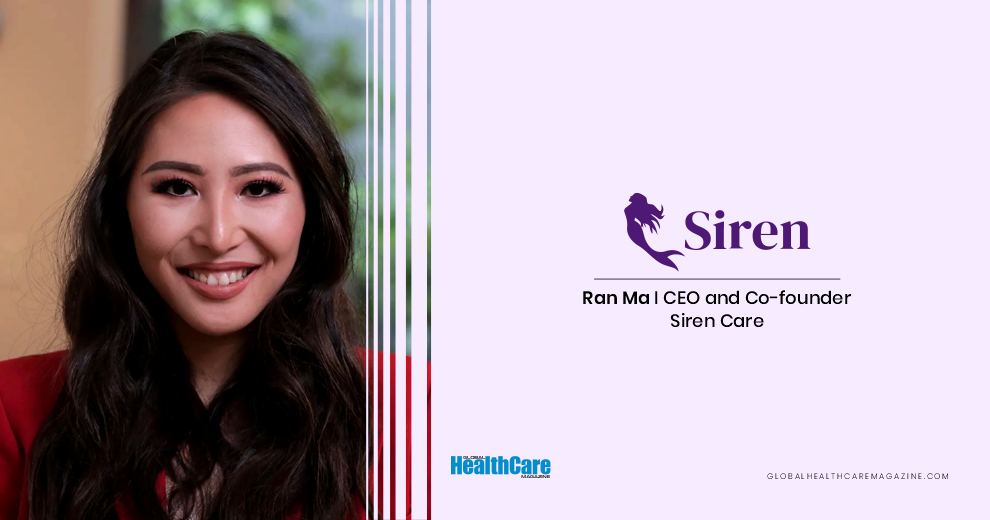
Ran Ma, Co-founder & CEO of Siren Care, does not remember the exact moment she decided that fabric could save lives. It was not a lightning strike of revelation but something slower, gentler, like a thread being pulled through cloth. The idea grew during her time at Northwestern University, where she worked on a “biomask” project designed to help wounded veterans regenerate skin. That project taught her two things: the human body is fragile, and technology, when used tenderly, can help it heal.
Years later, that same belief would resurface in the unlikeliest of forms—a sock. A piece of clothing so ordinary that most people never think twice about it. But for Ran, socks held a secret potential. They touched the body every day, covered an area that spoke volumes about a person’s health, and could carry data the way threads carry warmth.
“I’ve always been fascinated by how something simple can become powerful when reimagined,” she once said. “If you can weave care into fabric, maybe healing can start before illness begins.”
The Problem That Could Not Be Ignored
Fifteen million people in the United States live with diabetic neuropathy. Many of them will develop foot ulcers that go unnoticed until it is too late. Each year, thousands lose limbs because of infections that could have been prevented. The cost to the healthcare system exceeds 80 billion dollars annually, but the emotional cost is far greater.
Ran had seen those numbers before she had even founded Siren. They haunted her because they reflected not just inefficiency but silence—the quiet suffering of people who could not feel pain until it was irreversible. What if that silence could be broken, not by alarms or scans, but by something soft and familiar, something they already wore?
That question became the foundation for Siren Care, a San Francisco–based startup she co-founded in 2015. Its mission was both ambitious and poetic: to embed care into the clothes people wear.
Where Fabric Meets Code
At Siren, technology is not a separate layer; it is woven in. The company’s flagship product, Siren Socks, looks and feels like any other pair of socks. Yet hidden within their threads are microscopic temperature sensors that monitor foot health continuously.
The socks measure small fluctuations in temperature, which can signal inflammation long before ulcers appear. The data then travels to doctors, who can intervene early and prevent serious complications. In clinical studies, this simple act of early detection has reduced the risk of diabetic foot ulcers by up to 68 percent and amputations by 83 percent.
The beauty lies in its simplicity. Users receive five pairs that last six months, then another five pairs to complete the year. They wash the socks like normal, wear them like normal, and live with less fear. For those covered by Medicare, the system is reimbursable, making it accessible to many who need it most.
“It was important to make it invisible,” Ran explains. “Technology should not remind people they are sick. It should help them feel cared for, even when no one is watching.”
A Partnership That Widened the Horizon
In early 2025, Siren announced a $ 9.5 million funding round, led by Mölnlycke Health Care, a global leader in wound care. The partnership was more than financial. It represented a shared belief that prevention should replace reaction.
“This partnership represents a major milestone in our journey,” Ran said during the announcement. “Together, we want to empower patients with tools that help them stay healthy and independent while easing the load on healthcare providers. Prevention is the key to avoiding painful, costly, and life-altering complications.”
With Mölnlycke’s investment, Siren gained both resources and reach. The collaboration merged Siren’s temperature-sensing fabric technology with Mölnlycke’s global expertise, creating a stronger platform for diabetic foot ulcer prevention.
For Ran, this was not just about scaling a product. It was about building a future where wearable technology becomes a quiet companion to care.
From Biomask to Smart Yarn
Ran’s career has followed a subtle but steady pattern: finding beauty in function. Her first innovation, the biomask, was made for wounded soldiers who needed new skin. The second, Siren Socks, serves people whose skin has lost its sensitivity. Both projects bridge science and empathy.
The next chapter is already unfolding. Siren has patented Smart Yarn, a fabric embedded with electronics that can measure vital signs, transmit data, and withstand the chaos of the washing machine. This technology could one day power hospital gowns that track healing, or everyday clothes that quietly monitor chronic conditions.
Ran does not describe this as a disruption. She prefers the word “evolution.” In her view, healthcare should not feel like an event. It should feel like a rhythm that lives alongside us.
The Science of Softness
Ran’s approach to innovation is both analytical and emotional. She talks about sensors and signal processing with the same tenderness she uses to describe human touch. “When someone wears our socks, we are listening to their body in real time,” she says. “We’re creating a loop of care that never sleeps.”
In many ways, Siren’s success lies not in its sensors but in its philosophy. The company understands that technology must earn trust before it can transform behavior. By focusing on comfort, accessibility, and dignity, Ran has made something profoundly technical feel profoundly human.
This philosophy is what caught the attention of investors, clinicians, and patients alike. It is also what sets Siren apart in a crowded field of digital health startups that often chase metrics rather than meaning.
Leading with Quiet Conviction
Those who work with Ran describe her leadership style as calm but uncompromising. She is deliberate in her choices, guided by purpose rather than pressure. “She doesn’t rush,” one colleague said. “She listens until she understands, and then she builds until it’s right.”
Her decision to leave a master’s program in business to pursue Siren was not impulsive. It was intuitive. “You can learn strategy in a classroom,” she once said, “but you learn courage only by starting.”
That courage has carried Siren through the complexities of healthcare reimbursement, clinical validation, and the relentless pace of startup life. It has also kept the company anchored in empathy, even as it grows.
A Future Woven with Care
With new funding, global partnerships, and patented technology, Siren’s path forward is bright. Yet Ran still frames success in personal terms. When she talks about impact, she mentions individuals, not numbers. A patient who avoided surgery because an alert came in time. A doctor who could act early instead of too late. A family spared from the trauma of amputation.
“I want our technology to disappear into people’s lives,” she says. “The less they think about it, the better it’s working.”
In her world, innovation is not loud. It does not need to announce itself. It hums quietly beneath the surface, like the faint pulse of current in a thread.
The Fire Within
There is a quote Ran keeps close, one that reflects her philosophy of life and leadership. It is from Jack Kerouac:
“…because the only people for me are the mad ones, the ones who are mad to live, mad to talk, mad to be saved, desirous of everything at the same time…”
Ran embodies that madness—the kind that burns not with chaos, but with purpose. She is mad to create, mad to heal, and mad to make the world a little softer for those who need it most.
If you look closely at the fabric of her work, you will see it: the quiet fire stitched into every thread.
Also Read: The Most Prominent Leaders in Foot Care & Lower Limb Health to Watch in 2025