In a scientific breakthrough, an AI-designed vaccine for viruses has successfully completed its first human clinical trial, marking a significant step toward preventing future pandemics before they begin. Researchers from the University of Cambridge and biotechnology company DIOSynVax announced that their experimental universal coronavirus vaccine was safe in healthy volunteers and generated immune responses against multiple coronavirus-related threats.
The findings, published in the Journal of Infection, suggest that artificial intelligence could transform vaccine development by creating broader protection against entire virus families rather than targeting a single strain.
With emerging infectious diseases and zoonotic threats, this innovation may offer a new strategy to stay ahead of rapidly evolving pathogens.
World’s First AI-Designed Vaccine Shows Promising Results
The vaccine tested in the Phase I clinical trial is being described as the world’s first AI-designed vaccine whose active ingredient was created entirely using computer simulations and machine learning.
The AI vaccine trial involved 39 healthy volunteers between the ages of 18 and 50 and was conducted at clinical research facilities in Cambridge and Southampton, United Kingdom. Researchers reported no significant safety concerns or serious side effects of the vaccine.
According to the study, the vaccine triggered immune responses not only against SARS-CoV-2, the virus responsible for COVID-19, but also against SARS and several related bat coronaviruses that could potentially infect humans in the future.
How the Vaccine Made With Artificial Intelligence Works
Traditional vaccines are typically developed using virus strains that are already circulating among people. While effective, these vaccines often need frequent updates as viruses mutate.
The new AI-powered vaccine design uses a different strategy.
- Researchers collected genetic sequence data from sarbecoviruses, a large coronavirus family that includes SARS-CoV-2 and SARS.
- Machine-learning systems then analyzed these sequences to identify shared characteristics across the entire virus family.
- Using this information, scientists created an AI-designed super-antigen, a synthetic vaccine component designed to train the immune system to recognize common viral features rather than a single variant.
Professor Jonathan Heeney, scientific lead of the project at the University of Cambridge, explained, “We’ve converted vaccine development from being reactive to being future proof. Our vaccines will continue to provide protection against viruses even as they mutate into new strains.”
This approach aims to overcome one of the biggest challenges in vaccine development: keeping pace with constantly changing viruses.
AI-Designed Vaccine For Viruses Could Protect Against Future Variants
One of the most promising findings from the trial is the vaccine’s ability to generate immune responses against viruses that have not yet caused outbreaks in humans.
Scientists say this could allow vaccines to provide protection against future variants and even related viruses before they emerge.
The technology may eventually be adapted for multiple virus families, including:
- Coronaviruses
- Influenza viruses
- Ebola viruses
- Other emerging infectious diseases
With the rising prevalence of the Ebola outbreak in parts of Africa and progress in Bundibugyo strain vaccine development, the urgent need for broader vaccine strategies intensifies.
Needle-Free Delivery of AI- Designed Vaccine Offers Additional Benefits
The AI- designed vaccine trial uses a different vaccine delivery method.
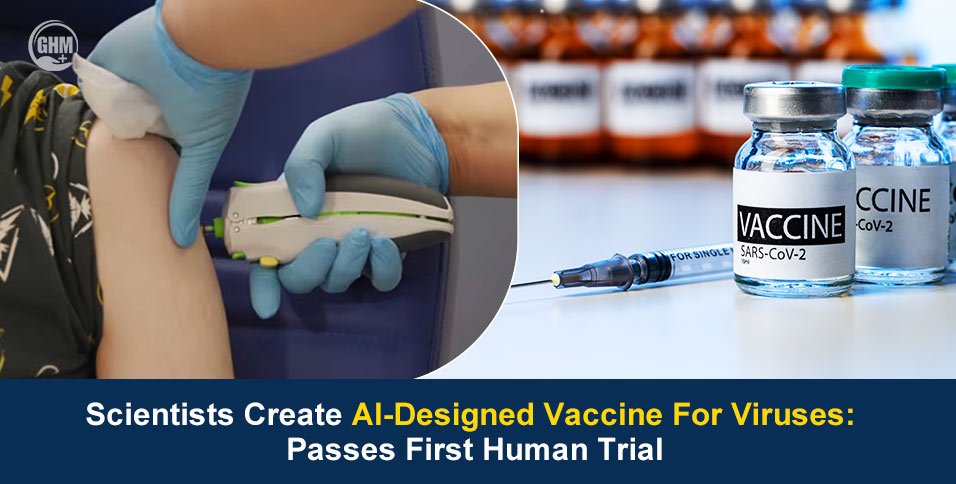
Instead of using a traditional injection, researchers administered the DNA vaccine through a microfluid jet system. The technology delivers vaccine material through a high-pressure stream of liquid, eliminating the need for needles.
Potential advantages include:
- Improved patient comfort
- Faster mass vaccination campaigns
- Easier administration in resource-limited settings
- Reduced barriers for people with needle anxiety
Scientists believe such innovations could improve vaccine access during future public health emergencies.
What Comes Next for the AI-Designed Vaccine for Viruses?
Although the results for the vaccine made with AI are encouraging, researchers caution that additional testing is required before the vaccine can be approved for widespread use.
A larger Phase II clinical trial is expected to enroll more than 200 participants and evaluate whether the vaccine produces strong and lasting immune protection across a broader population.
The project also reflects growing investment in advanced vaccine technologies. Similar momentum can be seen across the pharmaceutical industry. Recently, Eli Lilly has acquired three vaccine development firms to expand innovation in infectious disease prevention.
While larger studies are still needed, the early results suggest that vaccines made with artificial intelligence could become powerful tools for preventing future pandemics, strengthening global health security, and improving preparedness against emerging infectious diseases.
If future trials confirm these findings, the world’s first AI-designed vaccine may signal the beginning of a new era in preventive medicine.