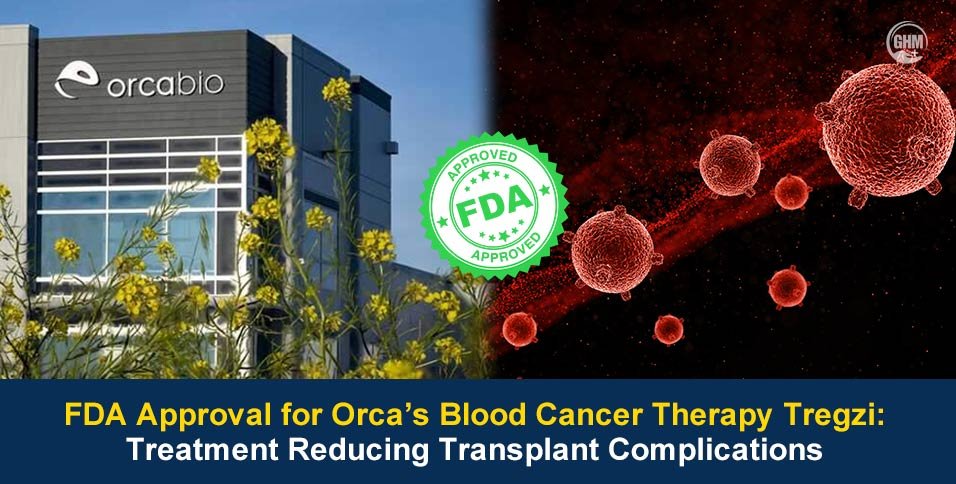
The U.S. Food and Drug Administration (FDA) has officially approved Orca Bio’s groundbreaking cell therapy, Tregzi (also known as Orca-T). It is the first-ever FDA approval for a regulatory T (Treg) cell-based immunotherapy. The FDA approval for Orca’s blood cancer therapy brings a transformative treatment option for adult patients with hematological malignancies (blood cancers) who are undergoing stem cell transplants (allo-HSCT).
Tregzi is designed to rebuild the patient’s immune system by successfully restructuring the donor’s immune cells. While doing that, it significantly lowers the risk of chronic graft-versus-host disease (GVHD), a frequent and life-threatening transplant complication.
Recognizing its profound therapeutic potential, the regulatory agency previously granted Tregzi both Orphan Drug Designation and Regenerative Medicine Advanced Therapy (RMAT) Designation to expedite its clinical review.
What Is Tregzi and How Does It Work?
Orca Bio’s Tregzi is an engineered, donor-derived cellular immunotherapy. Unlike conventional stem cell transplants that infuse raw donor blood directly into a patient, Tregzi precisely reformulates the blood material into three major cellular components:
- Hematopoietic Stem and Progenitor Cells (HSPCs): Master cells that help patients rebuild their blood-forming and immune systems.
- Regulatory T Cells (Tregs): Specialized immune cells that control immune responses and maintain tolerance, preventing the graft from attacking the host.
- Conventional T Cells (Tcons): Standard immune cells infused later to wipe out residual cancer cells and accelerate infection recovery.
By meticulously balancing these cells, this advanced blood cancer treatment by Orca Bio controls dangerous immune responses while safely restoring health.
Importance of FDA Approval of Tregzi
Conventional allogeneic stem cell transplants have long forced a harsh compromise: while they can cure leukemia, they often trigger chronic GVHD, a debilitating condition where donor cells attack the recipient’s organs.
This requires long-term, immune-suppressing drugs and diminishes a patient’s quality of life. Tregzi fundamentally shifts this paradigm, delivering a fully restorative treatment that balances a definitive cancer cure with minimized transplant complications.
“For patients with blood cancers who need stem cell transplantation, chronic graft-versus-host disease has long been one of the most feared and difficult-to-prevent complications,” stated Karim Mikhail, B.Pharm., M.S., Acting Director of the FDA’s Center for Biologics Evaluation and Research (CBER). “Today’s approval offers a genuine new approach”, he continued.
Trial Results Support FDA Approval of Tregzi
The FDA approval for Orca’s blood cancer therapy relies heavily on data from the randomized, late-stage PRECISION-T Phase 3 clinical trial. The trial evaluated 187 adult patients suffering from high-risk blood cancers, including:
- Acute myeloid leukemia (AML)
- Acute lymphoblastic leukemia (ALL)
- Myelodysplastic syndrome (MDS)
- Mixed-phenotype acute leukemia
The efficacy findings demonstrated overwhelming clinical benefits compared to standard unmanipulated transplants:
| Clinical Endpoint (At 1 Year) | Tregzi Therapy | Conventional Transplant |
| Chronic GVHD-Free Survival Rate | 78% | 38.4% |
| Severe Chronic GVHD Incidence | 12.6% | 44% |
| Overall Survival Rate | 94% | 83% |
Safety and Common Side Effects of Orca Bio’s Tregzi
The FDA’s benefit-risk assessment affirmed that Tregzi maintains a highly favorable safety profile.
The observed side effects of Tregzi were entirely consistent with standard stem cell transplantation complications, with infections being the most frequently reported adverse event.
Notably, there were zero reported cases of severe infusion reactions or graft failures during the study period.
Commercial Launch & Future Plans For Orca-T
Following the FDA approval for Orca’s blood cancer therapy, the company has announced a wholesale acquisition cost of $428,000. CEO Nate Fernhoff, Ph.D., noted that the therapy is expected to be available for orders by the end of July 2026.
Orca Bio is executing a controlled U.S. commercial rollout, launching initially at a handful of specialized transplant centers with plans to onboard 25 centers by the end of the year. It is backed by an optimized manufacturing strategy at its 100,000-square-foot facility in Sacramento, California, and a newly announced facility in Princeton, New Jersey.
Orca Bio guarantees a rapid 72-hour vein-to-vein production timeline while keeping manufacturing failure rates in the low single digits.
This FDA approval for Orca’s blood cancer therapy sets a powerful precedent for cell-based immunotherapy innovation, paving the way for a safer, more effective era of cancer treatment.