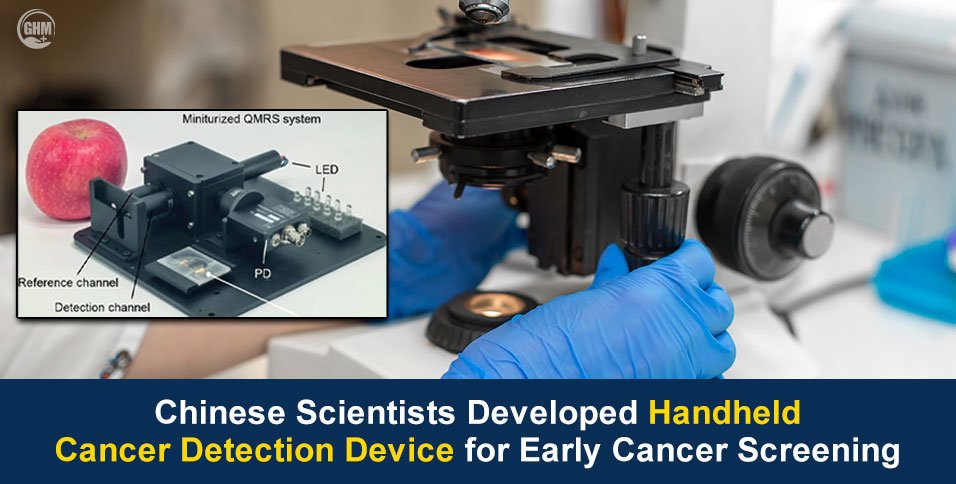
A new handheld cancer detection device developed by researchers in China could change how doctors detect cancer in its earliest stages. The compact system, created by scientists at Westlake University, can identify lung cancer biomarkers from a single drop of blood with remarkable sensitivity. Researchers say the technology may eventually support faster, cheaper, and more accessible cancer testing outside hospitals and laboratories.
The findings, published in Nature Photonics, showed how this portable cancer diagnostic tool could help expand access to early cancer screening, especially in remote or underserved areas.
What Are The Results of the Chinese Device for Cancer Detection
To evaluate the system, researchers collaborated with Xiamen University to detect small extracellular vesicles (sEVs). These tiny particles circulate in the blood and can serve as important biomarkers for early-stage lung cancer.
Detecting sEVs has traditionally been difficult because they exist in extremely low concentrations during the earliest stages of disease.
The study on early cancer detection analyzed more than 170 serum samples from lung cancer patients. Researchers found that the device achieved:
- Up to 94.9% accuracy for early lung cancer detection
- Around 92.1% accuracy for post-surgical monitoring
- Nearly 10,000 times greater sensitivity than standard ELISA testing
Traditional ELISA methods achieved approximately 74.7% accuracy in comparison.
Researchers also reported that the system could identify biomarkers within about 15 minutes, making it significantly faster than many existing laboratory procedures.
Why The Handheld Cancer Detection Device Is Important
Expensive Traditional Cancer Detection Systems
Current cancer biomarker testing often relies on large laboratory equipment that uses complex optical systems to analyze blood samples. These machines can be as large as refrigerators and are usually limited to specialized medical centers.
As a result, patients may face:
- Long waiting periods for test results
- Higher testing costs
- Limited access in rural or low-resource settings
This has created growing interest in portable technologies that support faster and more affordable testing.
Non-Invasive Cancer Diagnosis
Many researchers are now focusing on non-invasive cancer diagnosis methods that reduce discomfort and simplify testing. Blood-based diagnostics, often called liquid biopsies, are considered one of the most promising approaches because they can detect disease markers without surgery or invasive tissue collection.
The new handheld cancer detection device aims to advance this field by offering highly sensitive testing in a much smaller format.
How the Chinese Handheld Cancer Detection Device Works
The Cancer detection devices created by the Chinese scientists are a compact system using light-based technology. Unlike traditional systems that measure changes in light wavelength, the new device for cancer detection measures changes in light intensity. This process, known as Q-modulated refractometric sensing, allows the technology to detect extremely small biological changes linked to cancer.
According to the researchers, the Q-modulated refractometric sensing system includes only three major components:
- A 3D sensing chip
- An LED light source
- A photodetector
This simpler design significantly reduces the size of the equipment while maintaining high accuracy.
The handheld cancer detection device uses engineered materials called metamaterials, which can manipulate light more effectively than natural materials. Scientists built a special 3D nanophotonic chip that improves detection sensitivity while keeping the system compact.
In the research paper, lead investigator Wen Liaoyong stated that the technology creates “a scalable and robust nanophotonic biosensing paradigm for miniaturised, high-performance diagnostics.”
The team of Chinese scientists also developed a more efficient manufacturing method that allows thousands of chips to be produced simultaneously on semiconductor wafers. Researchers said this reduced production costs from hundreds of dollars per chip to approximately US$5.
What The New Breakthrough Means for Cancer Care
Experts believe portable diagnostic systems may help bring cancer screening into homes, clinics, and rural healthcare centers. This could improve access for patients who currently face barriers to specialized testing facilities.
Potential future applications include:
- At-home monitoring
- Remote healthcare services
- Faster outpatient screening
- Earlier treatment planning
Despite the promising results, researchers cautioned that the technology is still in the prototype stage. Larger clinical studies will be necessary before the device can become widely available.
Scientists also noted that additional engineering and regulatory approvals are needed before routine medical use.
Conclusion
The new handheld cancer detection device developed by researchers in China represents a major step forward in portable medical diagnostics. By combining high sensitivity, rapid testing, and low-cost manufacturing, the device could help make early cancer screening more accessible worldwide.
Although further validation is still required, the portable blood-based cancer detection technology highlights the growing potential of non-invasive cancer diagnosis tools that may eventually move advanced cancer detection beyond traditional laboratories and into everyday healthcare settings.