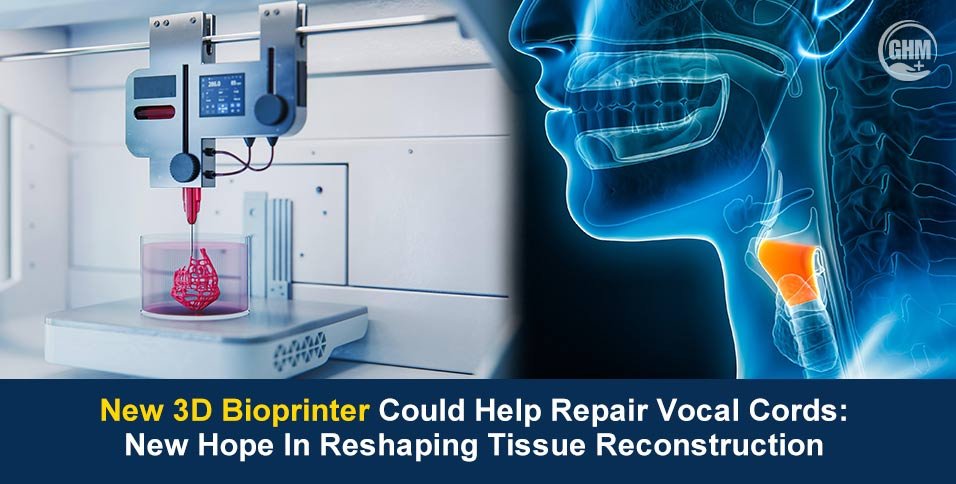
In a remarkable breakthrough, researchers have created a new 3D Bioprinter, the world’s smallest, just 2.7 millimetres wide, about the size of a pencil tip. This soft, flexible robot can print healing hydrogels directly inside the human body.
It will help reconstruct damaged vocal cords, an area where scar tissue often leads to permanent voice loss after surgery.
Developed by scientists at McGill University and partners, this new 3D Bioprinter marks a leap forward in precision medicine. Instead of repairing tissue outside the body and transplanting it later, this micro-robot works in situ, printing directly where healing is needed.
It represents not only an advance in tissue reconstruction but also a sign of what’s coming for future surgical robotics.
Why Miniaturisation in Bioprinting Matters
Until now, most 3D Bioprinters have been large, lab-based machines. They were powerful but impractical for surgery. The McGill team’s creation changes that narrative. Shrinking the technology to a millimeter scale opens up new frontiers in minimally invasive medicine.
Dr Luc Mongeau, a co-lead researcher, explains, “Our goal was to make a 3D printing robot small enough to fit through natural openings of the body, like the mouth or throat, without causing additional damage.”
Here’s why the smaller size is such a game-changer:
- Precision Without Trauma: The flexible tip can move like an elephant’s trunk, printing soft materials on irregular internal surfaces without cutting open tissue.
- Access to Tiny Anatomical Sites: Vocal cords, nasal passages, or even ear canals, spaces once unreachable by conventional surgical tools, can now be treated from within.
- Personalised Healing: Surgeons can print custom hydrogel “patches” that match a patient’s anatomy in real time.
This is not just about making devices smaller; it’s about redefining how healing materials can be delivered directly inside the body.
How the New 3D Bioprinter Works
This new 3D Bioprinter features a flexible printhead inspired by biological motion, which is soft, stretchable, and responsive. It delivers hydrogels, which are water-rich, biocompatible materials capable of mimicking human tissue.
Step-by-Step Process:
- The robot is inserted through the mouth or a tiny incision.
- Using imaging guidance, it reaches the injury site, like the vocal folds.
- It then extrudes layers of hydrogel, forming a scaffold that encourages tissue regeneration.
Hydrogels are vital here. They provide structural support while allowing cells to grow and integrate with existing tissue.
This means fewer complications, faster healing, and less scarring, which is critical for sensitive areas such as the throat, where even minor stiffness can impair speech.
Expanding Horizons: Beyond the Vocal Cords
While the world’s smallest 3D Bioprinter was designed for the vocal cords, its potential extends much further. Miniaturisation could soon make it possible to treat other delicate, hard-to-reach regions:
- Ear Canal: For repairing the eardrum or middle ear tissue after infections.
- Nasal Cavity and Sinuses: To reconstruct damaged mucosa from chronic inflammation or surgery.
- Heart Valves and Vessels: To print hydrogel scaffolds that prevent scarring after cardiovascular procedures.
Dr Xiaoyue Ni, co-author of the study, notes, “This is a step toward performing tissue reconstruction in confined spaces where no surgeon’s hand could reach.”
If successful in human trials, this could pave the way for “printing-on-demand” tissue repair, potentially transforming fields from ENT (ear, nose, throat) to cardiology and neurosurgery.
In-Situ Bioprinting in Tissue Reconstruction
The concept of printing tissues inside the human body, known as in-situ bioprinting, is one of medicine’s most exciting frontiers. It eliminates the need to grow tissues externally and reduces the risk of transplant rejection.
This new 3D Bioprinter represents a crucial step toward that vision. It merges robotics, biomaterials, and surgical precision into one device capable of performing delicate internal repairs.
If fully realised, future versions could print entire micro-tissues directly inside organs damaged by disease or trauma. From vocal cords to heart valves, the possibilities are vast.
Pathway and Challenges Ahead
Like any emerging medical technology, this new 3D Bioprinter must travel a careful path from lab to clinic. Currently, it’s being tested in preclinical models to assess safety, accuracy, and biocompatibility.
Key Steps Ahead:
- Animal Trials: To study tissue response and healing outcomes.
- Human Trials: To validate the technology’s safety and long-term function.
- Regulatory Approval: The FDA and similar bodies will require detailed evidence of reproducibility, sterility, and precision.
- Surgeon Training: Operating a miniaturised robot requires new skill sets and possibly AI-assisted visualisation systems.
The process could take several years before we see this in hospitals, but early data looks promising. Its potential to reduce invasive procedures and recovery time could make it a cost-effective, life-changing innovation.
Conclusion
The world’s smallest 3D Bioprinter is more than just a marvel of miniaturisation. It’s a glimpse into the future of regenerative surgery.
By combining flexibility, precision, and biomaterial science, researchers are bringing personalised healing to spaces once deemed unreachable.
As this tiny robot continues its journey from lab to clinic, the next revolution in tissue reconstruction will soon happen inside the human body.