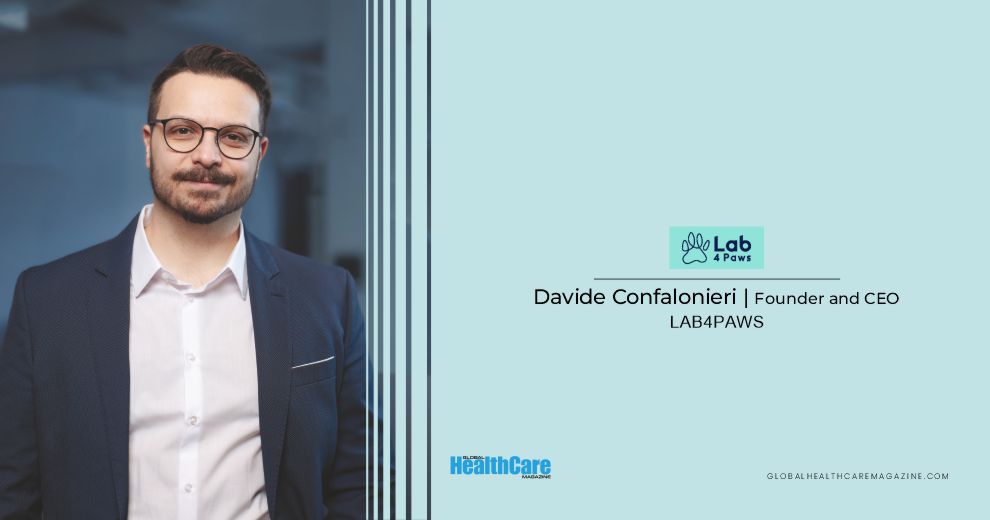
There is a moment in the life of every bench scientist when the abstraction of data collides with the reality of biology. For Dr. Davide Confalonieri, that moment came early in his career, during his studies. He was working in cancer research, a field that promises to repair the human body, but the path to discovery was paved with animal studies. He did the work. He handled the animals. He collected the data. And it left a mark on him; a deep, indelible scratch on his conscience.
“That hands-on experience was crucial,” he says, his voice measured but firm. “It gave me respect for in-vivo research, but also left a very deep mark on me scientifically and emotionally.”
Most scientists compartmentalize this feeling. They file it away under “necessary evils” and move on. Dr. Confalonieri did not. Instead, he let it become the engine of his career. He pivoted to tissue engineering not just for science, but for ethics—to develop models that could reduce the need for animal testing.
Today, as the Founder and CEO of Lab4Paws, based in Nuremberg, Germany, Dr. Confalonieri is doing something even more radical. He is trying to fix the broken pipeline of animal health R&D by proving that you don’t need to sacrifice more animals to save them. He is building a company that sources ethical biospecimens from veterinary clinics, blood left over from a diagnostic test, tissue from a necessary surgery, and turning waste into gold for researchers. He is proving that better science and better ethics are not enemies; they are partners.
The Gap in the Market
Dr. Confalonieri spent years in the life-science industry, working for giants like Lonza and smaller biotech firms. He stood at the intersection of science and business, watching deals get made and drugs get developed. But it was only after he started his own consulting company, Sellomics GmbH, that he saw the gaping hole in the market.
“I fully realized how few research tools were available to veterinary scientists,” he recalls.
The revelation crystallized during a conversation with an executive at a large pharmaceutical company. The executive was frustrated. He had drug candidates he wanted to test, but he had no meaningful way to do it without jumping straight into animal studies. There were no good cell models. There were no reliable sources of tissue. It was a black box.
“We quickly realized this wasn’t an isolated problem,” Dr. Confalonieri says.
Veterinary pharma and diagnostics companies were facing the same wall. They were flying blind, often forced to use animal studies simply because they lacked the in vitro tools to make a go/no-go decision.
Lab4Paws was born from this frustration. It was created to fill the gap: to provide the species-relevant biospecimens, models, and data that researchers desperately needed but couldn’t find.
The Lab4Paws Solution
The core offering of Lab4Paws is elegantly simple, yet logistically complex. They supply veterinary biospecimens, blood, tissues, primary cells, to pharma and biotech R&D. But unlike traditional suppliers who might breed animals specifically for this purpose, Lab4Paws taps into an existing network of veterinary clinics.
“Our key differentiator is that samples are collected through a curated veterinary network during routine clinical procedures,” Dr. Confalonieri explains.
This means the samples come from real patients with real diseases. A dog with cancer. A cat with kidney failure. These samples come paired with rich clinical metadata, providing a level of context that a lab-bred animal simply cannot match. It is the difference between studying a generic map and walking the terrain yourself.
By combining these samples with advanced cell culture and characterization services, Lab4Paws offers researchers a window into the biology of the disease before they ever touch a living animal.
The 3R Philosophy
Dr. Confalonieri’s work is deeply aligned with the “3R” principles of animal research: Replace, Refine, Reduce. But for him, these aren’t just buzzwords to put on a slide deck. They are operational directives.
- Replace: Lab4Paws enables early testing on cells and tissues, replacing the need for live animal studies in the early stages.
- Refine: By using better-characterized samples with clinical data, researchers can design better experiments.
- Reduce: By helping companies make clearer go/no-go decisions early on, fewer animals are used in doomed studies.
“A key aspect is ethical sourcing,” Dr. Confalonieri emphasizes. “Our samples come from partner veterinary clinics and are taken during routine diagnostics or surgical operations, avoiding additional interventions or stress for the animals.”
It is a model that aligns scientific rigor with ethical responsibility. And crucially, it produces better data.
The Technology of Empathy
Lab4Paws is not just a logistics company; it is a technology partner. They collaborate with developers of “Organ-on-a-Chip” technology, a cutting-edge field that creates micro-physiological systems on a chip to mimic the function of human organs.
Dr. Confalonieri sees immense potential here for veterinary science.
“Organ-on-a-Chip and advanced cell culture technologies allow researchers to test drug candidates in systems that better capture biological complexity,” he says.
By using species-specific primary cells in these chips, researchers can observe metabolic and toxicological responses in a dynamic environment. They can see how a dog’s liver might process a new drug, or how a cat’s kidney might react to a toxin.
“This makes it possible to observe integrated responses… much earlier,” he notes. “Reducing uncertainty and improving translational decision-making.”
The Scientist as CEO
At the helm of Lab4Paws, Dr. Confalonieri wears many hats. He is the strategist, the scientist, the salesperson, and the quality control manager.
“As CEO, my role spans strategy, science, and execution,” he says.
His day-to-day work is a mix of high-level portfolio strategy and granular operational details. He works on partnerships with pharma companies. He translates scientific needs into scalable products. But what keeps him engaged is the impact.
“What I’m most passionate about is sitting at the interface between researchers and real-world impact,” he says. “Building something that advances better science while reducing unnecessary animal use.”
Challenging the Status Quo
Innovation in science is often met with resistance. Scientists are trained to be skeptical. They trust established models, even when those models are flawed. Dr. Confalonieri approaches this resistance with a specific philosophy: start with the goal, not the habit.
“I prefer to start from the opposite direction: defining very clearly what we want to prove or disprove,” he explains.
Instead of asking, “How have we always done this?”, he asks, “What is the best way to answer this specific question?” This goal-oriented approach simplifies experiments and challenges implicit assumptions. It forces researchers to justify their methods.
“Over time, this shifts mindsets naturally,” he observes. “Because decisions become driven by outcomes rather than habits.”
The Trial by Fire
Building a company from scratch is never easy. For Dr. Confalonieri, the transition from solopreneur to organizational leader was a trial by fire.
“Creating systems under tight time and budget constraints puts enormous pressure on both processes and people,” he admits.
He learned that assembling a team is the most critical milestone. You don’t know who will perform under pressure until the pressure is applied. His response to this challenge was intentionality. He set clear expectations. He gave feedback. He held people accountable.
“That period taught me that leadership is as much about stewardship of people as it is about building systems,” he reflects.
The Impact So Far
Since its inception in 2024, Lab4Paws has moved quickly. It has transitioned from an idea to a trusted partner for pharma and biotech clients. They have built an operational network of veterinary clinics. They have delivered projects. They have repeat customers.
“A key milestone was the shift from ad-hoc requests to repeat customers and structured project pipelines,” Dr. Confalonieri says.
But the metric he is most proud of is decision-making.
“I’m particularly proud that our work is already helping researchers make earlier, better-informed decisions,” he says.
Every time a researcher uses a Lab4Paws sample to decide not to proceed with a flawed drug candidate, animals are saved. Resources are saved. And the pipeline gets a little bit cleaner.
The Bigger Vision
Looking ahead, Dr. Confalonieri wants Lab4Paws to become the “one-stop-shop” for preclinical veterinary research. He plans to expand the portfolio of primary cells and advanced models. He wants to raise the bar on data quality and ethical sourcing.
“The broader vision is to equip animal science with a comprehensive set of research tools… that enable better decisions earlier in development,” he says.
He sees a future where veterinary research infrastructure is robust enough to accelerate therapy development for animals while also creating a stronger bridge to human medicine.
Intentional Balance
Dr. Confalonieri does not claim to have a perfect work-life balance. He is, after all, a founder. But he is intentional about protecting his energy.
“I try to structure my time so that intense work phases are balanced with moments that fully disconnect me from business thinking,” he says.
He finds grounding in cooking and food culture. He spends time with his family. He is training for a half-marathon, finding clarity in the physical exertion of running and bouldering. And he reads widely, feeding a curiosity that extends far beyond biotechnology.
The Philosophy of Progress
At the end of the day, Dr. Confalonieri’s leadership is defined by clarity of purpose. He believes that meaningful innovation comes from listening to where people struggle, not just chasing novelty.
“My leadership philosophy is rooted in clarity of purpose: define the goal, remove unnecessary complexity, and build systems that allow people to do their best work,” he says.
He rejects the idea that ethics and performance are opposing forces.
“When you design science thoughtfully, you get better results and better outcomes for animals and patients,” he asserts.
In a world that is often loud with hype and promise, Dr. Confalonieri is doing the quiet, difficult work of laying a new foundation. He is serving the researchers who want to do better. He is serving the patients waiting for a cure. And, perhaps most importantly, he is serving the silent, living creatures who have, for so long, borne the burden of our curiosity.
He is building a future where, eventually, the cages might just stay empty.
Quotes

Also Read: Top Innovators in Animal Health & Translational Research Leadership 2026