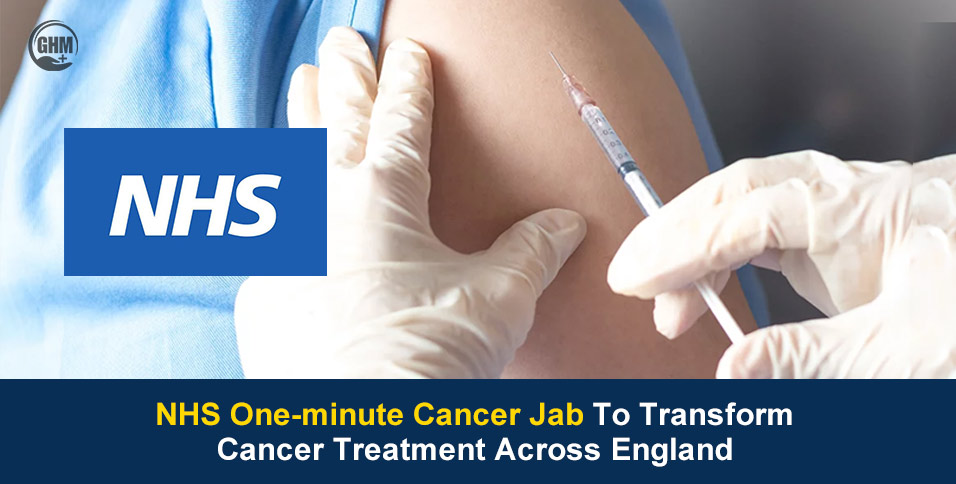
The newly launched NHS one-minute cancer jab is said to offer thousands of patients faster, more convenient treatment. The new cancer immunotherapy injection is a form of pembrolizumab, which can be administered in under two minutes, dramatically reducing the time patients spend in the hospital.
The rollout of the one-minute cancer jab by the NHS could benefit around 14,000 patients annually, with many more expected to transition to this faster treatment option.
What Is the NHS One-minute Cancer Jab?
The one-minute cancer jab is a new injectable cancer immunotherapy designed to replace the traditional intravenous (IV) drip used to deliver pembrolizumab, for cancer treatment, also known as Keytruda.
Key Features of one-minute cancer injection:
- Delivered in 1–2 minutes, compared to up to an hour or more via IV
- Administered every 3 or 6 weeks, depending on the patient’s condition
- Requires no complex preparation or cannula insertion
Previously, patients had to undergo lengthy IV infusions, often taking hours, including preparation time. The one-minute NHS jab simplifies this process significantly.
Despite its advanced delivery method, the NHS Pembrolizumab injection is expected to cost roughly the same as the IV version.
The pharma company Merck & Co (MSD) is manufacturing the cancer injection, which is one of the world’s best-selling cancer treatments. While patents may expire in the coming years, the introduction of the injectable format reflects ongoing innovation in oncology care.
How the Immunotherapy Cancer Jab Works
The NHS one-minute cancer jab works by targeting a protein called PD-1. This protein acts like a “brake” on the immune system.
- Cancer cells use PD-1 to hide from immune defenses
- The drug blocks this signal
- The immune system can then recognize and destroy cancer cells
The injectable cancer immunotherapy treatment is already used for more than a dozen cancers, including lung cancer, breast cancer, cervical cancer, and head & neck cancers.
The NHS oncology advancements are already underway, with early rollout of one-minute cancer jabs at:
- Mount Vernon Cancer Centre, Hertfordshire
- University Hospitals Bristol and Weston NHS Foundation Trust
More NHS facilities across England are expected to adopt the NHS one-minute cancer jab in the coming months.
How Does The NHS One-minute Cancer Jab Benefit Patients
The biggest advantage of the one-minute cancer injection is time.
- Treatment time reduced by up to 90%
- Less time in hospital chairs
- Lower physical and emotional burden
One patient, Shirley Xerxes from St Albans, described the experience as life-changing. She told that she was in the chair “for a matter of minutes instead of an hour or more,” giving her more time to enjoy everyday activities like gardening.
For many patients undergoing long-term cancer therapy, this shift improves both quality of life and treatment adherence.
How Immunotherapy Cancer Injection Impacts NHS Efficiency
Beyond patient benefits, the NHS one-minute cancer jab is a major operational upgrade.
- Expected to save over 100,000 hours annually in treatment and preparation
- Frees up hospital capacity
- Enables faster treatment for more patients
Professor Peter Johnson, NHS national clinical director for cancer, said the innovation allows patients to “get back to living their lives rather than spending hours in a hospital chair.”
Healthcare teams also benefit from simplified workflows, as the one-minute NHS jab eliminates the need for sterile IV preparation.
Conclusion
The NHS one-minute cancer jab is part of a wider transformation in UK healthcare. The NHS is increasingly focusing on preventive and efficient care delivery.
In a recent policy shift, the NHS is expanding access to weight-loss treatments. More than 1.2 million people in England could receive medications like semaglutide to reduce cardiovascular risks.
By combining proven immunotherapy with a faster, more efficient method, the NHS is improving both patient experience and healthcare system performance.
As the rollout continues, the newly launched one-minute cancer injection by the NHS could become a global model for modern oncology with quick, accessible, and patient-friendly cancer treatment.