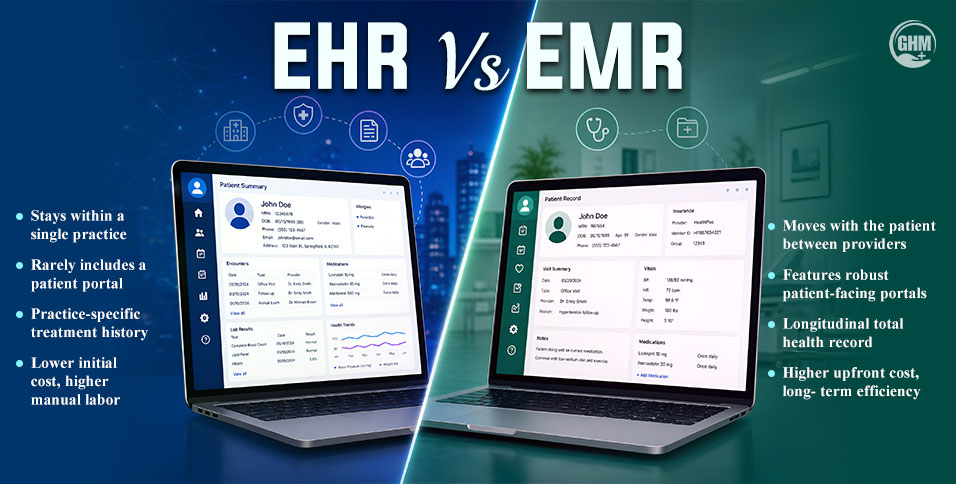
Finding the right digital record system can feel like navigating a maze filled with technical jargon and competing vendor claims. Traditionally, medical practices relied on paper-based records stored in physical folders, often confined within clinic walls. However, like many other industries, healthcare has undergone a major digital transformation, adopting electronic systems to improve care quality, streamline workflows, and reduce inefficiencies.
Today, the adoption of electronic record systems is nearly universal in developed healthcare systems. In the United States, around 95% of office-based physicians use some form of digital record system, while 96% of acute care hospitals rely on certified technologies to manage patient data. This widespread shift has created an extensive digital ecosystem that requires advanced tools to ensure data remains accessible, accurate, and actionable.
At the core of this transformation are EMR (Electronic Medical Record) and EHR (Electronic Health Record) systems. While both healthcare data management systems, the debate around EHR vs EMR largely centers on how data is shared and utilized across different healthcare settings.
Despite their importance, many healthcare professionals are familiar with these terms but lack a clear understanding of their functional differences. As a result, organizations sometimes invest in EHR or EMR software for clinics that fail to align with their long-term clinical and operational goals.
Choosing between EHR and EMR can significantly impact the efficiency and quality of healthcare delivery. However, distinguishing between the two is not always straightforward.
This comprehensive guide will help you differentiate EHR vs EMR systems, explore their benefits, and evaluate their strategic implications in modern healthcare.
The right choice between EHR and EMR will benefit you in your medical journey.
Let’s Understand The EHR and EMR Systems
What Is an EMR (Electronic Medical Record)?
An electronic medical record serves as the digital version of a patient’s chart within a single practice. Clinicians use the EMR tool to track a patient’s medical history, diagnoses, and treatments over time. Specifically, an EMR acts as a localized repository for clinical data generated during visits to that specific facility. It improves internal efficiency by allowing for faster charting and easier access to past visit notes.
Where is EMR Technology Used In Healthcare
Small, independent practices that handle specific, internal care tasks often find EMRs sufficient. These organizations typically do not require extensive referrals or coordination with large hospital networks. For a specialist working in a solo environment, the lower complexity of an EMR may offer a faster learning curve for staff. However, as healthcare moves toward integrated models, these solo EMRs are becoming increasingly rare.
Core Features of EMR Systems
EMR software primarily supports the internal clinical workflow of a small office or solo practitioner. These systems include features for scheduling, documenting patient encounters, and managing prescriptions within the office. They allow doctors to identify when patients are due for screenings or preventive care vaccinations. Additionally, EMRs store laboratory results and imaging reports that the practice orders directly.
Limitations of Electronic Medical Record Systems
The defining limitation of an EMR is its lack of external interoperability. These systems generally do not share data with other healthcare organizations or specialists.
Consequently, if a patient visits an emergency room or a specialist, their record stays behind in the primary EMR.
Providers using EMR technology must manually transfer these files via digital fax or physical copies. This creates “data silos” that hinder the continuity of care across the broader healthcare scale.
What Is an EHR (Electronic Health Record)?
An electronic health record offers a much broader view of a patient’s total health. Unlike an EMR, the EHR follows the patient wherever they go. It integrates data from every provider involved in the patient’s care, including specialists, laboratories, and imaging centers. This capability ensures that every clinician sees a complete, longitudinal record of the patient’s medical journey.
True interoperability allows different computer systems and software to communicate and exchange data accurately. EHR systems utilize standardized protocols like HL7 and FHIR to ensure that information moves securely between facilities. Because of this, a hospital can instantly access a patient’s primary care records during an emergency. This immediate availability of information significantly improves patient safety and clinical outcomes.
Functions of EHR systems
EHR systems for hospitals provide a suite of tools that extend beyond simple documentation.
- Most modern EHR platforms include integrated patient portals, telehealth modules, and digital health tools for remote monitoring. They also offer sophisticated reporting and analytics features. These tools allow health systems to track quality metrics and manage population health effectively.
- The Electronic Health Record systems support value-based care models. They help providers meet the requirements of programs like the Merit-based Incentive Payment System (MIPS).
- By capturing data on patient outcomes and care quality, these EHR systems ensure that practices receive maximum reimbursement. They also automate the submission of required metrics to payers and government agencies.
EHR vs EMR: Comparison At Glance
The following table highlights the primary distinctions that healthcare administrators must consider.
| Feature | EMR (Electronic Medical Record) | EHR (Electronic Health Record) |
| Data Mobility | Stays within a single practice | Moves with the patient between providers |
| Interoperability | Limited; generally siloed | High; uses FHIR and HL7 standards |
| Patient Access | Rarely includes a patient portal | Features robust patient-facing portals |
| Clinical Scope | Practice-specific treatment history | Longitudinal total health record |
| Decision Support | Basic internal alerts | Advanced, evidence-based AI tools |
| Cost Profile | Lower initial cost, higher manual labor | Higher upfront cost, long-term efficiency |
EHR vs EMR: Deep Comparison of Core Differences
While both EHR and EMR digitize information, their impact on the patient experience varies greatly. Therefore, understanding the functional gaps of EHR vs EMR is vital.
1. Data Mobility
An EMR provides a snapshot of what happened during a specific encounter. In contrast, an EHR provides a complete record of the patient’s medical life. This longitudinal view allows doctors to see patterns that they might otherwise miss in a siloed environment.
For example, an EHR might reveal that three different specialists prescribed medications that interact dangerously. An EMR, lacking that external data, would not flag the conflict.
2. Financial and Operational Scalability
As a practice expands, the limitations of an EMR often become a financial liability. Manual data entry for external referrals increases administrative overhead and the risk of billing errors. On the other hand, EHR systems automate many of these processes. Integrated EHR platforms often report cleaner claim rates and faster payment cycles.
Healthcare administrators must view the higher cost of an EHR as an investment in data-driven care and long-term viability.
3. Safety and Medication Error Reduction
EHR systems provide superior patient safety compared to EMRs. Specifically, EHRs include clinical decision support tools that check for drug interactions across all providers. Integrated systems can reduce prescribing errors by up to 81%. EHRs prevent unnecessary repeat tests by showing results from external labs, reducing duplicate testing.
Similarities Between EHR and EMR Systems
Despite their functional differences, both systems represent the digital foundation of modern medicine. They share several core characteristics that improve the baseline of care for all patients.
1. Improving Clinical Efficiency
Both EHR and EMR systems eliminate the need to hunt for physical paper charts. Clinicians can access information instantly from any computer in the office. This speed reduces wait times for patients and allows staff to handle larger patient volumes more effectively. Both platforms also utilize standardized templates to ensure consistent documentation across the practice.
2. Enhancing Security and Privacy Protocols
Digital health records offer far superior security compared to paper files. Both EHR and EMR systems include role-based access controls. This ensures that only authorized personnel can view sensitive health information. Additionally, digital systems maintain detailed audit logs. These logs track exactly who viewed a record and what changes they made, satisfying healthcare data security requirements.
3. Supporting Research and Quality Analysis
Digitizing patient information allows for easier data extraction. Researchers and practice managers can run reports to identify trends in chronic disease management. Both electronic medical record and electronic health record systems support basic clinical research by organizing data into searchable fields.
Challenges and Limitations of EHR vs EMR Implementation
No technology is perfect, and digital record systems come with significant hurdles. Successful adoption requires recognizing and planning for these obstacles.
1. The Problem of Clinician Burnout
The “digital paperwork” required by these systems is a leading cause of exhaustion among doctors. Many providers feel that the software turns them into data entry clerks rather than healers. Complicated workflows and poorly designed interfaces can double the time spent on documentation.
2. Security Vulnerabilities and Cyber Threats
As medical records move to the cloud, they become prime targets for hackers. Ransomware attacks on healthcare systems have increased as cybercriminals seek to lock down sensitive data for profit. Both EHR and EMR systems require constant monitoring and frequent software updates to defend against these threats. Small practices, in particular, may lack the resources to maintain high-level cybersecurity defenses.
3. Implementation Complexity and Downtime
Transitioning to an EHR is a massive organizational undertaking. It requires meticulous data migration, staff training, and workflow redesign. During this period, practices often experience a temporary dip in productivity and patient volume. Furthermore, unplanned system outages can paralyze a clinic, leaving doctors without access to vital patient history.
EHR vs EMR Systems: Choosing The Best for Your Organization
Choosing the wrong system can cost a practice hundreds of thousands of dollars in lost productivity and missed reimbursements. Consider these critical factors before signing a vendor contract.
1. Your Practice Size and Scope
If your practice operates within a single building and does not coordinate care with external specialists, a simple EMR system might suffice. However, if you have multiple locations or work within a large hospital network, an EHR is mandatory. Large health systems require the scalability and robust data-sharing capabilities that only an EHR can provide.
2. Your Budget and Compliance
Consider the total cost of ownership, not just the initial software price. An EHR often requires a higher initial investment but provides better return on investment through automated billing and higher claim acceptance rates. Furthermore, if you participate in government programs like Medicare, you must use a certified EHR to avoid financial penalties.
End Note
The distinction between EHR vs EMR technology is a fundamental one for the modern healthcare sector. While an electronic medical record digitizes the internal chart of a single practice, an electronic health record creates an interoperable, longitudinal record that follows the patient across the entire care journey.
For most organizations, the EHR is the clear choice for the future, offering superior patient safety, better care coordination, and improved financial outcomes.
Healthcare providers must choose a system that not only meets today’s documentation needs but also prepares them for a future of connected, data-driven medicine.
Whether you are a solo practitioner or a hospital administrator, understanding these differences is the first step toward building a more efficient and effective practice.
Did you find this guide helpful? Share this article with your colleagues to help them choose the right digital record system for their practice!
Frequently Asked Questions
- Is Salesforce considered an EHR or an EMR?
Salesforce is not a clinical record system itself. Instead, it is a Healthcare CRM that complements an EHR or EMR. It unifies clinical data with non-clinical information to help practices manage patient relationships and engagement more effectively across the broader care ecosystem.
- Do EMR systems help reduce clinical denials?
While any digital system is better than paper, EHRs are far more effective at reducing billing denials. EHRs offer real-time coding support and integrated verification tools that ensure claims meet payer requirements before submission, leading to acceptance rates as high as 98%.
- How does the patient portal trend impact the EHR vs EMR usage?
Patients now expect digital access to their digital health records. Since EHR systems typically include robust patient portals and mobile app support, they are much better suited to meet modern patient engagement demands. Simple EMRs often lack these patient-facing features.